Monday, June 5, 2017

Classic Movie Picks: June 2017

by Lani

Each month, I scour the Turner Classic Movies schedule for upcoming films that I can't miss. The highlights are posted here for your reading and viewing pleasure! (All listed times are Eastern Standard, check your local listings or TCM.com for actual air times in your area. Each day's schedule begins at 6:00 a.m.; if a film airs between midnight and 6 a.m. it is listed on the previous day's programming schedule.)


James A Fitzpatrick's Traveltalks The Voice of the Globe

6/9: Traveltalks in Europe
9:45 PM - Looking at London (1946)
10 PM - Seeing Spain (1953)
10:15 PM - Paris on Parade (1938)
James A. Fitzpatrick, a.k.a "the voice of the globe," produced and narrated a popular series of Traveltalks shorts which took viewers around the world to famous and "exotic" destinations. The shorts featured tonight were filmed in Technicolor and distributed by MGM. TCM often inserts the Fitzpatrick shorts in between scheduled films, but as part of their "European Vacation" programming on Fridays in June, the shorts are getting prime time play. The films concentrate on showing scenery and cultural heritage sites, rather than the daily lives of the people living there, and avoid any mention of politics or social issues. Made at a time when the average movie goer did not have the opportunity or means to travel, these shorts gave them a look at the places that Fitzpatrick believed any tourist would want to see. Today, the shorts are notable for the glimpses of landscapes from a bygone era, before major cities became dominated by skyscrapers or urban sprawl reached the countryside. Looking at London highlights historic landmarks in the UK capital city, as well as areas damaged during WWII. Seeing Spain features several cities around that country, while Paris on Parade provides a tour of the Paris International Exposition of 1937.


6/9, 2:15 AM - To Paris with Love (1955)
In this romp through the City of Light, Alec Guinness stars as Sir Edgar, a British widower who brings his 20 year old son, Jon, to Paris to give the boy an education on romance. Edgar seeks out just the right woman to set up with his son, while Jon tries to find the perfect match for his dad. Of course, it gets complicated when the women turn out to have romantic ideas of their own. Perhaps not as funny as Guinness's other comedies of the era, but as light romantic comedy, this film is a fizzy sip of champagne. It's worth seeing for Guinness's charming lead performance and comedic skill.


Marlene Dietrich

6/13: Starring Marlene Dietrich
8 PM - Desire (1936)
10 PM - Song of Songs (1933)
11:45 PM - A Foreign Affair (1948)
2 AM - Witness for the Prosecution (1957)
4:15 AM - Rancho Notorious (1952)
Highest-paid woman in America in the 1930s, WWII war hero, Medal of Freedom recipient, world's most glamorous grandmother -- believe it or not, these are all titles applied to tonight's featured star Marlene Dietrich. Chances are that you have a very specific image of Dietrich: platinum hair, pencil-thin eyebrows arched over bored eyes, and that husky, German-accented voice. She had an iconic style, but as tonight's line-up shows, Dietrich took on personas in her films as diverse as those in her real life, while somehow maintaining that essence of "Marlene" with each one. The films tonight also pair Dietrich with some of the best directors of the era, demonstrating her ability to be equally at home in a Billy Wilder comedy or a Frank Borzage romance.
In Desire, directed by Borzage and produced by rom-com master Ernst Lubitsch, Dietrich plays a jewel thief and phony European aristocrat who falls for all-American Gary Cooper. Song of Songs, a TCM premiere directed by eclectic innovator Rouben Mamoulian, gives Dietrich a suitably scandalous role as a German peasant girl who gets caught up with free-living artists in the nightclub culture of Berlin. In Wilder's satire of post-war Germany, A Foreign Affair (released the same year she became the world's most glamorous grandmother), she spoofs her own image as a sultry cabaret singer; and cast as a former saloon girl in Fritz Lang's Western-noir Rancho Notorious, Dietrich brings new depth to this familiar character as she intimidates and beguiles while presiding over a den of criminals. Witness for the Prosecution, also directed by Wilder and based on an Agatha Christie story, shows another side of Dietrich in a less overtly glamorous and sexual role as the wife of an accused murderer; however, as in many stories by Christie, the characters are not all that they seem. 


Poster art for My Name is Julia Ross

6/19, 1:15 PM - My Name is Julia Ross (1945)
I've recommended this sharp little thriller before, but think it's good enough to recommend again! The story begins with a young woman, Julia, who takes a job as a live-in secretary for an older lady. After going to sleep in her employer's London apartment, she wakes up in a remote Cornwall estate on the southern coast of England. She's told that her name is Marion and she is the wife of the lady's son, a spoiled creep who likes to play with knives. Nina Foch (perhaps recognizable as Milo in An American in Paris) is excellent as Julia/Marion as she struggles to maintain her sanity and identity while her captors' scheme unfolds. At a breezy 65 minutes, you could watch this movie on your lunch break; however, the gothic atmosphere is probably more effective late at night.
If you enjoy the plot of My Name is Julia Ross, consider seeking out 1987's Dead of Winter starring Mary Steenburgen, Roddy MacDowell, and Czech actor Jan Rubes -- the story of an actress held captive in service of a blackmail plot bears a strong, though uncredited, resemblance to this earlier film.


6/19, 3:45 AM - Gaslight (1940)
Consider making a double feature with My Name is Julia Ross and this psychological thriller set in the Victorian era about an evil husband who attempts to drive his wealthy wife mad in order to get at some jewels hidden in their home. As the husband, Anton Walbrook serves cold sophistication masking cruelty, which he did so well again as the ballet svengali of The Red Shoes. Diana Wynyard, an Oscar nominee for 1933's Best Picture Cavalcade, co-stars as the wife. 
This British film was made four years before the Ingrid Bergman/Charles Boyer film of the same name and source material; however, despite being well-received, it is much less familiar even to film fans. That may be by design -- according to Hollywood legend, MGM ordered all copies of the 1940 film destroyed to avoid competition for the Bergman version. Fortunately, they did not get the negative and so now we can enjoy both films. Here's a chance to make that comparison which MGM feared so much -- is one better or are they just as good in their own ways? (By the way, the 1944 version, for which Bergman won an Oscar, will air on TCM in August.)


Wednesday, May 3, 2017

Classic Movie Picks: May 2017

by Lani

Each month, I scour the Turner Classic Movies schedule for upcoming films that I can't miss. The highlights are posted here for your reading and viewing pleasure! (All listed times are Eastern Standard, check your local listings or TCM.com for actual air times in your area. Each day's schedule begins at 6:00 a.m.; if a film airs between midnight and 6 a.m. it is listed on the previous day's programming schedule.)

Lucille Bremer and Fred Astaire in Yolanda and the Thief

5/7, 8 AM - Yolanda and the Thief (1945)
This musical fantasy directed by Vincente Minnelli and starring Fred Astaire and Lucille Bremer is one that you'll either love or hate. In 1945, the feeling among audiences was mostly hate, and the film's poor reception effectively ended Bremer's career as a leading lady. I personally love the film and feel that it is notable among 1940s MGM musicals, and thus worth seeing, for the surrealistic production design, vibrant Technicolor photography, and elaborate musical numbers. There's also the stacked supporting cast which includes top character actors Mildred Natwick, Frank Morgan, and Leon Ames. The film's whimsical plot centers on Yolanda (Bremer), a naive heiress in the fictional country of Patria, and a con man (Astaire) who poses as Yolanda's literal guardian angel in order to bilk her of her fortune. Perhaps the 16-minute dream ballet based on the work of artist Salvador Dali and French filmmaker Jean Cocteau was just too "out there" for audiences of the 40s, but those fantastical elements are what has won over many contemporary fans.
This film had an interesting path to its final cast. Lucille Ball was originally going to play Astaire's partner in crime, a role that was ultimately filled by Frank Morgan (after some script revisions, I suspect). Judy Garland, who was married to Minnelli at the time, wanted to play Yolanda. However, producer Arthur Freed wanted the role as a showcase for his protege, Lucille Bremer, best known for playing Garland's older sister in the Minnelli-helmed Meet Me in St. Louis. (Garland and Minnelli would get to work together on The Pirate three years later, which nearly matches the colorful flamboyance of Yolanda.) Bremer had a dance background and acquits herself nicely opposite Astaire. Unfortunately, the film flopped and Freed lost interest in making Bremer a star; she made her last film 1948. 


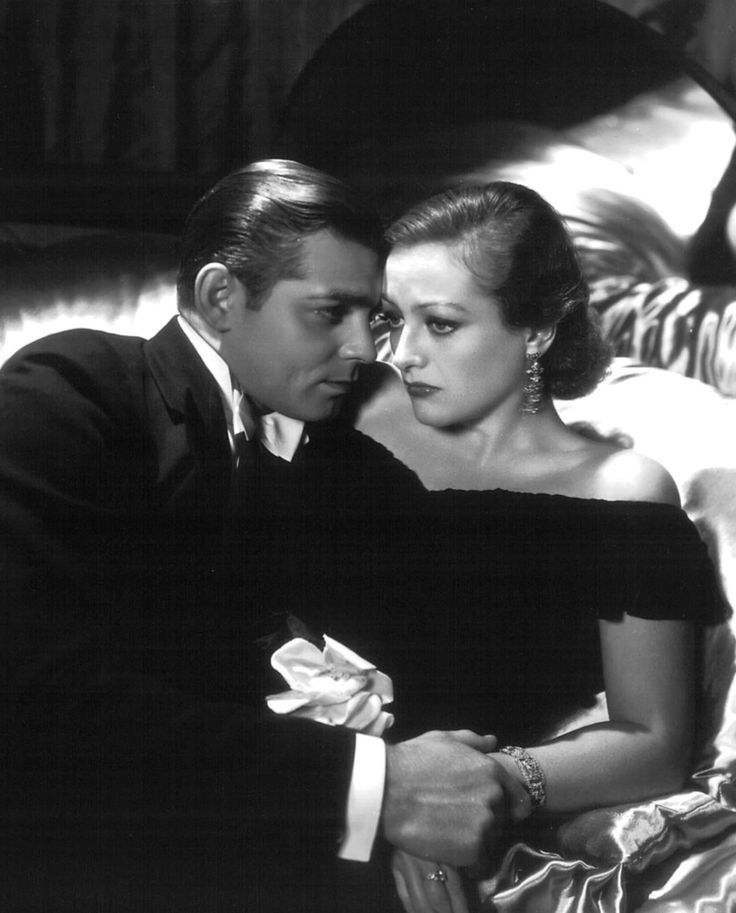
Clark Gable and Joan Crawford in Possessed

5/9, 8 PM - Possessed (1931)
I chose this film because it features TCM's Star of the Month Clark Gable alongside frequent leading lady (and off-screen paramour) Joan Crawford. This was their third film together and the chemistry between the two finally clicked on screen. Crawford received top billing as a working class girl who becomes the mistress of a wealthy lawyer, played by Gable. It's a Hollywood melodrama, so you can probably guess that everything doesn't go smoothly for these two, but the story is not entirely predictable. It is a good example of what happens in many pre-code dramas: despite introducing sophisticated themes about sex and relationships, concludes with a disappointingly conventional ending. But it is still an enjoyable ride, and along the way you can enjoy the lovely black and white cinematography and the two stars looking ravishing in fancy clothes.
The real-life (adulterous) romance between the stars ended, by order of studio head Louis B. Mayer, soon after Possessed. Nevertheless, Gable and Crawford continued to be a popular on-screen couple; in fact, tonight on TCM you can watch seven more of their films. However, Possessed may have been the height of their on-screen chemistry. As Crawford was quoted in a biography of Gable, "[We] were supposed to be madly in love. When the scenes ended, the emotion didn't."


Film poster for Mister Roberts

5/27: Comedy Aboard the USS Reluctant
10:30 PM - Mister Roberts (1955)
12:45 AM - Ensign Pulver (1964)
Henry Fonda stars in Mister Roberts as the title character, a naval officer aboard WWII supply ship the Reluctant. Roberts clashes with his commanding officer, earning the admiration of the rest of the crew, all the while longing for active duty. Mr. Roberts was first a novel, then a hit Broadway play starring Fonda. When the story was adapted for the screen the producers felt that the 50-ish Fonda was too old for the role of Roberts, which was originally written as a man in his twenties. (I would argue that since Fonda was in his forties when he originated the role on stage the original age of the character was already somewhat irrelevant.) However, director John Ford insisted on casting Fonda. Ford may have come to regret that decision since his on-set clashes with the star ultimately led Ford to drink himself into hospital and he was replaced as director by Mervyn LeRoy. Nevertheless, whatever off screen drama accompanied filming, it doesn't show in the final product, which was embraced by audiences for its humor and heart. To solve the problem of a middle-aged Roberts, the rest of the crew included actors who were even older than Fonda, including James Cagney as the tyrannical Captain and William Powell as the ship's surgeon, Doc. The fresh face among the cast was Jack Lemmon, in only his fourth film. Lemmon's performance as morale officer Ensign Pulver won him the Academy Award for Best Supporting Actor. Lemmon's was the film's only Oscar, though it was nominated for Best Picture. 
Ensign Pulver picks up on the continuing adventures of the Reluctant's crew, this time with the character of Pulver at the center. Because the sequel was made well after the original, all the parts have been recast with Robert Walker Jr., Burl Ives, and Walter Matthau stepping in as Pulver, the Captain, and Doc, respectively. Other familiar faces in small roles include Jack Nicholson, James Coco, and Larry Hagman. The story is similar to the first film with Pulver leading a prank war against the Captain to protest the harsh treatment of the crew. The film wasn't as big a hit as Mister Roberts, and even the filmmakers felt it may have suffered in comparison because the sequel lacked the crucial character of Roberts. However, it is entertaining on its own terms and has its own brand of charm. And, yes, that's Robert Walker Jr. - a.k.a. the son of Robert Walker and Jennifer Jones - in the title role.


Sunday, April 16, 2017

Classic Movie Picks: April 2017

by Lani

Each month, I scour the Turner Classic Movies schedule for upcoming films that I can't miss. The highlights are posted here for your reading and viewing pleasure! (All listed times are Eastern Standard, check your local listings or TCM.com for actual air times in your area. Each day's schedule begins at 6:00 a.m.; if a film airs between midnight and 6 a.m. it is listed on the previous day's programming schedule.)

William Daniels

4/17: Guest Programmer William Daniels
8 PM - 1776 (1972)
11 PM - A Thousand Clowns (1965)
1:15 AM - Dodsworth (1936)
People of my generation will know actor William Daniels as Mr. Feeny from 90s sitcom Boy Meets World (younger folks may know the character from the spin-off series Girl Meets World). Others may recognize him from his Emmy-winning role on 80s hospital drama St. Elsewhere. But, he's also had a long career on the stage and screen, and his programming picks tonight include two of his own films in which he reprised a successful stage role. First up is 1776a musical about the second Continental Congress and the creation of the Declaration of Independence, in which Daniels stars as founding father John Adams, reworking his acclaimed performance from the Broadway production for film. The numerous and lengthy debates, compromises, and votes are fascinating for any history buff (despite a bit of dramatic invention), though the witty dialogue and snappy songs keep it from feeling like a stale history lesson. The second film of the night, A Thousand Clowns, has a much smaller scope, centering on a New York City bachelor, played by Jason Robards, who is the guardian for his young nephew. When Robards quits his job, his ability to provide for the child is called into question and a social worker, played by Daniels in another reprise of a stage role, threatens to remove the child from his uncle's care. For his final pick of the night, Daniels chose the 1936 drama Dodsworth, starring Walter Huston. Daniels admires Huston's acting here in a role that Huston had previously played onstage (a theme tonight!). Huston's Dodsworth is a successful businessman living a comfortable life in middle age. His frustrated wife begins an affair which provokes Dodsworth to pursue a new life with another woman. It is a mature drama about adult people, with no contrived circumstances. Though times and social expectations have changed since the 30s, the film still plays well today. 


Florence Bates, Mary Wickes, Marjorie Main, Thelma Ritter

4/20: What a Character!
8 PM - On the Town (1949), Florence Bates
10 PM - By the Light of the Silvery Moon (1953), Mary Wickes
12 AM - The Long, Long Trailer (1954), Marjorie Main
2 AM - Rear Window (1954), Thelma Ritter
Throughout the month, TCM is highlighting character actors of Hollywood's golden age - the unsung heroes of many classic films. I singled out this evening's line-up because it features some of the best character actresses of all time. If you don't recognize the names, you'll certainly recognize the faces. These ladies bring texture to many a glossy film with their talent for cracking wise as maids, matrons, nurses, or other supporting characters. 
In the energetic musical On the Town, Florence Bates has a small, but memorable turn as Vera Ellen's stern, and apparently inebriated, ballet teacher. Then we get Mary Wickes playing the housekeeper (she was always the housekeeper) for the central family in the quaint musical By the Light of the Silvery Moon. Marjorie Main was well known for her leading role in the Ma and Pa Kettle films, but tonight you see her in a supporting role as a nosy neighbor in The Long, Long Trailer. Finally, we are treated to a performance by Thelma Ritter, an actress who received six Best Supporting Actress Oscar nominations between 1951 and 1963, but never won. She appears as James Stewart's nurse in Rear Window.


An Affair to Remember poster

4/21, 8 PM - An Affair to Remember (1957)
This film is part of a month-long spotlight on post-WWII melodramas, and it's definitely one of the biggies. The story was originally filmed in 1939 and again in 1994, both times under the title Love Affair. However, the 1957 film, starring Cary Grant and Deborah Kerr, remains the best-known version. From the poster, you'd think that Grant and Kerr are, well, kissing in Italy...across an ocean...and all over New York; but that would be misleading, as the two have a fairly chaste romance. They strike up a friendship on board a Transatlantic ocean liner heading from Europe to New York. Though both are involved with other people back home, Grant and Kerr's relationship blossoms into love. After landing in New York, they agree to reunite in six months at the Empire State Building. But will they? Not before quite a few tears are shed. 
The film received four Oscar nominations, for cinematography, costumes, original score, and original song for An Affair to Remember (Our Love Affair), sung by Vic Damone over the opening credits.


4/27, 2:15 AM - Bells Are Ringing (1960)
I saw this film for the first time just last year and it was so charming, I had the experience of thinking, "Oh, why did I wait so long to see this? To think I could have had Bells Are Ringing in my life sooner!" This is a film adaptation of a Broadway musical about an operator for a telephone answering service who gets too involved in the lives of her clients. Judy Holliday won a Tony on Broadway for her portrayal of operator Ella Peterson and reprises that role here. As Ella, she's bubbly, bright, and warm; she has a big heart which gets her into trouble sometimes, but enough pluckiness to pull herself out of any jam. It's possibly the most "Judy Holliday" of any Judy Holliday character, which isn't so surprising when you learn that authors Betty Comden and Adolph Green created the role as an idealized version of their old friend, Judy Holliday. Dean Martin co-stars as a writer who gains new motivation and inspiration after meeting Ella. 
This was Holliday's final performance on film; however, her final screen credit came in 1965's A Thousand Clowns (see above). The title song was composed by Holliday's boyfriend Gerry Mulligan with lyrics supplied by Holliday. Unfortunately, she died far too young, of cancer at age 43, before the film was released.

Tuesday, February 28, 2017

Classic Movie Picks: March 2017

by Lani

Each month, I scour the Turner Classic Movies schedule for upcoming films that I can't miss. The highlights are posted here for your reading and viewing pleasure! (All listed times are Eastern Standard, check your local listings or TCM.com for actual air times in your area. Each day's schedule begins at 6:00 a.m.; if a film airs between midnight and 6 a.m. it is listed on the previous day's programming schedule.)


3/2, 11 PM - What Ever Happened to Baby Jane? (1962)
I'm sure that many classic movie fans are intrigued by the new TV mini series Feud: Bette and Joan, centered on the tumultuous relationship between Bette Davis and Joan Crawford during the filming of Baby Jane. Feud, starring Susan Sarandon as Davis and Jessica Lange as Crawford, premieres March 5, so this is the perfect chance to see the film at the center of the series. 
Davis and Crawford play sisters, Jane and Blanche, who both went into acting and now live together in a decaying Hollywood mansion. While Jane achieved early success as a child star ("Baby Jane"), Blanche eventually surpassed her sister and achieved stardom and respect as an adult. After Blanche is paralyzed in a car accident, she is left in the care of the increasingly unhinged Jane. The two women engage in a psychological battle as Jane torments Blanche while also entertaining hopes of reviving her stardom. 
The success of Baby Jane created a brief sub-genre of "grande dame" horror films, in which a glamorous actress-of-a-certain-age is psychologically and physically terrorized or does the tormenting herself. Notable titles included Hush, Hush Sweet Charlotte with Olivia de Havilland and Davis, Whatever Happened to Aunt Alice? with Geraldine Page, What's the Matter with Helen? starring Shelley Winters and Debbie Reynolds, and Whoever Slew Auntie Roo? also starring Winters. The genre ran out of steam in the early 70s, or maybe just ran out of questions to use as titles. 
However, my favorite coda to the making of this film came at the Academy Awards in 1963, when Davis was nominated for Best Actress, but Crawford was not. Crawford had contacted all the other nominated women and offered to accept the award on their behalf, should they be unable to attend the ceremony. So, when the Best Actress award was announced for Anne Bancroft, who was in New York at the time, it was a glowing Crawford who ascended the stage to accept the Oscar.

The film will also air on 3/22 as part of the "March Malice" programming series spotlighting villains on film. There are a lot of great films in the line up, from noir to westerns to sci-fi.


poster for The Incredible Journey - a bull terrier, yellow labrador retriever and siamese cat

3/16, 12 AM - The Incredible Journey (1963)
TCM is opening the Disney Vault this month and has programmed four shorts and six movies themed around the great outdoors. The gem of the group is The Incredible Journey, a live-action film starring animals based on a book by Irish author Sheila Burnford. The main characters are Bodger (an old bull terrier), Tao (a Siamese cat), and Luath (a yellow Labrador Retriever), treasured pets of a family living in the Canadian countryside. When the family must travel to England for the summer, the pets are left on a friend's farm in Ontario. Feeling confused and homesick in their new surroundings, the three animals set off to cross over 200 miles of Canadian wilderness to return to the home they know. Of course along the way they have many adventures including encounters with wild animals - including a lynx, a bear, and a porcupine - as well as humans. The two dogs and cat are not provided with voices (as they are in the 1993 remake Homeward Bound: The Incredible Journey), but their journey is narrated by the frequent voice of Disney nature documentaries Rex Allen. Author Burnford found inspiration for the story from her own pets and adopted home in Canada. Pet lovers are sure to see their own furry friends in the three main characters and may find themselves tearing up by the end of this one.


poster for Ryan's Daughter - a woman stands on a cliff and looks out toward the ocean

3/17: Irish Heroines
1:45 AM - Ryan's Daughter (1970)
5:15 AM - Little Nellie Kelly (1940)
In honor of St. Patrick's Day, TCM has scheduled a day's worth of films which take place in Ireland or feature Irish characters. I'm interested in these two films which both feature an Irish heroine; however, that's about where the similarities between them end. 
Ryan's Daughter is an epic following in the footsteps of director David Lean's previous three films Doctor Zhivago, Lawrence of Arabia, and A Bridge on the River Kwai. The film is set in a small coastal Irish village during WWI and centers on three characters caught in a love triangle -- a schoolteacher and his wife, played by Robert Mitchum and Sarah Miles, and a young British officer, played by Christopher Jones -- and pulled apart by conflicting loyalties of Irish nationalism and British rule. The screenplay was written by 3-time Oscar winner Robert Bolt with his wife, Miles, in mind for the title role. Lean's knack for showcasing beautiful imagery while also creating intimate character portraits is on full display. Though a hit in the U.K., the Ryan's Daughter was not as popular in the U.S. as Lean's previous films (and Lean would not complete another film for 14 years!). However, it did receive Academy Awards for its cinematography and supporting actor John Mills, as well as nominations for Best Sound and Best Actress for Sarah Miles.

In Little Nellie Kelly Judy Garland plays dual roles as Irish immigrant Nellie Kelly and her daughter, Little Nellie. It's a light musical in which Garland must patch up differences between her father and grandfather, while also finding romance and becoming the toast of Broadway. Along the way she performs "It's a Great Day for the Irish" and a swinging version of "Singin' in the Rain." Though it was adapted from a George M. Cohan stage musical, the film contains only one Cohan song - "Nellie Kelly, I Love You" - sung by Garland's love interest Douglas McPhail. This was one of Garland's first adult roles and in addition to her impressive singing and dancing, she got a chance to show some dramatic chops with a death scene, a birth scene, and her first on-screen romantic kiss. 


poster for Bluebeard's Eighth Wife - a man sticks his head out of a doghouse and looks at a woman holding a puppy

3/19: Lesser-Known Lubitsch
8 PM - Cluny Brown (1946)
10 PM -  Bluebeard's Eighth Wife (1938)
Ernst Lubitsch directed over 70 feature films in both his native Germany and, beginning in the 1920s, in Hollywood. In his heyday of the 30s and 40s, Lubitsch was considered one of the top comedy directors in Hollywood and he helmed such classics as Trouble in Paradise, Ninotchka, and The Shop Around the Corner. His ability to find moments of sophisticated grace and visual wit was nicknamed "the Lubitsch Touch."
Cluny Brown was the last completed film directed by Lubitsch. Jennifer Jones stars as the title character, a young woman of humble means with a knack for plumbing. Charles Boyer is her love interest, a poor Czech intellectual living off the hospitality of the British upper crust. The two characters create a commotion as they upend social norms at a country estate. The film satirizes the British aristocracy in the pre-WWII years and though it was a hit with American audiences, the Brits were not amused. (So much so, that English actor Sir C. Aubrey Smith felt the need to apologize to his homeland for appearing in the film.)

Bluebeard's Eighth Wife is not often listed among its director's greatest works, but with talents like Lubitsch, Claudette Colbert, Gary Cooper, David Niven, and Edward Everett Horton (and the list goes on) working together, I'd say even an imperfect film is worth watching. Colbert is one of my favorite actresses and here she is doing what Colbert did better than anyone - wearing fabulous clothes and wittily rejecting the advances of a millionaire. Said millionaire, played by Cooper, has been branded a modern-day "Bluebeard" after being married and divorced seven times, each with a hefty settlement for the ex-wife which is certainly better than what Bluebeard's wives got. Colbert sets out to get the best of this inveterate ladies man by agreeing to marry him, but intending to get a divorce and live comfortably on her own settlement. For those keeping score, I'd say the bit with the pajamas is an example of the Lubitsch touch.


Monday, February 27, 2017

Best Pictures #39: 2016 Academy Awards, My Pick for Best Picture

by A.J.

Best Pictures #39: 2016 Academy Awards
My Pick for Best Picture

The 2017 Academy Awards ceremony for films released in 2016, held on February 26th, will go down in history for its unprecedented, weird, wild twist ending. La La Land, with its 14 nominations, was the front runner in nearly every category according to betting markets, critics, insiders, and amateur prognosticators. The night started out with some surprises, most notably Hacksaw Ridge winning two Oscars for Editing and Sound Mixing--giving veteran sound mixer Kevin O'Connell his first win after a record 21 nominations without a win. Though it took home the most awards of any film at the 89th Academy Awards with a total of six, La La Land unexpectedly underperformed and, most surprising of all, did not take home Best Picture.

Warren Beatty and Faye Dunaway were the presenters of the Best Picture award at the end of the night. Beatty opened the envelope looked at the card, looked confused, then checked the empty envelope again, hesitated for a moment, then checked the envelope again. After a long awkward moment, he handed the card to Dunaway who read: La La Land. Two of the three producers of La La Land had gotten through their acceptance speeches and the third was about to speak when there was commotion on stage. The expressions of people on stage in the background were of confusion and disbelief. It was La La Land producer Jordan Horowitz that announced to everyone that, in fact, Moonlight had won Best Picture. Some of the La La Land cast and crew on stage were visibly, and justifiably, upset, but Horowitz was the epitome of class and dignity and graciously turned over the Oscar to the producers of Moonlight

The accounting firm of PricewaterhouseCoopers counts all the of Oscar ballots and tabulates the winners, which are placed in the official envelopes and put in a locked briefcase handcuffed to a representative from the firm. For practical reasons, there are two sets of envelopes. Should anything happen and an envelope is missing, there is a backup. A close up freeze frame of the envelope in both Beatty and Dunaway's hands reveals that category on the envelope is: Actress in a Leading Role.
They were simply handed the wrong envelope. Beatty said that he opened it, it said "Emma Stone-La La Land" and he didn't know what to do, so when he showed it to Faye Dunaway she just read the name of the movie. Host Jimmy Kimmel tried graciously to take all the blame for the mix up saying that it was his fault and he won't be back next year. In reality, Kimmel was one of the best and liveliest hosts the Oscars has had in quite some time.

Early on in the night I thought: wouldn't it be nice if an independent film with no big name stars, about a troubled gay black man wins over the big Hollywood musical about the greatness of Hollywood? Then it didn't happen and La La Land won...then it did happen! I would not have voted for La La Land, but it would by no means be the Best Picture winner with which I most disagreed. It is a fine movie, but, frankly, I've seen it before, and I've seen it done better before. La La Land is simply another musical. Moonlight is filmmaking that approaches poetry. It takes a step back from the events happening to its main character, Chiron, allowing you to experience what he is experiencing. Moonlight is an art film, but it is open with its emotions and thus engaging. It is a special film that I've grown to like more and more.  
I'm very glad that Moonlight won, but it is still not the way I would cast my vote...

My Pick for Best Picture of 2016: Arrival
I didn't respond to any of the 2016 Best Picture nominees the way I responded to Arrival. It's rare that a science fiction film actually focuses on science instead of using the genre as a more interesting background for an action/fantasy story-- exactly what is the science in Star Wars? And, too often, when a science fiction film does focus on science it is to the detriment of the human aspect of the story. This is not the case with Arrival. It is a science fiction film brimming with pathos and thought provoking ideas.
There's so much to enjoy in Arrival: a new take on alien invaders, solid and even restrained filmmaking, and an excellent performance from Amy Adams. I was just as moved when I saw this film a second time as I was the first time I saw it in theaters. Perhaps the main reason for that is Adams' performance. The written language of the aliens is inventive and intriguing, as are the ideas it raises about language and time. The ideas it presents are interesting to ponder and move the story forward. Arrival is a serious science fiction film but it is also very entertaining. Genre conventions and references to other sci-fi movies are in the background, not the foreground, letting audiences enjoy this movie without constantly being reminded of other films in the same genre. Director Denis Villeneuve and screenwriter Eric Heisserer have crafted something poetic and profound.

Sunday, February 26, 2017

Best Pictures #38: 2016 (89th) Academy Awards Best Picture Nominee, Hacksaw Ridge

by A.J.

Best Pictures #38: 2016 (89th) Academy Awards Best Picture Nominee

Hacksaw Ridge is a good film, but too uneven to be a great film. There is noticeable talent at work both in front of and behind the camera. It has received a total of six Oscar nominations for Best Picture, Director (Mel Gibson), Actor (Andrew Garfield), Editing, Sound Mixing, and Sound Editing. Noticeably, and rightfully, not among those nominations is the screenplay by Andrew Knight and Robert Schenkkan, which is by far the clunkiest element in an otherwise well-made, well-acted war film.

It seems like a paradox that a movie about a pacifist should be so bloody and gory, but the incredible true story of Desmond Doss, the first conscientious objector to win the Congressional Medal of Honor, is exactly that. Doss saved the lives of 75 fellow soldiers at the gruesome Battle of Okinawa in 1945 without even carrying a gun. Andrew Garfield plays Doss, a Seventh Day Adventist who enlisted as a combat medic during World War II, despite his vow to never touch a gun or take a life. His beliefs and refusal to use a weapon—not even for target practice—does not win any favor with his army superiors or fellow soldiers.

There are two distinct halves to Hacksaw Ridge: Doss’s life and experiences stateside at home in Virginia and at basic training, and his experience at the Battle of Okinawa. It isn’t just Doss’s religious beliefs that compel him to never use firearms. We see him as a child nearly kill his brother with a brick during a fight. There is also his abusive, alcoholic father, Tom, an emotionally and psychologically scarred veteran of WWI, played with a superb performance by Hugo Weaving. A brighter side of his life in Virginia is his sweet romance with a nurse named Dorothy, played by Teresa Palmer. They marry and he enlists in the army. If there were so many people taking life in the war, Doss thought, then he would be one person saving life. The movie stops just shy of making Doss into a saint thanks to Garfield’s performance. He makes Doss a believable person of strong conviction and goodwill.

When Doss arrives at basic training we meet characters with names like: Vito, Tex, Hollywood, Smitty, and Grease. You might think that Hacksaw Ridge accidentally used the screenplay of a war movie from the 1940s or 50s (and one that would’ve been clichĂ©d even then). There is scene after scene of ham-fisted dialogue of people underestimating Doss, then realizing that they had him all wrong. It’s a bit much, but just as soon as you’re ready to write off Hacksaw Ridge, it wins you back, usually thanks to one of the strong performances. It’s at basic training that we meet Vince Vaughn (the lone American in a cast of Brits and Australians) as Doss’s tough and serious, but somehow hilarious, sergeant. It’s a role that is perfect for Vaughn. He’s great at delivering amusing insults to the new recruits, but his stern face and formidable stature, especially when confronting the slender Andrew Garfield—Vaughn is 6’5” after all—make him quite intimidating. Like Doss, he’s a character you believe because of the talent of the performer.

Hacksaw Ridge really shines in its second half at the Battle of Okinawa and the skillful direction of Mel Gibson takes the film to another level. Frantic, hellish, and horrific violence and battle sequences are what he excels at, but he never loses the underlying humanity that the first half of the film builds. The scenes set in Virginia are also well done, but only Gibson could craft the second half of this movie. Doss spends three days on the battlefield, day and night, finding wounded and dying soldiers and taking each one to safety by lowering them down a steep cliff one by one. Each time, Doss asks God to help him get one more. This film revels in blood and guts but it does not glorify or make war seem adventurous. It makes war look dirty and gross and frightening and bloody and scary and awful.

I’m perplexed that the movie telling the true story of Desmond Doss is steeped in war movie clichĂ©s. It’s almost frustrating. These clichĂ©d scenes with stiff, uncreative dialogue occur throughout the movie. It is the excellently shot battle scenes and great performances from Andrew Garfield, Vince Vaughn, and Hugo Weaving that make the film substantial. Despite its flaws, Hacksaw Ridge has enough quality moments and performances to make it well worth watching.

Nominees: Bill Mechanic, David Permut, producers
Director: Mel Gibson
Screenplay: Andrew Knight and Robert Schenkkan
Cast: Andrew Garfield, Vince Vaughn, Sam Worthington, Hugo Weaving
Production Companies: Pandemonium Films, Permut Productions, Vendian Entertainment, Kylin Pictures
Distributor: Summit Entertainment, Icon Films
Release Date: November 4th, 2016
Total Nominations: 6, including Best Picture
Other Nominations: Director-Mel Gibson, Actor-Andrew Garfield, Editing-John Gilbert, Sound Mixing-Kevin O'Connell, Andy Wright, Robert Mackenzie, Peter Grace, Sound Editing-Robert Mackenzie, Andy Wright

Saturday, February 25, 2017

Best Pictures #37: 2016 (89th) Academy Awards Best Picture Nominee, Hidden Figures

by A.J.

Best Pictures #37: 2016 (89th) Academy Awards Best Picture Nominee
I’m not surprised at all that there are still untold stories of the early days of the space race and NASA. I’m also not surprised that one of those stories is of the crucial role played by intelligent African American women. Hidden Figures is the story of three of those women: Katherine G. Johnson (Taraji P. Henson), Dorothy Vaughan (Octavia Spencer), and Mary Jackson (Janelle MonĂ¡e) whose work helped send men into space. The film that tells their inspirational and genuinely interesting story is, unfortunately, a conventional one.
In the early 1960s NASA was based in Langley, Virginia; both Virginia and NASA were segregated. Stress and frustration levels are high at NASA as, at this point in the space race, the U.S. was routinely surpassed by the Soviet Union. It is in this climate that our three heroines find career and life changing circumstances. Katherine Johnson, a mathematical prodigy, is assigned to the elite (and all white and all male) Space Task Group to create and compute—Johnson’s official title is “computer”—the calculations for Alan Shepard’s spaceflight and John Glenn’s historic orbit. Mary Jackson is working with engineers to construct the Mercury capsule, but needs to further her knowledge of physics to remain with the project. This means she has to seek the permission of a judge to attend night classes held at an all-white high school. Dorothy Vaughan is the supervisor of the “colored” computer division at NASA, all she lacks is the official title and pay. When she discovers that an IBM computer is being delivered that will make her staff obsolete, she sets about teaching herself and then her staff computer programming. Each has an overwhelming job to accomplish and they have to do so in the face of institutional racism and sexism.
Though this is an ensemble movie, the focus is Henson’s character, Katherine Johnson. Her scenes working with the Space Task Group are what keeps the story moving. Kevin Costner plays Al Harrison, head of the Space Task Group, as a stern man of few words whose main concern is results. Jim Parsons plays the lead member of the group whose main concern is having Johnson compute his calculations, write up his reports, and expecting her to stay silent and in the background. She, of course, does not and a big dramatic speech ensues. Did such a moment actually happen? Perhaps. Many scenes in Hidden Figures feel simultaneously true and contrived or embellished for the sensibilities of a 21st century audience. These scenes, however, are still satisfying because the racism and prejudice, both casual and direct, these women experienced is so awful and absurd that it feels good to see it confronted. Did Al Harrison really end segregation at NASA by ripping the steel “colored bathroom” sign down with a crowbar? I wouldn’t be surprised if this scene was more symbolic than factual, but it’s very satisfying to see happen.
Hidden Figures is directed by Theodore Melfi in a very straightforward, conventional way. It is most concerned with telling a true and inspirational story and making sure the audience leaves the theater with a warm, happy feeling. It does this quite well. There are good performances from the three leads (Octavia Spencer has picked up a Supporting Actress Oscar nomination) and the film moves along at a steady pace. Snappy one-liners and Johnson’s romance with a Colonel played by Mahershala Ali (who has a Supporting Actor Oscar nomination for his role in Moonlight), take Hidden Figures to the brink of feeling like a made-for-TV movie, but thankfully the cast and the Oscar-nominated screenplay by Allison Schroeder and Theodore Melfi keep the movie on track. As a film, Hidden Figures is nothing out of the ordinary, but its story and cast make it enjoyable.

Nominees: Peter Chernin, Donna Gigliotti, Theodore Melfi, Jenno Topping, Pharrell Williams, producers
Director: Theodore Melfi
Screenplay: Allison Schroeder and Theodore Melfi, based on the book by Margot Lee Shetterly
Cast: Taraji P. Henson, Octavia Spencer, Janelle MonĂ¡e
Production Companies: Fox 2000 Pictures, Chernin Entertainment, Levantine Films, TSG Entertainment
Distributor: 20th Century Fox
Release Date: December 25th, 2016
Total Nominations: 3, including Best Picture
Other Nominations: Adapted Screenplay- Allison Schroeder and Theodore Melfi, Supporting Actress-Octavia Spencer