Showing posts with label Brad Pitt. Show all posts

Tuesday, March 3, 2026

Best Pictures #119: 2025 (98th) Academy Awards Best Picture Nominee: F1

 by A.J.

Best Pictures #119: 2025 (98th) Academy Awards Best Picture Nominee

“When I said I like straight talk, I meant me. From others, I prefer mostly praise, flattery, idolatry. Sometimes, even gibberish.
Nearly everything about F1 feels familiar. It follows the basic formula of a washed up veteran getting a second chance, being at odds with the younger hot-shot, defying expectations, and wowing everyone. It also follows the basic formula not just of other racing movies, but sports movies in general: the underdogs with no chance think outside the box to overcome the odds. Following a formula isn't necessarily a bad thing; it is relying only on the formula, using it as a crutch, that gets a movie in trouble. The familiarity of the plot, structure, and character types are the chassis upon which the expert direction of Joseph Kosinski and a great Brad Pitt performance have their fun. This movie does not reinvent anything about its genre or subgenres; it does not aim to do that. Like Kosinski’s previous film, the spectacular 2022 Best Picture Oscar nominee Top Gun Maverick, it makes the most of the familiar. 
Brad Pitt plays Sonny Hayes, a dedicated racecar driver, who is not so much of a has-been as a never-was. A prologue shows that he is clearly a good driver, with little patience for anyone who isn't as dedicated to his sport as he is, but after winning the 24 Hours of Daytona race, and being offered a permanent spot on the team, he moves on. This is when an old friend, Ruben (Javier Bardem), appears right on cue to ask Sonny to join his failing Formula 1 team and turn things around. Bardem's team is performing so badly that if they cannot win at least one of the remaining races of the season then "the board" will sell the team. Sonny isn't sure about the offer because dramatic structure dictates that the hero must first refuse the call to action, but then he turns up in London to race in F1 for the first time since he crashed and burned 30 years ago.
Charm goes a long way in this movie. Damson Idris as Sonny’s new teammate, Joshua, is quite good at playing the young hot shot seeking fame and fortune. Idris is charming enough even though his character is at times more concerned with building a social media following, as advised by his cousin/manager Cashman, nice comic relief by Samson Kayo. The screenplay by Ehren Kruger gives little more to Joshua than the usual just-trying-to-win-money-to-take-care-of-my-mom motivation, but Idris makes the most of it. Pitt's charm might as well be the industrial strength garment rack on which everything that is not dazzling racing hangs. We've seen his character type before, but the smart, even clever, touch is that Sonny is willing to do whatever it takes to win even if that means playing the supporting role so the team can win. The twist is that he is a team player. He uses his reputation for wrecklessness and being a wild card to draw the attention of the other drivers to him, allowing Joshua to move closer and closer to first position. The frustrating part of the movie, and Sonny, is that he doesn't share this plan with anyone beforehand. His strategy is meant to be a revelation but that is only because he doesn't tell anyone. 
The race announcers have the thankless task of explaining the basics of F1 racing (what is allowed, expected, unexpected) and also being exposition machines. As someone who knows nothing about professional racing, I found this helpful but annoying because I knew I was being spoonfed information. The commentators never talk about the other drivers or teams, so it just comes across as weird that they only talk about Sonny and his backstory and the stakes for his team. 
The weakest part of F1 is its screenplay which does not give the actors much to work with and over emphasizes “the stakes” (that the team will be sold if it doesn't win). The problem is that “stakes” only matter to studio executives who think audiences will only care about a story if something big is on the line. The truth is we just want to see Brad Pitt be charming, play a character who's good at what they do, and see exciting races. On that front F1 delivers. Kosinski and cinematographer Claudio Miranda apply some of the same techniques to racing as they did to flight in Top Gun Maverick (cameras are mounted on the F1 cars, POV shots put us in the driver's seat) to great effect. The sound design is magnificent, even on simple TV speakers: the zipping of the cars, the high pitched roar of the F1 engines, the rumble of tires all enhance the experience of the racing scenes.
As for the performances, if anyone is impressive it is because of what they bring to the role, not the role itself. The screenplay includes such clunky lines of dialogue like, "So how does one get to be the first female technical director of an F1 team?" which Pitt does his best to deliver as an almost joke to his love interest Kate (Kerry Condon). She brings depth to her character more with how she plays her than anything in her familiar backstory. Sonny's dialogue varies from simple but effective (“Hope is not a strategy!”) to wry comments to an inarticulate speech about why he loves racing. Nevertheless, through peaks and valleys, Pitt makes the most of it. Like Sonny, he is doing the best with what he was given. 
It is no surprise that F1 got Oscar nominations for sound, editing, and visual effects, (the cinematography went surprisingly unnominated) but its Best Picture nomination came as a big surprise to me. Perhaps I should have seen it coming since the Academy Awards seems to love racing movies, like the 2019 Best Picture nominee Ford v Ferrari. That movie was derisively categorized as a "Dad movie" and many critics and commentators want to lump F1 into that nebulous sub-genre. However, F1 has a slick, polished veneer that skews towards a different and wider audience. I'm sure dads will like this movie, I know I did, and should you come across it, you'll have a good time too.

F1 is available on AppleTV+.
Nominees: Chad Oman, Brad Pitt, Dede Gardner, Jeremy Kleiner, Joseph Kosinski, Jerry Bruckheimer, producers
Director: Joseph Kosinski
Screenplay: Ehren Kruger; story by Joseph Kosinski, Ehren Kruger
Cast: Brad Pitt, Damson Idris, Javier Bardem, Kerry Condon
Production Companies: Apple Studios, Jerry Bruckheimer Films, Plan B Entertainment, Monolith Pictures, Dawn Apollo Films
Distributor: Warner Bros. Pictures, Apple Original Films
Release Date: June 27th, 2025
Total Nominations: 4, including Best Picture
Other Nominations: Editing-Stephen Mirrione; Sound-Gareth John, Al Nelson, Gwendolyn Yates Whittle, Gary A. Rizzo, Juan Peralta; Visual Effects-Ryan Tudhope, Nicolas Chevallier, Robert Harrington, Keith Dawson

Thursday, October 24, 2024

13 Nights of Shocktober: Interview With the Vampire

 by A.J.

Night 6: Vampire Night
“I’m going to give you the choice I never had.”

There are only a handful of vampire movies that are so influential that they change the way people think about the undead creature and how they are portrayed in future movies. Among them are F.W. Murnau’s silent classic Nosferatu, Tod Browning’s Dracula (1931) starring Bela Lugosi, Francis Ford Coppola’s Bram Stoker’s Dracula (1992), and the 1994 big screen adaptation of Anne Rice’s novel Interview With the Vampire.
Anne Rice’s novel, first published in 1975, not only had the vampire as the main character, but the vampire wasn’t a villain. These vampires have complex personalities: moody, brooding, and profoundly sad. The novel and movie are best described as drama rather than horror; the characters undergoing an existential crisis just happen to be vampires. 
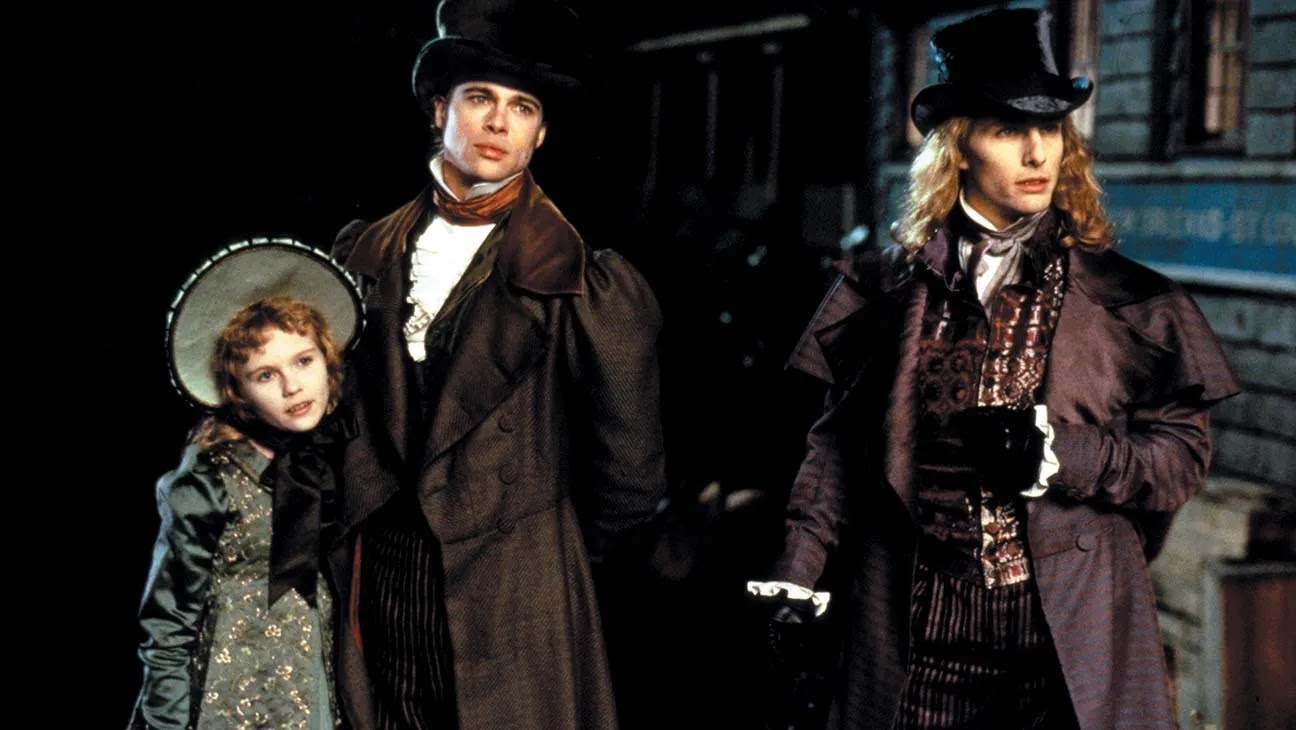
As the title would suggest, the story is structured as an interview taking place in the present day (early 1990’s) between a radio journalist (Christian Slater) and a mysterious pale man who claims he is a vampire. Perhaps the journalist is putting together the most macabre episode of This American Life. The vampire is Louis (Brad Pitt) and he tells the story of his life as a vampire. This was a major role for Pitt that would help launch him to superstardom, but it is Tom Cruise as the charismatic, dastardly vampire Lestat who gives the standout performance. The casting of Tom Cruise as Lestat caused uproar and controversy at the time, which was quite a feat in the pre-internet era. His movie star persona seemed at odds with the character of Lestat who is more or less a villain in this story and anti-hero in later Rice novels. Rice was very publicly against the casting of Tom Cruise. She went as far as advocating for fans of the book to boycott the movie and saying that casting Cruise as Lestat was like casting Edward G. Robinson as Rhett Butler. However, after seeing the finished film she would publicly retract her protests and even took out a full page ad in the New York Times praising Cruise’s performance. In Cruise’s career, this performance really does stand out. It’s one of the few times he's played a villain and one of the few times he’s really gone broad with a performance, which is just what the movie needs. Lestat shows the appeal of being a vampire: he embraces having no remorse, overindulging in luxury and the superiority he feels as an immortal. Pitt’s Louis bears the weight of conscience and remorse and the disadvantages of immortality. Each character is overbearing in their own way, but since Lestat is the more lively of the pair his impatience with Louis feels surprisingly welcome, and adds some humor.
In a moment of weakness Louis attacks and feeds on a small girl and Lestat turns 12 year-old Claudia into a vampire child. Kirsten Dunst’s performance as Claudia is brilliant, proof of her innate abilities as an actress. They form a vampire family and these scenes are amusing in a dark comedy sort of way. These happy times are short lived and Louis and Claudia leave for Paris in search of other vampires and answers to their questions about their own existence.
There is a strong and blatant streak of homoeroticism throughout the film between Louis and Lestat and later between Louis and the old world vampire Armand (Antonio Banderas). A newer adaptation would explore this more, in fact, the recent TV series, very loosely based on the book, does just that. However, here the subtext is so loud that a more explicit or direct portrayal does not seem necessary. It’s obvious that Louis and Lestat are in a relationship, however toxic. When Lestat turns Claudia into a vampire it comes across like having a child to save a failing marriage; this turns out to be a mistake for both humans and vampires. 
There is a fair amount of violence and horror effects, but because of the overall tone of the movie they hit differently than in a straightforward horror movie. They are usually punctuated by humor or sadness. Only in the climax, which almost feels like an action scene, are the horror effects played for shock. Special effects master Stan Winston (whose other credits Terminator 2, The Monster Squad, Batman Returns, and Jurassic Park) created the vampire effects and makeup. When Claudia attempts to murder Lestat by poisoning him and slitting his throat, Winston and the effects team built an emaciated animatronic Tom Cruise that writhes dying on the ground. This effect remains impressive even today. 
This is a brilliant movie worthy of the lasting influence it has had on vampire stories and horror in general. You can watch it with a horror hesitant viewer since it is more of a drama than outright horror. Thanks to the well-played, deep emotions on display it has a great effect on a wide swath of people. No matter how many other versions or remakes, even if they are good, Interview With the Vampire will stand alone, unchanging and forever captivating.

Interview With the Vampire is available to stream on Max and free on Tubi.

Sunday, February 9, 2020

Best Pictures #60: 2019 (92nd) Academy Awards Best Picture Nominee: Once Upon a Time…in Hollywood

by A.J.

Best Pictures #60
2019 (92nd) Academy Awards Best Picture Nominee

“I hired you to be an actor, Rick, not a TV cowboy. You’re better than that."
There are certain filmmakers that settle into their distinct style more and more with each film. Quentin Tarantino is among that group. Tarantino has also reached the same stature in the film community that Stephen King has in the literary world: for better or worse, he’s too successful to be edited down. Indeed, his latest film might also be his most “Tarantino” film since Pulp Fiction. Once Upon a in Time…in Hollywood, a sprawling but not quite epic tour through Los Angeles in 1969 that crosses paths with Bruce Lee, the Manson Family, and Sharon Tate, indulges in long, two-character conversations, pop culture references (both obvious and subtle), wall to wall pop music, flashbacks, insert shots and closeups, barefoot women, an unnecessary narrator, cameos from actors from previous films, and, of course, some bloody, bloody violence. There’s also an emotional maturity that we haven’t seen since Jackie Brown.
I left the theater uncertain whether I liked the picture or not, but by the time I got to my car I knew for sure that I had just seen the most interesting and challenging film by Tarantino in years. I also knew I had seen one of the best films of 2019. Tarantino always manages to surprise us, even when his films are set around historical events.
Leonardo DiCaprio stars as Rick Dalton, a former TV cowboy who can now only land roles playing the villain of the week on other shows (many of them, Green Hornet, The F.B.I, Lancer, are real shows). A Hollywood agent (Al Pacino in a small but well-played part) offers Rick a second chance as a leading man in Italian spaghetti westerns. Rick takes this as proof that he’s a has-been. DiCaprio does the best acting of his career as the washed-up TV cowboy, especially in the scenes of him on the set of the TV western, Lancer. In a wonderfully written, beautifully performed scene between Rick and a child actress DiCaprio expresses vulnerability in a way he never has with any character. 10-year-old Julia Butters proves to be a worthy scene partner for DiCaprio (which is no surprise if you’ve seen her steal every scene on the TV show American Housewife).
Brad Pitt plays Cliff Booth, Rick’s stuntman, driver, handyman, and only friend. If Rick is washed up, Cliff is un-hirable. He may, or may not, have killed his wife and gotten away with it (Tarantino shows us a brief ambiguous flashback) which, along with his irresponsible behavior on set, doesn’t endear him to stunt coordinators. Pitt’s performance is not exactly showy, but it is pronounced. Cliff is a character with no self-illusions; he has an easy confidence and Pitt is very comfortable in the role. It’s not his most challenging performance but it is one of his most memorable.
Margot Robbie plays the beautiful rising star Sharon Tate. She and her husband Roman Polanski, the hottest director in Hollywood, have just moved in next door to Rick. The few scenes that follow Tate as she goes about her day play more like distant observations that idolize her rather than moments that show us an inner life or build her up as a character. Robbie doesn’t have many lines but she still brings her enchanting screen presence to the role, which in this case is all that is required.            
Once Upon a Time...in Hollywood has a fun, brilliant energy. Since you are essentially just hanging out with Rick and Cliff as they go about their days there is a slight episodic feel as the movie goes on but the pacing is smooth and steady. In each scene you’ll find Tarantino’s signature sharp dialogue and interesting, colorful characters, both fictional and fictionalized. A long scene that places Cliff at the Spahn Movie Ranch, home of the Manson Family, is the most tense and frightening scene Tarantino has ever done. It’s a Hitchcockian scene bursting with suspense. The most entertaining scene in the entire movie is a long flashback to Cliff’s fight with Bruce Lee. This scene has caused a lot of controversy (Lee’s family has called in disrespectful) because it suggests that Cliff, a stuntman with no training, could have possibly won in a fight with Bruce Lee. I don’t think the scene pokes fun at Lee; if anything, Lee getting thrown without padding into a car door so hard it leaves a crater and then just shaking it off a moment later makes this Bruce Lee look pretty badass. It’s also a delight to watch Mike Moh’s great performance as the larger than life Bruce Lee.

The Hollywood of this movie feels like a very lived-in world. Nothing feels completely brand new. The sets of TV shows are deglamorized work places. Everything from the hip and not so hip clothing to the cars to the homes feel like the people in this movie have actually been using them. Little details like radio commercials for movies, old TV commercials, movie posters, and billboards all add up to a total immersion in this time period. It’s this immersive, authentic feel that is at odds with the film’s final act, the night of the Sharon Tate and her houseguest’s murder. Tarantino, never one to let a story go where you think, does something unexpected which, honestly, I should have seen coming. It’s right there in the title, “Once Upon a Time…” Despite all of the intricate details, it seems this film is a fantasy after all. 
The final act won’t work for everyone, there’s also plenty in the rest of the movie that won’t work for everyone (like having one of the leads be a potential murderer). There have been many, many discussions and arguments about nearly everything in this movie; it’s rare that we get a film that sparks such interest and conversations. Tarantino has said that he plans to retire after his next movie. I’m skeptical of such declarations from any filmmaker. If true, his penultimate film provides great entertainment and plenty for us to ponder. It also has my expectations high for his supposed final film.
Nominees: David Heyman, Shannon McIntosh, Quentin Tarantino, producers
Director: Quentin Tarantino
Screenplay: Quentin Tarantino
Cast: Leonardo DiCaprio, Brad Pitt, Margot Robbie
Production Companies: Columbia Pictures, Bona Film Group, Heyday Films, Visiona Romantica
Distributor: Sony Pictures
Release Date: July 26th, 2019
Total Nominations: 10, including Best Pictures
Other Nominations: Director-Quentin Tarantino; Actor-Leonardo DiCaprio; Supporting Actor-Brad Pitt; Original Screenplay-Quentin Tarantino; Cinematography-Robert Richardson; Costume Design-Arianne Phillips; Production Design-Barbara Ling, Nancy Haigh; Sound Mixing-Michael Minkler, Christian P. Minkler, Mark Ulano; Sound Editing-Wylie Stateman

Friday, February 12, 2016

Best Pictures #12: 2015 (88th) Academy Awards Best Picture Nominee, The Big Short (2015)

by A.J.
2015 (88th) Academy Awards Best Picture Nominee
The Big Short is a sharp comedy that assembles a strong cast to tackle an important, but complicated true story. It stars Christian Bale, Steve Carell, Ryan Gosling, and Brad Pitt, but the actors share little screen time with each other. In fact, Bale’s storyline does not cross paths with any of the others. Bale plays Dr. Mark Burry, an eccentric fund manager whose bosses don’t take seriously because he wears shorts, goes barefoot in his office, and gets his hair trimmed at Supercuts. In spite of his appearance, Burry is smart enough to figure out, in 2005, that the housing market is headed for disaster…and that there is a way to profit from the impending collapse. Ryan Gosling, as Deutsche Bank bond salesman Jared Vennett, most closely resembles the stereotype of a slick Wall Street executive, but is still seen as an outsider by his co-workers; he is also our narrator. He partners up with Mark Baum, played by Steve Carell, another hedge fund manager and Wall Street outsider who is trying to maintain independence while working within the system and dealing with his loathing for the Wall Street way. He and his team (Hamish Linklater, Rafe Spall, and Jeremy Strong) also notice the housing bubble about to burst and see a way to make a profit. John Magaro and Finn Wittrock play two young investors from Colorado who are eager to make it big—and move their hedge fund out of their garage—so they seek out the help of a retired banker, contentedly approaching hermit-hood, played by Brad Pitt. There are good performances from the ensemble all around, but only Bale snagged an Oscar nomination for Best Supporting Actor. I didn’t think that there was a clear stand out of cast, but I was impressed at how close all the actors came to going over the top without actually go over.

The Big Short has to explain a lot of dense, complicated exposition about credit default swaps, synthetic CDO’s, bonds, and other things that people take college classes to understand and finds some interesting ways to do that, some more effective than others. Gosling’s character tells the audience that explaining financial stuff can be boring and complicated, so in order to keep our interest we are shown scenes of celebrities explaining clearly and simply rather dense concepts. All of those expository segments are quick and fun and liven up the movie, in addition to actually explaining bonds and synthetic CDO’s. The first of these scenes, Margot Robbie in a bubble bath drinking champagne, is the least effective because unlike the segments with Anthony Bourdain making fish soup and Selena Gomez playing blackjack, Robbie’s actions and setting don’t help to illustrate the thing she is explaining. Several characters break the fourth wall and address the audience directly, sometimes explaining that a scene didn’t exactly happen the same way in real life; more often they tell us that a ridiculous, unbelievable thing really did happen.
Carell’s character is one most likely to strike a chord with audiences because his loathing for Wall Street turns to outrage when he uncovers the stupidity, corruption, and fraud rampant among the big banks and the complete lack of concern for how these actions will affect the country and the world. Carrell is also not afraid to say as much to the people he meets, no matter their standing, or even interrupt a speech at a conference with an annoying, but completely reasonable and legitimate point. He really did that, Gosling assures us. We can like these characters, despite that their goal is to profit from the collapse of the U.S. economy, because each one has a scene where they try explaining what they’ve discovered and are ignored by the people who should be most concerned. We can’t help but root for these guys because that is what we are used to doing when characters in a movie are smart or insightful, but are ignored by the stuffy, arrogant old guard. Pitt’s jaded ex-banker makes a point to damper the excitement of his young protégés by telling them that they “just bet against the American economy;” if they’re right, they will profit greatly, but many people will lose their jobs and homes as well.
Director Adam McKay has received an Oscar nomination for his direction of The Big Short and commentators cannot help but point out that this the same director who made the broad comedies Anchorman, Talladega Nights, and The Other Guys. The Big Short is different in tone than his previous films, but it is ultimately still a comedy despite its serious and true subject matter. There are some stylistic choices in this film that didn’t quite work for me. There are montages of images from pop culture—a rap video, people buying iPhones, etc. that are meant to show what American culture was obsessed with while the economy was beginning to crack and crumble, but felt more like a failed passage-of-time montage. I understood the purpose, but I didn’t feel the intended effect. In a film where actors will look right at the audience and explain what everything means, these montages are the one thing which are not given a clear definition or purpose. Another thing that bothered me must be mentioned, minor though it is: the multitude of bad wigs. It seems like each actor was made to pick out a wig and apply it themselves. Pitt’s beard, real or not, looks like a wig on his face.

What The Big Short does well is deliver facts about an incredibly important and unfortunate chapter of American history in a high energy, entertaining movie; but it never gives us more fun than frustration over the absurdities which hold up the American economy. The Big Short at times feels like an episode of Seinfeld or Curb Your Enthusiasm, in which a fairly average person is confronted by an absurd, bizarre character or situation and can’t understand how this could be happening. Adding to the absurdity and frustration is that we already know the results; so when, as the perfect sour cherry on top, Gosling tells us that nobody learned anything and nothing changed, it comes as no surprise. The same material in The Big Short is covered in the documentary Inside Job (2010), which is a sharp, rage-inducing look at the financial collapse which also explains clearly and simply what happened and why. Inside Job won the Academy Award for Best Documentary and should be sought out by anyone who hasn’t seen it yet; however, if I ever want a refresher on the hows and whys of the 2008 financial collapse, I will revisit The Big Short. A little levity–and seeing characters share my repulsed reaction to the behavior of the banks– goes a long way to help digest such a stomach churning material. 

Nominees: Brad Pitt, Dede Gardner, Jeremy Kleiner, Producers
Director: Adam McKay
Screenplay: Adam McKay and Charles Randolph, based on the book by Michael Lewis
Cast: Christian Bale, Steve Carrell, Ryan Gosling
Production Companies: Plan B Entertainment, Regency Entertainment
Distributor: Paramount Pictures
Release Date: December 11th, 2015
Total Nominations: 5, including Best Picture
Other Nominations: Director-Adam McKay, Supporting Actor-Christian Bale, Adapted Screenplay-Charles Randolph, Editing-Hank Corwin