Showing posts with label Timothee Chalamet. Show all posts

Monday, March 2, 2026

Best Pictures #118: 2025 (98th) Academy Awards Best Picture Nominee: Marty Supreme

Best Pictures #118: 2025 (98th) Academy Awards Best Picture Nominee

“I have a purpose. If you think that it's some kind of blessing it's not. It means I have an obligation to see a very specific thing through.”
In 2025 the directorial team of the Safdie brothers (Benny and Josh, whose previous films include much lauded and extremely tense Uncut Gems) each released their solo directorial efforts: Benny with the sports biopic The Smashing Machine and Josh with Marty Supreme, inspired by, but not based on, real life table tennis player Marty Reisman. It would be reductive and inaccurate to call Marty Supreme a sports movie, but like all great sports movies it is not really about the sport. This is a character study equally fascinating and frustrating because while Marty Mauser is very talented at table tennis, his real passion is the next win. This, more than any of the misfortunes and misadventures that Marty encounters, is the great conflict of the movie. Yet, no matter what the Oscar nominated original screenplay by Safdie and Ronald Bronstein throws at Marty, somehow he comes up with a plan and, somehow, no matter how absurd or stressful things get, it is all very entertaining.
Marty Mauser (Timothée Chalamet) is on his way to a stable, average life in New York City in the 1950’s. He works in his uncle’s shoe store and is such a good salesman that he is about to be made manager; but the job is only a way for him to make money to pay his way to compete professionally in the emerging sport of table tennis. Perhaps this is a mild spoiler, but he loses that tournament–he’s quick to blame the type of paddle, not the talent of his opponent–and spends the rest of the movie scheming and hustling to come up with enough money to enter the next global tournament and prove that he really is the best in the world. 
If Marty seems frustrating and annoying that’s because he is, but Chalamet's performance and natural charisma go the distance required to make the character and the movie work. There are three things in Marty’s favor. 1) Chalamet’s screen presence: Marty talks fast and big with a mixture of boasts, lies, and bent truths. Chalamet really makes us feel that the next big, epic win is just around the corner; he just needs to get around the corner first. 2) Chalamet’s youthful look: Marty is 23 and each mistake and misadventure feels like a chance for him to learn something. 3) Marty is genuinely, supremely talented at table-tennis/ping-pong and may actually be the best in the world; the only thing standing in the way of a spot in the professional big time is himself. 
Although, to be fair, not all of the obstacles Marty faces are his own doing. Marty catches the attention of a wealthy businessman Milton Rockwell (Kevin O'Leary, AKA Mr. Wonderful of TV's Shark Tank), who sees the potential for profits in a new field, but wants Marty to take a dive. (Marty’s affair with Rockwell’s wife, Kay Stone (Gwyneth Paltrow), a movie star of yesteryear preparing for her stage comeback only sets up more complications and is Marty’s own doing.) A series of random and ridiculous events has Marty looking after and then almost immediately losing a stranger's dog to a deranged farmer who insists the dog is his. Rachel (Odessa A'zion), his now married childhood friend turned lover and mother-to-be of Marty’s child, tries a hustle of her own and gets Marty wrapped up in a dog ransom scheme with violent gangsters. In so many other movies a plotline involving gangsters and a shootout would feel like a contrived way to force action and "raise-the-stakes”–a favorite term of unimaginative studio executives and screenwriting professors. Here, however, it makes eye-rolling sense; of course Marty Mauser would manage to get mixed up with violent gangsters over something like a dog.
Though firmly set in a realistic 1950's, the soundtrack utilizes music from the 1980's and a score evocative of that later time period. This shouldn't work. It should feel like forced retro hipness, but the music choices hit at the core feelings of particular scenes in such a way that it does not matter if the music is period accurate or not; it is emotionally accurate. 
No matter how stressful, frustrating, or absurd the movie gets, it never feels like an assault on the audience or the main character. It feels like we are watching a flawed person deal with their mess instead of watching a fictional character get slapped around for the sake of shock value. Marty Supreme earned an impressive 9 Academy Award nominations, including: Best Picture, Best Actor for Chalamet, Director for Josh Safdie, Original Screenplay, Editing, Cinematography, and the brand new Casting category. It may not be my first choice to win any of these categories but it is a worthy film. Marty Supreme is a rare thing these days: a major studio movie for grown ups. 
Nominees: Josh Safdie, Ronald Bronstein, Eli Bush, Anthony Katagas, Timothée Chalamet, producers
Director: Josh Safdie
Screenplay: Ronald Bronstein & Josh Safdie
Cast: Timothée Chalamet, Gwyneth Paltrow, Odessa A'zion, Kevin O'Leary
Production Companies: Central Pictures
Distributor: A24
Release Date: December 25th, 2025
Total Nominations: 9, including Best Picture
Other Nominations: Actor-Timothée Chalamet; Director-Josh Safdie; Original Screenplay-Josh Safdie, Ronald Bronstein; Cinematography-Darius Khondji; Editing-Ronald Bronstein, Josh Safdie; Production Design-Jack Fisk (production designer), Adam Willis (set decorator); Costume Design-Miyako Bellizzi; Casting; Jennifer Venditti

Sunday, February 23, 2025

Best Pictures #110: 2024 (97th) Academy Awards Best Picture Nominee: Dune: Part Two

 by A.J.

Best Pictures #110: 2024 (97th) Academy Awards Best Picture Nominee
Dune: Part Two

“Power over spice is power over all.”
Denis Villeneuve’s Dune: Part One (2021) was an incredible box office hit, pop culture phenomenon, and big winner at the Academy Awards, winning 6 of its 10 nominations at the 94th Awards. Dune: Part Two, the continuation of Frank Herbert's epic science fiction fantasy novel, was also a major box office hit though this installment earned a total of only 5 Oscar nominations (Picture, Cinematography, Production Design, Sound, and Visual Effects). I must admit that I was not caught up in the mania for Dune: Part One; it is without a doubt a technical achievement but I found it too serious to be any fun or have a sense of adventure–unlike David Lynch's maligned turned cult classic 1984 version, which is campy and strange and entertaining. I am happy to report however that Dune: Part Two does have a sense of adventure and entertainment in addition to its sense of grandeur and importance.
Perhaps I found this chapter of the new Dune saga more entertaining than Part One because I was already familiar with Villeneuve’s version of the world and characters of the desert planet, Arrakis, also called Dune. Or, perhaps it is because things like world building and the exposition of an intricate plot were the burden of Part One. With all of that out of the way, Dune: Part Two feels by contrast more focused and less esoteric. There is little talk of the mystical and powerful "spice", a thing so coveted and necessary for this interplanetary society that it is the crux of the entire plot. I would even go so far as to guess that someone who is entirely unfamiliar with the Frank Herbert novel, David Lynch version, or even Villeneuve’s Dune: Part One could watch this movie and not feel lost at all. Dune: Part Two is the story of an oppressed native people fighting colonial invaders and a young outsider who may or may not be–but almost certainly is–their prophesied messiah. The exotic sounding names and creatures and costumes are all just window dressing, which is how science fiction fantasy should be.
The cast of Part One returns with Timothée Chalamet playing Paul Atreides and Rebecca Ferguson as his mother, Lady Jessica, who is part of the mystical religious order the Bene Gesserit. There is no “previously on" or recap but the plot threads are easy to pick up. Paul and Lady Jessica have survived a betrayal and massacre of their entire royal house by the evil Harkonnens, who now control Dune. Paul and Lady Jessica are only welcomed, to a degree, into the society of the native Fremen because one of their leaders, Stilgar (Javier Bardem) believes Paul to be the messiah who will liberate Arrakis and turn the desert world into a green paradise. His daughter and Paul's love interest, Chani (Zendaya) is more than skeptical of the prophecy but she starts to have feelings for Paul. Their moments alone together–her teaching him to walk without rhythm, which still seems to have a rhythm, or her not believing Paul about the idea of swimming–are nice character building and emotional respites. Paul comes to believe that he is the messiah and whether or not this is because of a generations old plan by the Bene Gesserit becomes less important as Paul delivers on the promises of the messiah.
At many points in Dune: Part One I could barely see what was happening even though I had all the lights off in my house and the brightness settings on my TV turned all the way up. With Part Two I had no such problems–I did turn off all the lights in my house but this gave the movie a more theatrical feel instead of being a visual necessity. Perhaps this is because most of the action takes place in the desert daytime outdoors though even scenes in underground caves were also clear. Paul triumphantly riding the gigantic desert sandworm is an impressive sight though it is unclear how he makes it stop. The most visually stunning sequence however belongs to the world of the villains, a world that is not so much black and white as it is devoid of color. Baron Harkonnen's (Stellan Skarsgård) favorite and sadistic nephew Feyd-Rautha (Austin Butler) slaughters drugged fighters in a massive coliseum but one of them, an Atreides prisoner, puts up a real fight, to the blood thirsty delight of Feyd-Rautha. It is impressive that a scene so devoid of color can be so eye-catching. 
Other new cast members include Christopher Walken as the galactic emperor who set the betrayal of the Atreides family in motion and his daughter, Princess Irulan (Florence Pugh), who functions as an audience stand-in, getting filled in on information about the main plot. The increasing severity of Florence Pugh’s headdresses and face coverings throughout the movie cannot go without notice and feels like a joke by the costume designers. Both Walken and Pugh have little to do other than lend their screen presence, though hearing Walken talk sci-fi Dune speak in his unique voice is unintentionally funny 
In the novel Paul gets to be a bit annoying; he has all the bravado and swagger of a regular teenage boy multiplied by his privileged upbringing and discovery that he is the messiah. Thankfully, as played by Chalamet, Paul is a young man who harbors doubts about himself and his abilities. We know that the prophecy of the messiah was created by the Bene Gesserit to control the Freman; Lady Jessica knows this, Paul knows this, Chani knows it instinctually. Yet Paul and Lady Jessica rebel against their religious and political order and make the prophecy come true, so do they not fulfill the prophecy? Can people believe something enough to make it reality? These are surely questions that Frank Herbert meant to stir with his novel. They were absent or muddled in Dune: Part One but are here in Dune: Part Two adding an extra thematic layer that does not distract from the adventure. 
Though Dune: Part Two concludes the story of Frank Herbert’s Dune, it is actually the middle part of an intended trilogy (to be concluded with Dune Messiah, based on the second Dune novel, in 2026). As far as middle film installments of recent trilogies go, this one is pretty good. It ends with a feeling of “onto the next adventure!” instead of “come back next year for the ending.”

Nominees: Mary Parent, Cale Boyter, Tanya Lapointe and Denis Villeneuve, Producers
Director: Denis Villeneuve
Screenplay: Denis Villeneuve and Jon Spaihts; based on the novel by Frank Herbert
Cast: Timothée Chalamet, Zendaya, Rebecca Ferguson, Josh Brolin, Austin Butler
Production Companies: Legendary Pictures
Distributor: Warner Bros. Pictures
Release Date: March 1, 2024 (United States)
Total Nominations: 5, including Best Picture
Other Nominations: Cinematography-Greig Fraser; Production Design-Shane Vieau (set decorator), Patrice Vermette (production designer); Sound-Gareth John, Richard King, Ron Bartlett, Doug Hemphill; Visual Effects-Paul Lambert, Stephen James, Rhys Salcombe, Gerd Nefzer

Friday, February 21, 2025

Best Pictures #109: 2024 (97th) Academy Awards Best Picture Nominee: A Complete Unknown

 by A.J.

Best Pictures #109: 2024 (97th) Academy Awards Best Picture Nominee

“Don’t think twice, it’s alright.”
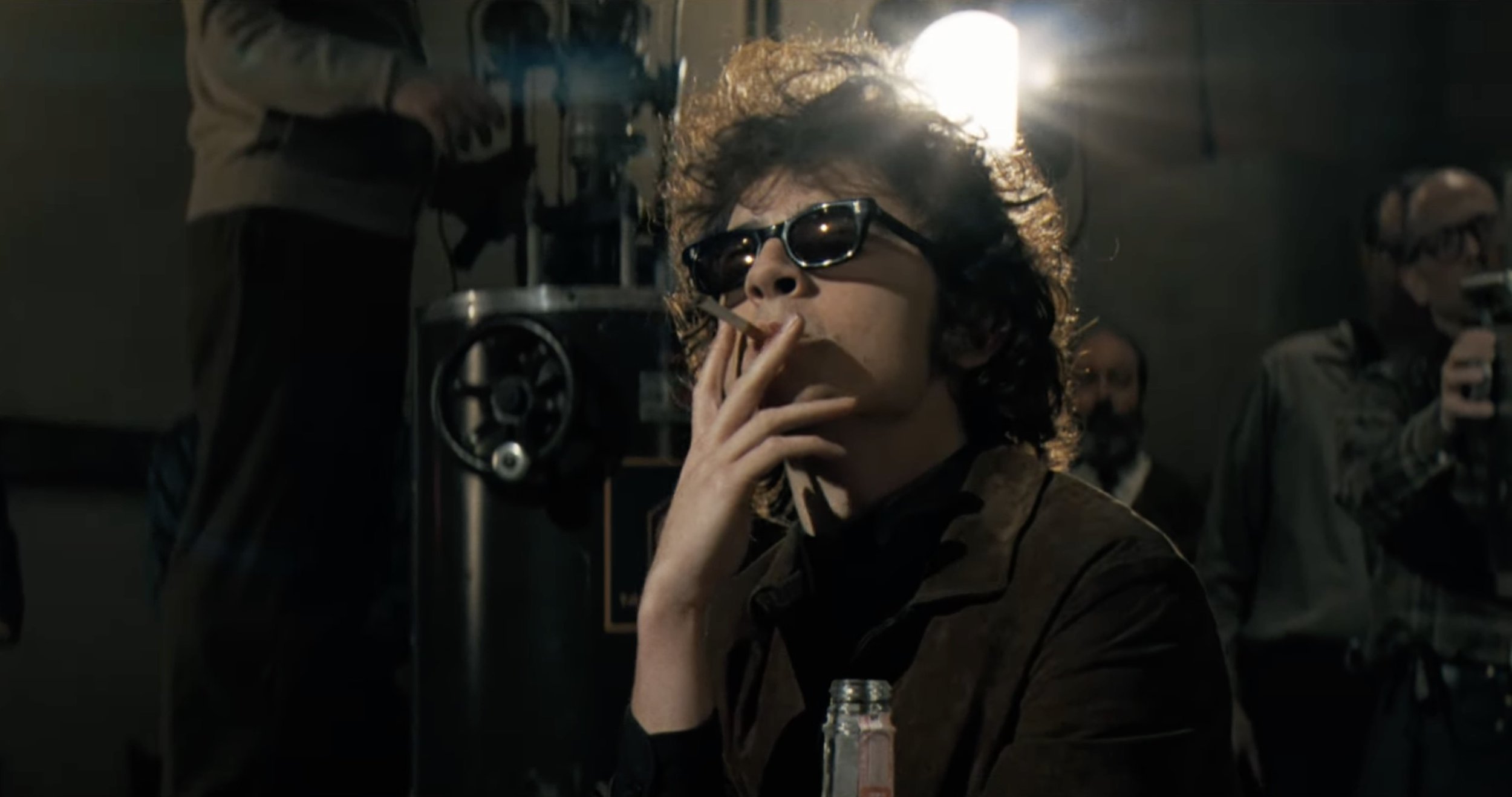
If I wanted to show someone a movie that captured the appeal of the enigmatic and mysterious and prickly person of Bob Dylan, beyond just the songs he wrote and sung, I would show them Todd Hayne’s 2007 non-biopic I’m Not There, in which six different actors played Bob Dylan-like characters in different stories (Cate Blanchett as the sunglasses hipster Dylan who goes electric is the stand out of the film and received a Supporting Actress Oscar nomination). Director James Mangold’s Bob Dylan biopic, A Complete Unknown, based on the book Dylan Goes Electric by Elijah Wald, is a very well-made and entertaining, if standard feeling, film about the musician. This is technically a biopic, but it is less a biography than a dramatization of some of the events in Bob Dylan’s career from his beginnings in 1961 through the infamous and consequential Newport Folk Festival in 1965 where Dylan famously, or notoriously, “went electric.” 
Young Bob Dylan (Timothee Chalamet) arrives in New York to meet the legendary Woody Guthrie (Scoot McNairy) at a hospital so empty and bleak it reminded me of the hospital where Michael Corleone had to save his comatose father from hitmen in The Godfather. (Guthrie had Huntington’s Disease but I don’t remember if this is mentioned). Guthrie’s regular visitor Pete Seeger (Edward Norton) is there and offers the young musician a place to stay and introduces him to the burgeoning folk music scene. There is nothing of Bob Dylan before he arrives in New York. This isn’t an attempt to explain or understand Dylan—neither the real Dylan nor fans then or now would want that because the mystique, the poetic enigma, is the appeal of not Bob Dylan, but “Dylan.” They’re right of course. There are no scenes showing how or why he came up with his songs; such scenes would be hacky and feel blatantly false. A true feeling moment happens when Dylan confesses that he hates talking about his music because when people ask “where do your songs come from?” they’re really asking, why didn’t they come to me? An annoying moment comes when Sylvie (Elle Fanning, playing a composite character) finds a scrap of paper with lyrics from The Times They Are A Changin’ and recites them to a bashful Dylan. 
Whether he’s an annoying jerk (if you don’t want to be recognized then maybe comb your distinctive hair differently when you go out?) or a brilliant, innovative musician, Timothee Chalamet gives a great performance. He performed all of the songs live to camera, at the urging of co-star Edward Norton, and does a great job sounding like Bob Dylan, speaking and singing, without approaching parody. More importantly, he is believable as the kind of person who other people project their desires and aspirations onto and made people want to collaborate with him, be his mentor, his friend, his lover, even if he treated them poorly. Chalamet’s Oscar nomination may have been a foregone conclusion before the movie was even released, but it is still deserved. 
As good as Chalamet is, the real standouts are his co-stars, specifically Monica Barbaro as Joan Baez and Edward Norton as Pete Seeger, both of whom have also received Oscar nominations in the Supporting categories. Barbaro’s performance is especially noteworthy because this movie is so harsh to her character. In their scenes of conflict, as lovers or collaborators, the movie is firmly on Dylan’s side; after all he is the musical genius and she is just a singer (the movie’s sentiments, not my own). 
Norton’s great success with his portrayal of Pete Seeger, more than performing the music, also live, is in making his unbelievably kind and positive version of Seeger believable. Norton hasn’t played a character this optimistic and positive since Sheldon Mopes in Death to Smoochy, where he played another kind character who believed that music could change the world. 
James Mangold also directed the great Johnny Cash biopic Walk the Line (2005), a film so good that it could only be topped by the brilliant music biopic parody to end all music biopics, Walk Hard: The Dewey Cox Story, but the problem is that Hollywood kept making music biopics, A Complete Unknown included. As a Johnny Cash fan, the moments that made me perk up were the scenes of Dylan exchanging letters with Cash–I immediately recalled the scene in Walk the Line where Cash can’t remember what he did with the letter to that “young folk singer” because he wrote it on a paper bag because when he was drunk. I nodded approvingly. Much easier to notice is Mangold recycling an entire scene from Walk the Line in which Cash and June Carter play Dylan’s It Ain’t Me Babe while Cash’s wife Vivian looks on with heartbreak and anger. Here Dylan and Baez sing It Ain’t Me Babe while Elle Fanning’s Sylvie looks on, but emotions just aren’t there. Another element of Walk the Line that Mangold reuses, but to positive effect, is shooting concert scenes from the stage or backstage allowing for the spotlights to create brilliant silhouettes. 
Johnny Cash shows up at the 1965 Newport Folk Festival where Dylan is about to displease the organizers and most of the audience when he “goes electric” and changes music history. Boyd Holbrook gives a great performance as Cash, playing him somewhere between comic relief and as an alternative mentor–someone who also bounced between genres while maintaining a rebel persona. He holds out his guitar to Dylan and Dylan taking it won me over. So Dylan wins again.
Dylan sours on Seeger and Baez because he has outgrown the whole folk scene, but no explanation or catalyst is given, just a jump in time and change of clothes and hair. The unknowability of “Dylan” becomes like a crutch because any flaw in Dylan’s character or change in behavior can be chalked up to the “unknowable genius” angle. Yes, no one can pin down why a creative person is creative, but at a certain point that becomes a cop out. You can probably guess what the final image of the movie will be; Mangold tries to draw it out and then, yes, it happens, epilogue cards and all.
Nominees: Fred Berger, James Mangold and Alex Heineman, Producers
Director: James Mangold
Screenplay: James Mangold and Jay Cocks; based on Dylan Goes Electric! by Elijah Wald
Cast: Timothée Chalamet, Edward Norton, Elle Fanning, Monica Barbaro
Production Companies: Searchlight Pictures, Veritas Entertainment Group, White Water, Range Media Partners, The Picture Company, Turnpike Films
Distributor: Searchlight Pictures
Release Date: December 25, 2024
Total Nominations: 8 including Best Picture
Other Nominations: Director-James Mangold; Actor-Timothée Chalamet; Supporting Actor-Edward Norton; Supporting Actress-Monica Barbaro; Adapted Screenplay-James Mangold and Jay Cocks; Sound-Tod A. Maitland, Donald Sylvester, Ted Caplan, Paul Massey and David Giammarco; Costume Design-Arianne Phillips

Wednesday, January 25, 2023

Best Pictures #80: 2021 (94th) Academy Awards Best Picture Nominee: Dune (2021)

 by A.J. 

Best Pictures #80:
2021 (94th) Academy Awards Best Picture Nominee

 “Fear is the mind killer.”
Frank Herbert’s 1965 epic science-fiction/fantasy novel Dune has long been considered by many to be unfilmable. The fabulous documentary Jodorowsky's Dune details the attempt by cult filmmaker Alejandro Jodorowsky to adapt the novel. David Lynch’s 1984 version flopped on every front and, despite the cult following it has since built, seemed to prove the novel’s unfilmableness. Now, director Denis Villeneuve also proves that Dune is unfilmable, but in a different way. This version, co-written by Jon Spaihts, Denis Villeneuve and Eric Roth, adapts only half of the novel. However, it did succeed in creating a film that was a massive hit with critics and audiences. A sequel to adapt the rest of the novel was quickly greenlit. Dune (2021) is undeniably a great technical achievement but I was underwhelmed by the characters and story and suspect I only understood the plot and world of Dune because I had recently read the novel and had seen the David Lynch version.  
The plot, in its simplest form, is as follows: In the year 10191, the House of Atreides, led by Duke Leo Atreides (Oscar Isaac) is given charge of the desert planet of Arrakis, also called Dune, source of the spice-melange, a narcotic that makes space travel possible. The former ruling family, led by the evil Baron Harkonan (Stellan Skarsgard), springs a trap that sends the duke’s son, Paul Atreides (Timothee Chalamet) and wife, Lady Jessica (Rebecca Ferguson), a member of a mystical spiritual order, into the unlivable deserts of the planet only sparsely populated by the native Fremen people and giant sandworms. 
It’s no surprise that Dune received Oscar nominations for Sound and Visual Effects. The “thropter” aircrafts are particularly memorable and overall the visual effects blend CGI well with the practical elements of just about any scene. However, the Costume and Production Design nominations are more perplexing. The color palette is nearly monochromatic; everything is a shade of brown or beige or yellow. Many of the costumes are black, which doesn’t seem like a good color for the desert, and the interiors are large chambers that might be more impressive if they weren’t so empty.
Before arriving on Arrakis, Paul began having visions and may be the chosen one of ancient prophecies. Timothee Chalamet does a good job as the gifted but inexperienced Paul. Stellan Skarsgard, channeling Marlon Brando as Colonel Kurtz from Apocalypse Now–he even emerges from shadows with water dripping over his bald head–is plenty villainous as Baron Harkonen. Rebecca Ferguson and Oscar Isaac also give good performances, yet I wasn't especially attached to any of the characters. Though the screenplay takes its time with only half of the novel, the film still feels like it is trying to cram in and explain a lot, leaving little time for characters to breathe or intrigue to grow. 
There is enough of a quasi-conclusion that you feel satisfied when the credits roll, though it is clear that the story is not over. I suppose I will watch the sequel/continuation when it is made, but I’m in no rush. However, I don’t think I’ll rewatch this version of Dune before I do; Denis Villanueve’s Dune isn’t a place I would like to revisit. This is a serious, humorless film that not only takes itself very seriously but demands you take it very seriously as well. That is hard to do when so much about the world Frank Herbert created is kind of weird and even silly (in this version we do not see the rhythmless walk Paul and Lady Jessica must do to not attract the worm). David Lynch’s adaptation, for all its flaws, embraced that weirdness and never tried to be “cool.” It took itself seriously but never asked that of the audience, which allows it to be fun. David Lynch’s Dune is a place I have been to many times.  
Nominees: Mary Parent, Denis Villeneuve, Cale Boyter, producers
Director: Denis Villeneuve
Screenplay: Jon Spaihts, Denis Villeneuve, Eric Roth
Cast: Timothée Chalamet, Rebecca Ferguson, Oscar Isaac, Josh Brolin, Stellan Skarsgård
Release Date: October 22nd, 2021
Production Companies: Legendary Pictures
Distributor: Warner Bros. Pictures
Total Nominations: 10, including Best Picture
Wins: 6) Cinematography-Greig Fraser; Editing-Joe Walker; Original Score-Hans Zimmer; Production Design-Patrice Vermette (production design), Zsuzsanna Sipos (set decoration); Visual Effects-Paul Lambert, Tristan Myles, Brian Connor, Gerd Nefzer; Sound-Mac Ruth, Mark A. Mangini, Theo Green, Doug Hemphill, Ron Bartlett
Other Nominations: Adapted Screenplay-Jon Spaihts, Denis Villeneuve, Eric Roth; Costume Design-Jacqueline West, Bob Morgan; Makeup and Hairstyling-Donald Mowat, Love Larson, Eva Von Bahr

Monday, February 3, 2020

Best Pictures #57: 2019 (92nd) Academy Awards Best Picture Nominee: Little Women (2019)

by A.J.

Best Pictures #57
 2019 (92nd) Academy Awards Best Picture Nominee

“I'm so sick of people saying that love is just all a woman is fit for.”
With Little Women, first published in 1868, Louisa May Alcott crafted a story so nearing perfection that not only has it become a classic, but it is difficult to mess up when retelling it. The fourth big screen adaptation Alcott’s novel, written and directed by Greta Gerwig, finds a fresh approach to the lives of the March sisters without making any major changes to the well-loved story. Gerwig uses a flashback structure, a steady and lively pace, equally lively performances, and a lovely score by Alexandre Desplat to make this period drama easily engaging to a modern audience. 
Gerwig begins her film near the end of Alcott’s story with Jo (Saoirse Ronan) living in New York trying to carve out a career as a fiction writer. Her sisters are scattered and wrapped up in their adult lives. Meg (Emma Watson) is raising a family and keeping a house while struggling with money. Amy (Florence Pugh) is learning painting in Europe. Only selfless and caring Beth (Eliza Scanlen) remains with their parents at the March family home in Massachusetts. Then the film flashes back to where to the novel and other film versions begin, with the sisters as adolescents living together under one roof with their mother, Marmie (Laura Dern, with infinite patience and warmness and wisdom). Their father is away serving with the Union army in the Civil War. It is seven years before we began with Jo living in New York.
There is real joy and emotion in the scenes of the March sisters together (that’s the appeal of watching any version of Little Women) but we get time with each of the sisters on their own. We get to know them as individuals and are privy to what is in their minds and hearts. Gerwig put together a fine ensemble but Saoirse Ronan and Florence Pugh have been singled out by the Academy with Oscar nominations in the Lead and Supporting categories, respectively. This is no surprise since Jo and Amy are the two showy roles.
Ronan brings just the right kind of energy to the rebellious, strong willed, sometimes abrasive, but always charming, Jo. She is full of life and personality without becoming a caricature. On the other hand, I found Florence Pugh’s performance as the youngest sister Amy (a child when the novel begins) so broad as to be distracting. Pugh plays Amy throughout the film, but the younger Amy’s behavior and actions have not been altered in any significant way. So, in the flashbacks we see an adult Florence Pugh speaking and acting like a child even though she looks like a teenager at the youngest (even with her Cindy Brady haircut). This unfortunately makes the younger Amy come off as odd and extra bratty.
Timothèe Chalamet is a perfect fit for the role of Laurie, the dreamy and charming boy next door destined to be intertwined with the March sisters. Chalamet brings a lively physicality to his performance, moving his long, slender body with a lilt that matches the energy of the movie. In smaller but no less entertaining roles are Meryl Streep and Tracy Letts. Streep plays the intimidating and acerbic Aunt March, who is rich enough to be able to speak her mind. She is full of 19th century quips and zingers that are delivered wonderfully. Letts plays a grumpy New York publisher that is willing buy Jo’s stories if they are spicy and if Jo’s female main characters get married at the end, or die. Jo’s conversations with him are entertaining but also come right up against being too meta for the movie's own good (if you weren’t sure about Jo being a stand-in for Alcott, these scenes leave no doubt).
I have to admit that as much the jumps back and forth in time work for the overall structure of the film some of the cuts are not immediately apparent and it takes a moment to figure out where you are in the timeline. Once you get into the rhythm of the pacing, however, you’ll find yourself caught up in the film’s enthusiasm and love for its characters. Right from the start this version of Little Women lets you know that it is not a pageant, not just another recreation of a familiar story, but a new perspective on a classic story that gets to the core of what makes this story timeless. The climax of Gerwig’s adaptation, is not whether or not Jo gets married and to whom, but how she is able to stay true to herself and her dreams and her family.
Nominees: Amy Pascal, producer
Director: Greta Gerwig
Screenplay: Greta Gerwig, based on the novel by Louisa May Alcott
Cast: Saoirse Ronan, Emma Watson, Florence Pugh, Eliza Scanlen, Laura Dern, Timothée Chalamet
Production Companies: Columbia Pictures, Regency Enterprises, Pascal Pictures
Distributor: Sony Pictures
Release Date: December 25th, 2019
Total Nominations: 6, including Best Picture
Other Nominations: Actress-Saoirse Ronan; Supporting Actress-Florence Pugh; Adapted Screenplay-Greta Gerwig; Costume Design-Jacqueline Durran; Original Score-Alexandre Desplat