Showing posts with label surreal. Show all posts

Wednesday, October 22, 2025

13 Nights of Shocktober: Mulholland Drive

by A.J.

Night 4: David Lynch Memorial Night
“I hope that I never see that face, ever, outside of a dream.”

Earlier this year the great David Lynch passed away at the at age of 78 and his loss was greatly felt by fans and cinephiles. I never considered myself a fan but his death affected me more than I expected. It wasn’t until relatively recently that I came to appreciate his films and style. I think what really helped was that I realized his films are not puzzles to be solved. There are no answers because that was never the point. The point was what the experience made you feel. There was something very sincere and even endearing in the experience that he wanted to give the viewer.

Of all his notable films, Mulholland Drive has come to be regarded as Lynch’s masterpiece, at least by film critics. In terms of indecipherableness, Mulholland Drive rests in a sweet spot between being frustratingly incomprehensible like Inland Empire or Lost Highway and being relatively straight forward with some oddness here and there like Blue Velvet or Wild at Heart. I don’t mean to suggest that Mulholland Drive is decipherable but it is certainly less intimidating than the 3-hour surreal odyssey of Inland Empire. Mulholland Drive may not technically be a horror movie but it is frightening at times and unsettling throughout. The first time I saw it was late at night and it so unnerved me that I did not want to go to sleep. 
The plot oscillates between a fun amateur detective story and a strange, dark Noir. Naomi Watts plays fresh faced Betty who has just moved to Los Angeles to pursue her dream of being an actress. She is so impossibly innocent and kind hearted that when she finds another woman (Laura Harring) showering in her aunt’s vacant apartment she assumes the woman is a friend of her aunt. Actually the woman doesn’t know who she is but we know she barely escaped being murdered and was in a bad car accident. She calls herself Rita after a poster of Rita Hayworth and Betty befriends her and becomes determined to find out Rita’s lost identity. There is also the plot involving Adam (Justin Theroux), a young movie director being forced to cast a specific actress by mysterious men in suits. The plots do converge though not in a conventional way. 
What makes this a horror movie, more than any of the surreal, frightening imagery are the ideas at play. Dreams, nightmares, and what is really real loom large and foreboding over Mulholland Drive; not being sure which is which seems to be the main theme of the movie, at least for me. If you ever wondered what it is like to be trapped in a dream or not know whether you are awake or dreaming, this is a good example. Lynch rejected being labeled a surrealist, though that is the easiest way to describe his approach to films and television. Of course, the best adjective is Lynchian, though you have to watch a few of his movies before you understand what that entails, and even then the term has been defined only loosely. Lynchian can refer to how his films often presented a seemingly idyllic setting only to reveal the dark secrets and hidden violence known but not spoken of (Blue Velvet is a good example of this). It can refer to nightmarish but captivating imagery mixed with the mundane (Eraserhead, Lost Highway). It can refer just to the overall ominous mood that dominates whatever is on screen no matter how cheery or mundane it may seem. More than a story or theme, it is a mood or feeling that Lynch wants his films to convey. 
The scariest moment happens in a seemingly unrelated scene with minor characters. Dan (Patrick Fischler, a character actor who you’ll recognize even if you don’t recognize the name) meets with a friend at Winkie’s Diner and tells him about a dream. In the dream he is at Winkie’s Diner with that friend who is standing in line to pay and he is terrified and realizes that there is a “man” behind the restaurant making him scared. Dan brought his friend there to prove to himself that there is nothing to the dream. Then the friend gets up to pay and Dan realizes that the dream is happening. They go outside behind the restaurant and what happens is maybe the most effective jump-scare in film history, even though, like Dan, you know what is going to happen. Did he make the dream come true? Was he having the dream again? His experience is the same whether what happens is real or not, so does it matter? This dilemma reflects Betty’s experience, even in the surreal third act. It also reflects a real life fear that many people have, that in trying to find comfort in disproving something they make it true. 
Mulholland Drive began as a TV pilot for ABC, the same network that produced Lynch’s beloved and classic series Twin Peaks, but the network canceled the pilot after an illfated early morning preview. After a year of negotiations, Lynch secured additional funding from the French production company Canal+, wrote 18 additional pages, reassembled the cast, and turned the failed pilot into a movie. You can probably guess the point where the pilot ends and the additional scenes begin. Yet, this provides another possible point for where dreams or reality stop, or start. A TV pilot typically contains many starting points for a series to expand upon in later episodes. This happens here but not every character or plot is expanded  or tied together, at least not in a conclusive way. My favorite of these false starts is the inept hitman. The most disturbing is the character of the Cowboy who meets with Adam the director and tells him, “Now... you will see me one more time, if you do good. You will see me... two more times, if you do bad.” 
You’ll hear or read that the first two thirds of the movie are a dream and the final third is the nightmarish reality. Of course the first two thirds could be a reality unrecognizable to us and the final third is a nightmare, quotidian and grim by comparison. Maybe the dream had a nightmare? One of the very first images we see is someone under bedsheets. Is everything after a dream? Was it Betty in bed? Or Rita? Or Diane? Or Camilla? Even Adam? Lynch, famously, would never answer direct questions about the meaning of his movies. When asked about symbolism or meaning of
Mulholland Drive he would wryly answer with statements like “I think you know” or respond to an interpretation with a simple and definitive but polite, “No.” He began his career as an artist and painter, then an avant-garde experimental filmmaker before making his first feature, Eraserhead. I think understanding Lynch’s career path goes a long to way to understanding not the meaning but the purpose of his films. He created the work, set it out, and it is up to the viewer to provide the interpretation.

Mullholland Drive is available to rent on AppleTV and Fandango At Home. It is also available on DVD & Blu-ray from the Criterion Collection and probably at your local library.

Thursday, October 26, 2023

13 Nights of Shocktober: Twixt (2011)

 by A.J.

Night 8: Ghost Story Night
“Our work must be the grave that we prepare for its lovely tenant.”

My podcast The Directors’ Wall, co-hosted by Bryan Connolly, recently wrapped up season 2, covering the career of Francis Ford Coppola and we ended on a high note with Coppola’s most recently released film, Twixt, which we both enjoyed very much. We also reviewed Coppola’s re-edit titled B’twixt Now and Sunrise: The Authentic Cut. While both begin the same, major changes to the ending give B’twixt a more open ended “arthouse” conclusion (or lack thereof). The emphasis is on the main character’s emotional journey to confront the tragedy in his past and the horror plot is downplayed. Coppola’s original cut of Twixt, we both agreed, captures the character’s emotional journey while also being a lively and fun horror movie. Currently, only B’twixt is available to stream, but Twixt, if you can find it, is the version we both recommend. Our discussion contains major spoilers, but if you don’t mind (or care) or think it might peak your interest please give it a listen on Apple Podcasts, Google Podcasts, Spotify, or our website.

A brief spoiler-free summary and review:
Released in 2011, Twixt marked Coppola’s return to the horror genre for the first time since Bram Stoker’s Dracula in 1992. Twixt tells the tale of third-rate horror novelist Hall Baltimore, played by Val Kilmer, who stops on his book tour in a small town with a dark past and a recent mysterious murder. The local sheriff, played by Bruce Dern, thinks that the murder is tied to a group of goth teens, led by Alden Ehrenreich, who he believes are vampires, and wants to collaborate with Hall on a book about the murder. Hall is desperately in need of money, so he reluctantly agrees. 
Coppola effectively creates an eerie atmosphere through striking dream sequences, encounters with strange characters, and touches like the body in the morgue with a giant stake still stuck in it and the seven-faced clock tower that tells seven different times. The dream sequences are what really make the movie. They are not so much in black and white as they are drained of color, except for certain things like a red carpet or yellow lantern. In these dreams Hall wanders in the woods and meets V (Elle Fanning), a ghost and victim of the long ago murders. In the dreams Hall is also visited by Edgar Allan Poe, played wonderfully by Ben Chaplin, who discusses writing techniques, the nature of tragedy and melancholy, and also reveals the secrets of the terrible murders that happened in the town decades before. There are also some funny moments like Hall’s video calls to his wife and then his publisher and an out of control Ouija board session. These scenes add in some comedy without turning the movie into a horror-comedy.
Twixt is not especially violent and not especially scary, but it is eerie and creepy and entertaining and the kind of movie you should settle in with on a Shocktober night.

Thursday, October 20, 2022

13 Nights of Shocktober: Picnic at Hanging Rock

 by A.J.

This is my favorite time of year, second only to Christmas. Autumn has arrived, the weather is cooling down, and October becomes the month-long celebration of scary movies called Shocktober. So, for the days leading up Halloween I’ll be posting some horror movie recommendations to help you celebrate Shocktober.

Night 2: Mystery Night
“That’s just the trouble. Nobody knows what happened.”
Picnic at Hanging Rock (1975) is not technically a horror film but it is a haunting and unsettling film. It is a mystery with an eerie tone, a mixture of ethereal beauty and dread that lingers long after the credits roll. There is no psycho-killer or monster and only the vaguest hint of the supernatural. The horror of Picnic at Hanging Rock comes from the slow realization by the characters and audience that no solution exists. The existence of the unknown is brought to the forefront, and fear of the unknown is one of the oldest fears in humankind.
To describe the plot of Picnic at Hanging Rock is, in one way, to give away all that happens in the movie. In Australia on St. Valentine’s Day, 1900, a group of students and their chaperones from an all-girls boarding school go on a picnic to Hanging Rock. Some of the girls go exploring the Rock, a series of stony volcanic formations jutting up out of the earth. Three of the girls and one of the teachers go missing. One of them is found a week later completely unscathed but with no memory of what happened. The rest are never seen again. However, this description does not do justice to what makes this such a beguiling and unique mystery picture. 
Every cinematic element (cinematography, score, sound design, editing, performances, costumes) works to sustain a subtle, surreal atmosphere without calling attention to technique. The two most striking and unforgettable elements of Picnic at Hanging Rock are the sun-drenched, soft-focus cinematography by Russell Boyd, who won a BAFTA award for his work, and the pan flute score which, together, cast a big part of the movie’s spell. Cinematographer Boyd hung a wedding veil over the camera lens to create a diffused backlit look. Sunlight catches in the girls’ hair and white dresses and seems to make them glow. For certain close ups director Peter Weir had the actors remain completely still and unblinking while they were filmed in slow motion. The result is almost an imperceptible effect that the brain cannot immediately interpret but the eye can detect and knows something is amiss.  
The potential of the supernatural exists throughout Picnic at Hanging Rock and the rock itself seems to be potentially supernatural or paranormal. On the carriage ride to Hanging Rock the girls talk about its ancient age and how it has been waiting for them for millions of years. There seem to be faces in the rock and the watches of one of the teachers and the carriage driver stop at exactly noon. Somehow all the most logical explanations of what happened to the girls (kidnapping and murder, trapped in a crevice) also feel like the most unlikely explanations. A definitive concrete explanation wouldn’t just be a disappointment, as the solutions to most mysteries are, it would completely ruin the spell that the film has cast. Even if you figured out why they disappeared you would still have to figure out where they went. 
Picnic at Hanging Rock feels like it is based on a true story but it is not. It is adapted from a novel by Joan Lindsay who based the story on a series of dreams. Like a dream, a big part of the movie’s appeal is the many interpretations and theories that can be applied. The emerging sexuality of the adolescent girls, the repressive nature of the boarding school, the imposition of English customs and culture in a place where they do not belong, the ancient nature of the rock, the young age of girls are all important themes that seem to hint at a reason for disappearance. Much has been written on these themes and others and more could be written still. This is part of why Picnic at Hanging Rock lingered despite its negative reception in 1975.  
For me, the most important scene is a conversation between a male employee of the school and the old groundskeeper. The younger man insists that an explanation will be found and lists theories, some logical, some illogical. The groundskeeper asks the younger man if he knows that there are plants that can move. The younger man shakes his head and the groundskeeper shows him a plant whose leaves close rapidly after they are touched. The younger man is left in stunned silence. The groundskeeper says, with plain, unadorned wisdom, “There’s some questions got answers and some haven’t.”

Picnic at Hanging Rock is streaming on HBOmax and The Criterion Channel. 

Thursday, October 28, 2021

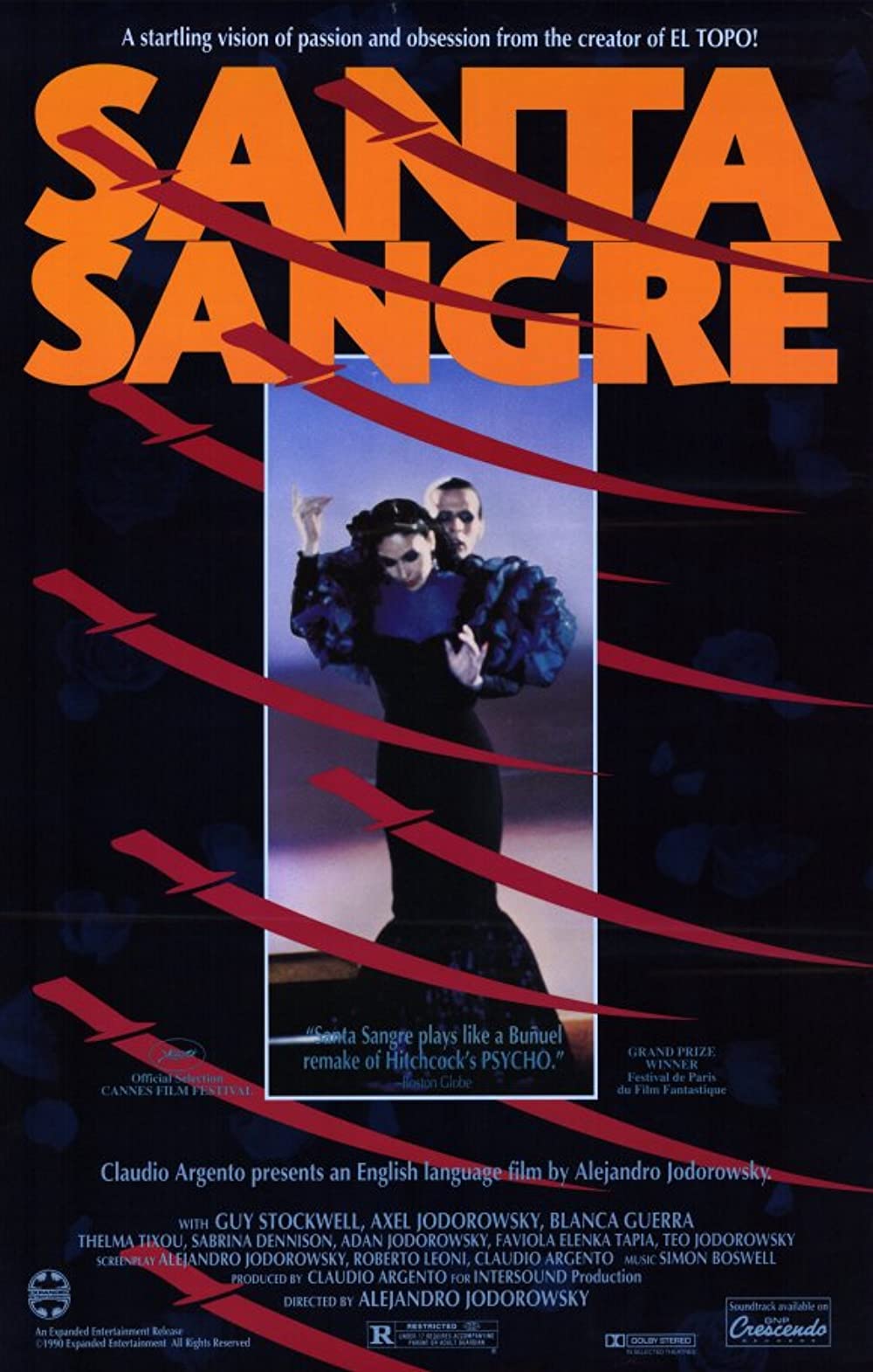
13 Nights of Shocktober: Santa Sangre

 by A.J.

This is my favorite time of year, second only to Christmas. Autumn has arrived, the weather is cooling down, and October becomes the month-long celebration of scary movies called Shocktober. So, in the days leading up Halloween I’ll be posting some horror movie recommendations to help you celebrate Shocktober.

Night 10: Surreal Horror Night “My hands…my hands.”
It is hard for me to articulate why the films of avant-garde director Alejandro Jodorowsky fascinate and captivate me so much even though many of their defining traits are things that frustrate me in other art films. His films are strange and surreal, heavy on symbolism, magical realism, and absurd and grotesque but striking imagery. They are not subtle about their themes or symbols or attitudes towards politics, or religion, or society in general and aim to challenge artistic and filmmaking conventions. They are also filled with tenderness and sincerity. His films can be described as challenging, but Jodorowsky only means to challenge to audience only up to a point. It feels like his real intention is to change the way we view movies, art, and the wider world so that we can challenge those things together. There is no pretention or condescension in his films, only a welcoming invitation to a new experience and a new perspective. This is especially true of Santa Sangre, one of the strangest and most compassionate films I have seen.
Santa Sangre isn’t exactly a horror film, but it isn’t exactly any other kind of film either. There is violence, drama, humor, cruel characters, bizarre scenes, psychological horror, even elements of a slasher film, but also many moments of great emotion and sympathy. All of this is put together and handled so delicately that it feels like a magic trick.
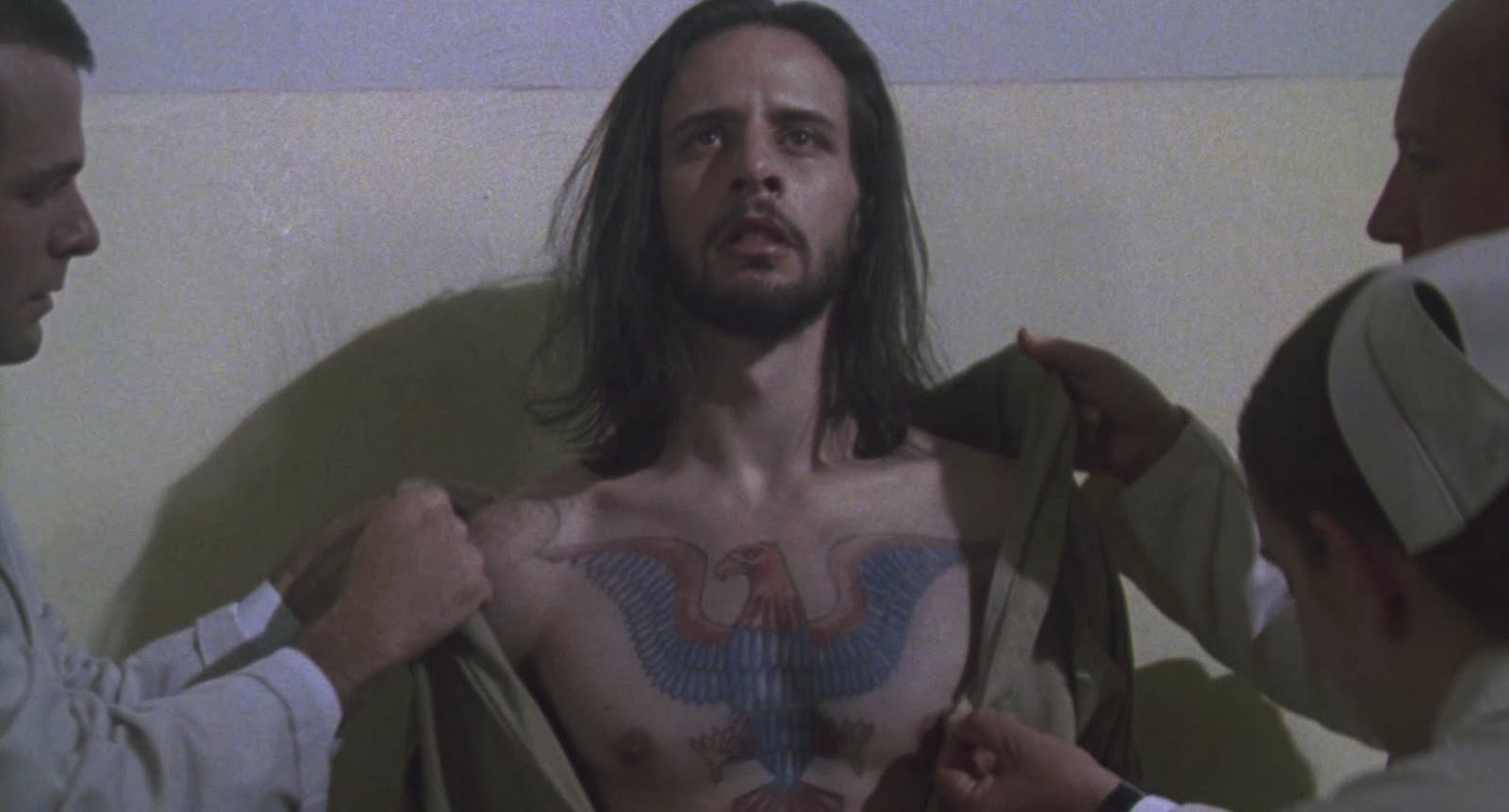
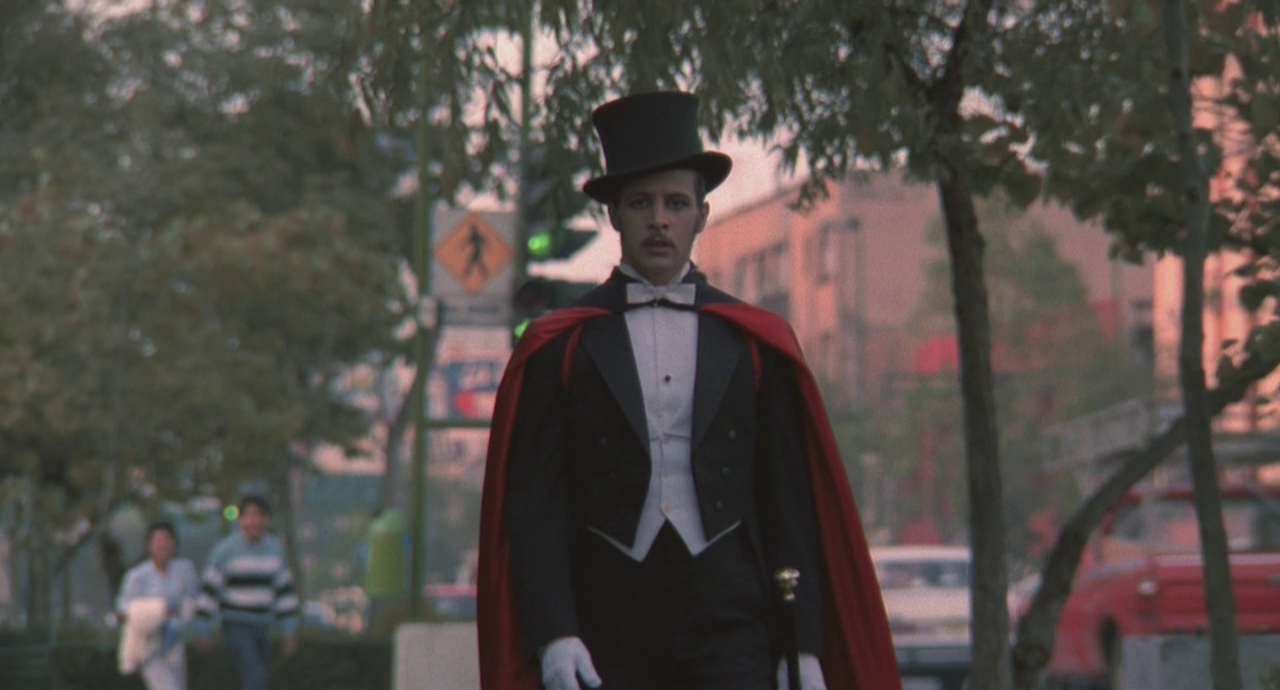
The film opens with image of a nude man posed like bird on an oversized perch in a mental institution. In an extended flashback we see Fenix's traumatic childhood in a circus where he was the boy magician. His mother, Concha (Blanca Guerra), was the trapeze artist and also the leader of a religious sect that worships a saint whose arms were cut off by her rapists. His father, Orgo (Guy Stockwell), was the circus owner and knife thrower. He is crude, excessively macho, and having an affair with the tattooed woman, who is the mother of Fenix’s mute friend, Alma. One night Concha discovers Orgo's affair and throws acid on Orgo's genitals. He cuts off her arms and then cuts his own throat. Somehow, despite all of that, the most traumatic moment of that horrible night is the tattooed woman driving away with Alma in the backseat, her face against the window looking back at Fenix.  They watch each other being separated in a heartbreaking exchange.
When Fenix, now an adult, is beckoned by his mother, he escapes from the mental institution. Hiding behind her, he acts as her arms and hands in a stage show and also in their private moments. In these scenes the actors have so well-choreographed their movements that Concha really does seem to be controlling his hands and Fenix seems to know beforehand what Concha wants to do. Concha’s control over Fenix is domineering and somewhat mystical. Through controlling him psychologically she controls him physically, and this is how she exacts her revenge.
The first slashing is, like many things in this movie, a paradox: it is gruesome but also hokey. The victim stands behind a sheer curtain and a knife wielding hand stabbing in a cliched, mechanical motion. Bodies pile up, but unlike a slasher movie, the kill scenes are not the crux of the movie. Concha’s desire for complete control over her son results in any other woman being a threat. The slashings are a result of the horror and trauma Fenix has suffered and continues to suffer, so he is able to draw our sympathy even though he is also a murderer.  
This is a movie where a funeral march through town square for an elephant that ends with the elephant corpse being thrown into a canyon were residents of a shantytown cut it up for food is a footnote to the actual plot. Fenix paints the body of a victim white and buries her in a grave that glows and a bird rises out. A scene of a group of patients from the institution being taken to a red-light district with drugs and sex workers actually turns out alright. A large, muscular trans-woman wrestler turns out to be a gentle soul. Every scene contains something unexpected.
Santa Sangre was written by Jodorowsky, Robero Leoni, and Claudio Argento (brother of Italian filmmaker Dario Argento). I suppose this is technically a slasher movie, but it is a slasher movie as only Jodorowsky could make. It doesn’t feel like a traditional horror movie because of its emphasis on emotion and sympathy for its main character. Adult Fenix is played by Axel Jodorowsky, Alejandro’s son, and he does an amazing job playing a tortured, conflicted character. He is a gentle soul and you want desperately for him to be treated as such and be freed from his trauma. There are horror movies that have strong characters, likeable characters, characters you root and cheer for, but I don’t think there is another horror film that loves its main character as much as Santa Sangre loves Fenix, and that love is contagious.    
So why recommend Santa Sangre for Shocktober if it is not exactly horror movie? Well, if this movie is a magic trick, then I guess I want other people to see the trick. Santa Sangre is a dark fairy tale. No matter how bizarre or surreal, we accept the sights we see because they serve something more that just the images. Fairy tales use harsh situations and grim scenarios to teach a simple lesson or moral. So too does Santa Sangre use its garish, striking, but always memorable imagery and scenarios to convey something so simple we can only accept it if it is wrapped up in fantasy. At the climax there is a reveal that may not be a surprise but it is not meant to be. It is a revelation for Fenix and as such is deeply satisfying. It’s the moment we’ve been waiting for. What a unique character study. What a gentle and loving movie. The world is cruel and there are cruel people but kindness and love can still exist and we need not be cruel to ourselves; that only leads back to cruelty to others. This is a beautiful film, a reaction I’ve had only a handful of times.