by A.J.
Best Pictures #109: 2024 (97th) Academy Awards Best Picture Nominee
“Don’t think twice, it’s alright.”

If I wanted to show someone a movie that captured the appeal of the enigmatic and mysterious and prickly person of Bob Dylan, beyond just the songs he wrote and sung, I would show them Todd Hayne’s 2007 non-biopic I’m Not There, in which six different actors played Bob Dylan-like characters in different stories (Cate Blanchett as the sunglasses hipster Dylan who goes electric is the stand out of the film and received a Supporting Actress Oscar nomination). Director James Mangold’s Bob Dylan biopic, A Complete Unknown, based on the book Dylan Goes Electric by Elijah Wald, is a very well-made and entertaining, if standard feeling, film about the musician. This is technically a biopic, but it is less a biography than a dramatization of some of the events in Bob Dylan’s career from his beginnings in 1961 through the infamous and consequential Newport Folk Festival in 1965 where Dylan famously, or notoriously, “went electric.”

Young Bob Dylan (Timothee Chalamet) arrives in New York to meet the legendary Woody Guthrie (Scoot McNairy) at a hospital so empty and bleak it reminded me of the hospital where Michael Corleone had to save his comatose father from hitmen in The Godfather. (Guthrie had Huntington’s Disease but I don’t remember if this is mentioned). Guthrie’s regular visitor Pete Seeger (Edward Norton) is there and offers the young musician a place to stay and introduces him to the burgeoning folk music scene. There is nothing of Bob Dylan before he arrives in New York. This isn’t an attempt to explain or understand Dylan—neither the real Dylan nor fans then or now would want that because the mystique, the poetic enigma, is the appeal of not Bob Dylan, but “Dylan.” They’re right of course. There are no scenes showing how or why he came up with his songs; such scenes would be hacky and feel blatantly false. A true feeling moment happens when Dylan confesses that he hates talking about his music because when people ask “where do your songs come from?” they’re really asking, why didn’t they come to me? An annoying moment comes when Sylvie (Elle Fanning, playing a composite character) finds a scrap of paper with lyrics from The Times They Are A Changin’ and recites them to a bashful Dylan.

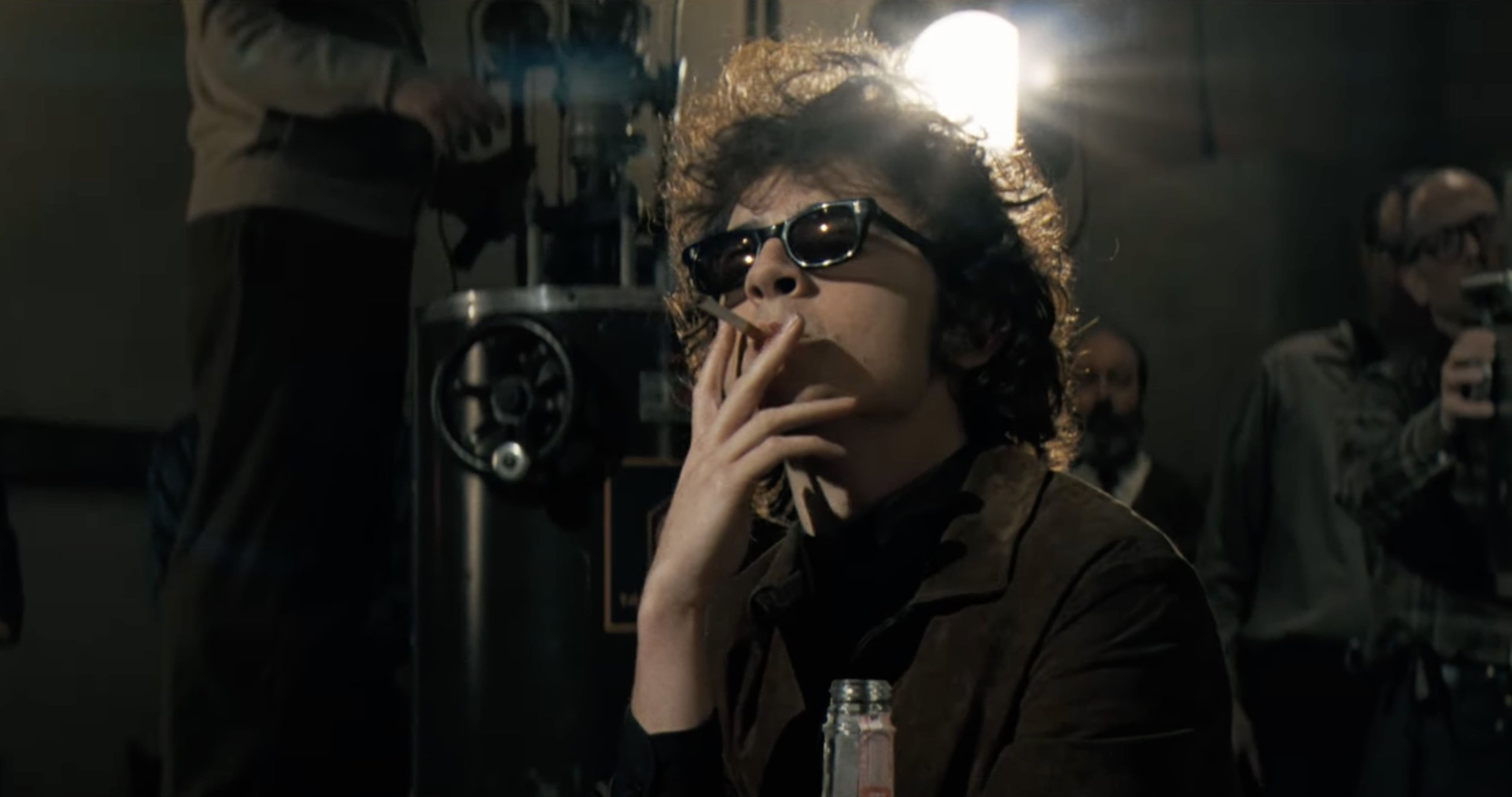
Whether he’s an annoying jerk (if you don’t want to be recognized then maybe comb your distinctive hair differently when you go out?) or a brilliant, innovative musician, Timothee Chalamet gives a great performance. He performed all of the songs live to camera, at the urging of co-star Edward Norton, and does a great job sounding like Bob Dylan, speaking and singing, without approaching parody. More importantly, he is believable as the kind of person who other people project their desires and aspirations onto and made people want to collaborate with him, be his mentor, his friend, his lover, even if he treated them poorly. Chalamet’s Oscar nomination may have been a foregone conclusion before the movie was even released, but it is still deserved.
As good as Chalamet is, the real standouts are his co-stars, specifically Monica Barbaro as Joan Baez and Edward Norton as Pete Seeger, both of whom have also received Oscar nominations in the Supporting categories. Barbaro’s performance is especially noteworthy because this movie is so harsh to her character. In their scenes of conflict, as lovers or collaborators, the movie is firmly on Dylan’s side; after all he is the musical genius and she is just a singer (the movie’s sentiments, not my own).

Norton’s great success with his portrayal of Pete Seeger, more than performing the music, also live, is in making his unbelievably kind and positive version of Seeger believable. Norton hasn’t played a character this optimistic and positive since Sheldon Mopes in Death to Smoochy, where he played another kind character who believed that music could change the world.

James Mangold also directed the great Johnny Cash biopic Walk the Line (2005), a film so good that it could only be topped by the brilliant music biopic parody to end all music biopics, Walk Hard: The Dewey Cox Story, but the problem is that Hollywood kept making music biopics, A Complete Unknown included. As a Johnny Cash fan, the moments that made me perk up were the scenes of Dylan exchanging letters with Cash–I immediately recalled the scene in Walk the Line where Cash can’t remember what he did with the letter to that “young folk singer” because he wrote it on a paper bag because when he was drunk. I nodded approvingly. Much easier to notice is Mangold recycling an entire scene from Walk the Line in which Cash and June Carter play Dylan’s It Ain’t Me Babe while Cash’s wife Vivian looks on with heartbreak and anger. Here Dylan and Baez sing It Ain’t Me Babe while Elle Fanning’s Sylvie looks on, but emotions just aren’t there. Another element of Walk the Line that Mangold reuses, but to positive effect, is shooting concert scenes from the stage or backstage allowing for the spotlights to create brilliant silhouettes.

Johnny Cash shows up at the 1965 Newport Folk Festival where Dylan is about to displease the organizers and most of the audience when he “goes electric” and changes music history. Boyd Holbrook gives a great performance as Cash, playing him somewhere between comic relief and as an alternative mentor–someone who also bounced between genres while maintaining a rebel persona. He holds out his guitar to Dylan and Dylan taking it won me over. So Dylan wins again.

Dylan sours on Seeger and Baez because he has outgrown the whole folk scene, but no explanation or catalyst is given, just a jump in time and change of clothes and hair. The unknowability of “Dylan” becomes like a crutch because any flaw in Dylan’s character or change in behavior can be chalked up to the “unknowable genius” angle. Yes, no one can pin down why a creative person is creative, but at a certain point that becomes a cop out. You can probably guess what the final image of the movie will be; Mangold tries to draw it out and then, yes, it happens, epilogue cards and all.
Nominees: Fred Berger, James Mangold and Alex Heineman, Producers
Director: James Mangold
Screenplay: James Mangold and Jay Cocks; based on Dylan Goes Electric! by Elijah Wald
Cast: Timothée Chalamet, Edward Norton, Elle Fanning, Monica Barbaro
Production Companies: Searchlight Pictures, Veritas Entertainment Group, White Water, Range Media Partners, The Picture Company, Turnpike Films
Distributor: Searchlight Pictures
Release Date: December 25, 2024
Total Nominations: 8 including Best Picture
Other Nominations: Director-James Mangold; Actor-Timothée Chalamet; Supporting Actor-Edward Norton; Supporting Actress-Monica Barbaro; Adapted Screenplay-James Mangold and Jay Cocks; Sound-Tod A. Maitland, Donald Sylvester, Ted Caplan, Paul Massey and David Giammarco; Costume Design-Arianne Phillips


