Showing posts with label The Irishman. Show all posts

Monday, February 10, 2020

Best Pictures #64: 2019 (92nd) Academy Awards: My Pick for Best Picture

by A.J.

Best Pictures #64
The 2019 (92nd) Academy Awards
History was made at the 92nd Academy Awards for films released in 2019. The South Korean film Parasite won Oscars for Original Screenplay, International Film, Director, and, in a historic first, Best Picture. In 1933, The Private Life of Henry VIII became the first non-Hollywood film to be nominated for Best Picture and win an Academy Award (Charles Laughton for Best Actor). In 1938, Grand Illusion made history by becoming the first foreign language film to earn a nomination for Best Picture. A total of 11 foreign language films (or 12 if you include 2006's Babel, which has some scenes in English), including Parasite, over an 80 year time span would earn Best Picture nominations. A foreign film earning a Best Picture nomination is no easy feat, even in the expanded "up to 10 nominees" era, but the contention of these films is usually not taken seriously; that film would win Best Foreign Language Film (now called International Film), and that was that. Until February 9th, 2020. 
The British World War I action thriller 1917 was released at the very tail end of 2019 and quickly earned precursor awards (Golden Globes, BAFTAs). 1917 and and its director, Sam Mendes, took frontrunner status and seemed like locks for the Academy Awards. Parasite was a lock to win the newly renamed International Film category, and Bong Joon-ho and Han Jin-won became favorites to win in the Original Screenplay category (and indeed they did). 
Bong Joon-ho's win for Best Director and Parasite's win for Best Picture were the most pleasing upsets in recent Oscar history. In his acceptance speech for Best Director, Bong Joon-ho honored fellow nominees Scorsese and Tarantino and asked for a "Texas chainsaw" to split the Oscar statue. The audience at the Academy Awards (judging from what I saw on TV) matched my own and doubtless many others: initial shock followed by total delight. The cast and crew of Parasite were noticeably thrilled (it's always great to see people that are actually happy to win an award). Not only was Parasite's win a landmark moment for international cinema and Academy Awards history and film history, but it encapsulated everything that the Oscars could and should be. A brilliantly crafted, superb film that uses every aspect of filmmaking to the fullest was singled out for its achievements drawing even more attention it, and, hopefully, new audiences. And for viewers at home, the ceremony had an actual sense of excitement, as opposed to being a parade of preordained winners from start to finish (though there were some of those too).
 
Overall, the the 9 Best Picture nominees of 2019 were an interesting group. They included period pictures, war films, satires, a literary adaptation, a comic book movie, a crime drama, a divorce drama, and, of course, a foreign film. Except for Joker, they were all strong, entertaining films that I would recommend. I'm glad that a movie that I never would have seen, Ford v Ferrari, picked up a Best Picture nomination (it ended up with well deserved wins for Sound Editing and Film Editing) so that I had to watch it and got to be thoroughly entertained and thrilled by its quality filmmmaking. I am extremely happy that Parasite won as many Oscars as it did, especially Best Picture. The reaction on social media was that the actual best picture of 2019 won Best Picture. Parasite is a superb, one-of-a-kind film. Everything about it works in harmony to excellent results: the screenplay, production design, cinematography, editing, score, performances, and direction. It is timely in its themes but it is never for a moment didactic or pandering. It is a compelling satire and thriller that challenges the audience and genre conventions. It entertains at every moment but also causes us to reflect on our society. That is cinema. That is art. That's the movies at their best. 
As excited and delighted as I am that Parasite won Best Picture and made history, were I a voting member of the Academy I would still have to cast my vote for my favorite film of 2019.
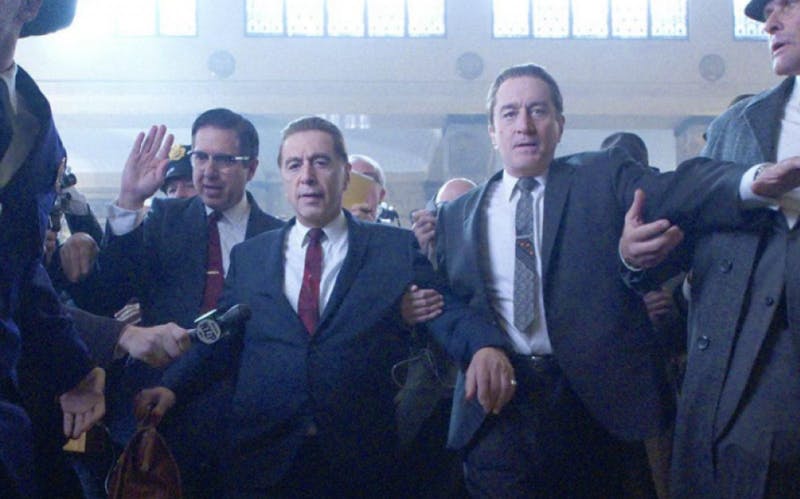
My Pick for Best Picture of 2019: I Heard You Paint Houses (The Irishman)
The great critic and filmmaker Francois Truffaut said (I'm paraphrasing) it is impossible to make an anti-war film because to put anything on film is to ennoble it. Roger Ebert believed that if Truffaut had lived to see Oliver Stone's Vietnam film Platoon (1986) he would have changed his mind. While watching I Heard You Paint Houses (The Irishman) I thought, surely if Truffaut were alive today he would agree that The Irishman in no way ennobles the criminal or the criminal life. Scorsese has been accused of glamorizing the gangsters in his crime movies (Goodfellas, Casino, and, if you count it as a crime movie, which I do, The Wolf of Wall Street), which he does to a point to show the appeal of that life to a certain kind of young person or outsider. Though the main character lives to be an old man (and not in prison), this film feels like a great tragedy from its opening moments. The elderly Frank Sheeran recalls his life, not just his crimes, like it is a confession. Anna Paquin as Frank's adult daughter, Peggy, has only a few scenes and even fewer lines but what she does with those scenes says everything about the kind of person she knows Frank actually is. Paquin does more with a cold, accusing stare than most actors or actresses could do with entire monologues. Joe Pesci was my personal pick for Best Supporting Actor. His performance steals the whole movie. That he came out of retirement for it, and likely will go back into retirement, makes it all the more notable. This film spans an adult life but also history. In the background are major events, like the Bay of Pigs invasion and Watergate break-in, covered in other films like Oliver Stone's JFK and Nixon. 
Yes, this is a very long movie; some of the best films are. I don't think any of The Irishman's effect would be lost by watching it over separate viewings. Being the story of a life over the course of 30 years, it has an episodic feel which would lend it to being watched in parts. Currently, The Irishman is only available for streaming through Netflix, but it was recently announced that the Criterion Collection will be releasing on DVD/Blu-ray later in 2020. I can't wait to actually own this movie. Everything I've said about this film makes it sound like a depressing movie, but I stress that while what happens in the film is depressing, watching the film is not. The Irishman is a masterful achievement that ranks among Martin Scorsese's best films. 

Sunday, February 9, 2020

Best Pictures #63: 2019 (92nd) Academy Awards Best Picture Nominee: The Irishman (I Heard You Paint Houses)

by A.J.

Best Pictures #63 
2019 (92nd) Academy Awards Best Picture Nominee

“It’s what it is.”
Things aren’t stated directly in the mafia. They use codes and euphemisms but everyone involved understands clearly. So, when mob hitman Frank Sheeran is told by his boss and longtime friend, Russell Bufalino, “It’s what it is” about Frank’s other longtime friend and mentor, Jimmy Hoffa, his heart crumbles.  Those words signal a point of no return for everyone involved and set into motion the final hour of Martin Scorsese’s I Heard You Paint Houses, or, The Irishman. It is also the most poignant and compelling hour of filmmaking of any film I saw from 2019. The proceeding two and a half hours, also excellently done, bring the total runtime to 3hours 29minutes. This is Scorsese’s longest film, and, also, one of the best films in the career of one of, if not the, greatest living film directors.
We learn from an elderly Frank Sheeran (Robert De Niro), narrating his life story from a nursing home, that a “house painter” is mafia code for a hit man. De Niro’s narration is quiet and full of reflection and regret. He isn’t narrating so much as confessing. He tells an unseen listener about a road trip he and Russell Bufalino (Joe Pesci) took with their wives to attend a wedding, but the real reason for the road trip was “business.” The story of the road trip acts a spring board to flashback to the 1950’s when Frank went from a union truck driver looking to make extra money to a “house painter” to bodyguard and friend of Teamsters Union president, Jimmy Hoffa (Al Pacino).
The screenplay, adapted by Steve Zaillian from the book I Heard You Paint Houses by Charles Brandt, allows the characters to build their personalities and inner lives through small moments like conversations in cars or restaurants. The back and forth between the actors bring the characters and the movie to life. There are several scenes that are as tense as they are entertaining, especially Hoffa’s meeting with a rival in the teamsters, who arrives late and wearing shorts. It’s the kind of scene that Scorsese specializes in.
De Niro gives one of his best and most “Robert DeNiro” performances. Narration aside, he says as little as he can with as few words as he can, even then stammering over phrases. Emotion is just below the surface of a quiet, stony exterior. Joe Pesci comes out of retirement to give one of his best and most unexpected performances. Unlike the hot head tough guy characters he is most famous for, Pesci as Bufalino is a calm tough guy. He never has an outburst or raises his voice but his aura is no less intimidating. Here, Pesci tries to mediates potentially violent situations. He asks an agitated Hoffa if there’s “another reason” for his actions in such a calm and inoffensive tone you get the feeling that Pesci’s version of Bufalino would have been a good therapist or marriage counselor. Al Pacino is over the top as Jimmy Hoffa but his acting style works because the real-life Hoffa was an outspoken, flamboyant, larger than life personality (Jack Nicholson’s performance as Hoffa in Danny DeVito’s film, Hoffa, is among his most ostentatious). Harvey Keitel, who starred in Scorsese’s first film has a small part as the mafia boss, Angelo Bruno. He sits like a king in his restaurant booth exuding a cool but threatening presence.
The digital de-aging of the actors to make them look up to 30 years younger than their actual ages works well enough; it helps that their ages are never specified. As an effect, the de-aging is far from convincing but not very distracting, except for one shot where young Joe Pesci’s face appears to be floating over his body. The overall effect, however, is no different than dying their hair darker. However, the performances do feel richer for having the same actors in the same roles throughout the film.
Films like Mean Streets, Goodfellas, and Casino (featuring Harvey Keitel, Robert De Niro, and Joe Pesci) have made Scorsese synonymous with the modern gangster picture. Each of those films glamorized the criminal life to a certain extent to show its insidious appeal. There is not a bit of glamour to be found in The Irishman. There is no luxury or appeal to Frank’s lifestyle. When not carrying out hits or driving a truck across the country, he acts as a go-between for Hoffa and the mob bosses trying to diffuse potentially dangerous situations.
The Irishman is an epic film. It sprawls not over picturesque landscapes but a life in crime. It feels episodic, any complete life story would, but it flows smoothly. The doo-wop song “In the Still of the Night” by The Five Satins opens the film and plays more like a dirge than a pop song. It sets the tone for the film perfectly. The brilliant score by Robbie Robertson feels like it grew out of the film’s contemplative, somber tone. This story explores what it means to survive a life of crime and what it leaves a person with. Frank entered the criminal world to make more money to take care of his family, but there are tellingly few scenes of Frank with his family. What was it all for?
This is a long movie and it feels like a long movie—I won’t argue that—but it is also thoroughly engrossing. I was completely immersed in these lives and this world without ever wanting to be a part of them. The first two-thirds of the film builds up emotions so subtly that you are taken by surprise and overwhelmed when those emotions come into play in the final act. When Frank and Bufalino go to prison, the film doesn’t jump over their sentence, we stay with them. Scorsese knows that the real power of this story is to stay with Frank as an old man instead of using a montage or epilogue cards. This biopic of Frank Sheeren is a sad, tragic movie, but it is so well executed cinematically and emotionally that it is a joy to watch. I was reminded of a quote from the great critic Roger Ebert, “No great movie is depressing. All bad movies are depressing”
Nominees: Martin Scorsese, Robert De Niro, Jane Rosenthal, Emma Tillinger Koskoff
Director: Martin Scorsese
Screenplay: Steven Zaillian, based on the book I Heard You Paint Houses by Charles Brandt
Cast: Robert De Niro, Al Pacino, Joe Pesci
Production Companies: TriBeCa Productions, Sikelia Productions, Winkler Films
Distributor: Netflix
Release Date: November 1st, 2019
Total Nominations:10, including Best Picture
Other Nominations: Director-Martin Scorsese; Supporting Actor-Al Pacino; Supporting Actor-Joe Pesci; Adapted Screenplay-Steven Zaillian; Cinematography-Rodrigo Prieto; Costume Design-Christopher Peterson, Sandy Powell; Production Design-Bob Shaw, Regina Graves; Film Editing-Thelma Schoonmaker; Visual Effects-Pablo Helman, Leandro Estebecorena, Nelson Sepulveda, Stephane Grabli