Wednesday, October 28, 2015

13 Nights of Shocktober: Targets

by A.J.  

This is my favorite time of year, second only to Christmas. Autumn has arrived, the weather is cooling down, and October becomes the month long celebration of scary movies called Shocktober. There are a lot of horror movies out there, but as a genre, horror is still looked down upon by some mainstream critics and moviegoers. It doesn’t help that, admittedly, there are so few quality horror movies made but, like comedy, it’s a very difficult and subjective genre. So, in the days leading up Halloween I’ll be posting some recommendations for scary movies to help you celebrate Shocktober.

Night 10: Meta-Horror Night, “You know what they call my films today? Camp! High camp!”

Targets
Targets is a very peculiar film. It is more of a slow burn thriller than a traditional horror movie, but it is partly about horror films and meditates on both horror movies and real life horrors. Targets is director Peter Bogdanovich’s first feature film. He made the film in 1968 for legendary producer Roger Corman, whose only requirements of Bogdanovich was that he use actor Boris Karloff (who owed Corman two days’ work), and use stock footage from Corman’s 1963 film, The Terror (starring Boris Karloff). The story could be about anything. Bogdanovich wrote the screenplay with then wife Polly Platt, who was also the production designer. The result is a dual story, low budget movie that moves slow, but is interesting.
Boris Karloff plays an elderly horror movie legend named Byron Orlok who wants to retire against the wishes of the studio executives and the director of his latest movie, played by Peter Bogdanovich. The movie begins with the stock footage from The Terror (which also stars Jack Nicholson) doubling for footage of Orlok’s latest movie. It is a horror film with a castle, period costumes, and a terrible thunderstorm. It’s the kind of horror movie that Karloff himself made throughout his career, and like the films made by Hammer Films. Orlok is unhappy watching a preview of the film and decides to retire. He says that he feels like an anachronism and says the world belongs to the young. 
The second story is about a seemingly average, normal, clean cut looking young man named Bobby Thompson, played by Tim O'Kelly. He is a veteran and likes to collects guns. We see his home life; he and his wife live with his parents. He starts acting strangely. When out shooting at cans with a friend he lets the sight of his gun linger on the other person while their back is turned. He is distant from his wife and smokes in bed with all of the lights turned out. Then he types a cryptic note in red ink on his typewriter and begins a killing spree. He takes his rifle and some other guns, finds a high place, and starts picking off people.
The stories are not related directly but you know that they will eventually intersect. Bogdanovich works subtly to meld the stories together. The first time we see the Thompson is in a gun shop across the street from where Orlok screened his movie. The young man puts Orlok in his gunsight and lets it linger. It is safe to assume that the two men will have a confrontation at the premiere of Orlok’s movie at the drive-in theater where he will make his final public appearance before retiring. 
You can tell that Bogdanovich really wanted his movie to be 90 minutes long. Scenes play out a bit longer than they should and sometimes that helps the narrative, sometimes it doesn’t. There are several extended scenes of the Bobby Thompson’s average home life as he is becoming slowly and quietly unhinged. These scenes don’t really build character, but when they work, they have you searching for clues for why he’s cracking up. Even then, however, these scenes could still be shorter. The most effective of these lengthy scenes happens when Thompson is up on a refinery tower and unpacks his lunch. It’s an odd, humanizing moment (even psycho killers need to eat too), and it means that he planned ahead enough to pack a lunch, which is unnerving.    
The scenes with Boris Karloff work purely because it is interesting to watch Karloff playing a character loosely based on himself. He spends his scenes either with his assistant contemplating retirement or with Bogdanovich, who is trying to convince him not to retire. I get the distinct feeling that their scenes together exist just because Bogdanovich wanted to hang out with Boris Karloff. I can’t blame him; I would’ve done the same thing. The best scene of Targets by far is of Karloff telling an audience an old ghost story about a man encountering Death.
This movie was made at a time when the country was changing, culture was changing, and all the while the Vietnam War raged in the background. Targets is not explicitly about gun control, mental health, or even Vietnam, though the specter of each looms over every scene. It seems fairly obvious that the young man is based on Charles Whitman, who killed several people from the University of Texas tower in Austin only two years prior. That very year, 1968, would see two American political figures, each a symbol of promise and hope in their own way, gunned down by assassins: Martin Luther King, Jr. and Robert F. Kennedy. If you read books about film history, Targets will likely be in more than one of those books. It is not a landmark film like Rosemary’s Baby or Night of the Living Dead but it is a notable part of the shift that began to occur in horror films in the late 60s.
Up until this time in film history nearly every horror film was set in the past, in a faraway land, or a large spooky house or castle. The most notable exception to this was a few horror films produced by Val Lewton in the 1940s and 50s. That changed in 1968, the same year Targets was released, with movies like Rosemary’s Baby and George Romero's Night of the Living Dead that set the supernatural in a modern setting subtly and believably. As George Romero continued to make horror films, soon joined by Wes Craven, Tobe Hooper, and David Cronenberg, horror films moved further and further away from costumes and monsters in castles. The most interesting aspects of Targets are its juxtaposition of real and movie horrors, and its awareness of the fading out of fashion of Gothic, fantasy horror movies in the character of Byron Orlok. Karloff as Orlok sees newspaper headlines of shootings and murders and becomes depressed. “Nobody’s afraid of a painted monster,” Orlok says in one scene. His horror movies can’t compare to the horrors in the newspaper and, soon, he feels, the public will feel the same.

Tuesday, October 27, 2015

13 Nights of Shocktober: The Devil Rides Out

by A.J. 

This is my favorite time of year, second only to Christmas. Autumn has arrived, the weather is cooling down, and October becomes the month long celebration of scary movies called Shocktober. There are a lot of horror movies out there, but as a genre, horror is still looked down upon by some mainstream critics and moviegoers. It doesn’t help that, admittedly, there are so few quality horror movies made but, like comedy, it’s a very difficult and subjective genre. So, in the days leading up Halloween I’ll be posting some recommendations for scary movies to help you celebrate Shocktober.

Night 9: Christopher Lee Memorial Night II, “The power of darkness is more than just a superstition. It is a living force which can be tapped at given moment of the night.”

The Devil Rides Out 
Christopher Lee is most famous for his roles as villains, which he was great at playing, but occasionally he got to play the hero and when he did, he was great at that, too. According to a few different websites, his heroic turn as Nicholas Duc de Richleau in The Devil Rides Out was one of his favorite roles. Made in 1968 for Hammer Films, The Devil Rides Out was directed by Terence Fisher with a screenplay written by Richard Matheson, based on a novel by Dennis Wheatley. In the U.S. this movie was released as The Devil’s Bride because executives thought the title The Devil Rides Out sounded too much like a western. Hammer is best known for its remakes of the Universal Monsters movies (Dracula, Frankenstein, and so on), and the sequels that each remake spawned, but this non-monster, non-remake is still everything you’d hope for in a Hammer film.
The film begins with Duc de Richleau and his friend, Rex Van Ryn, checking up on their younger friend, Simon, who has recently joined a suspicious “astronomical society.” Right away de Richleau, who is an expert on the occult, sees that this club is actually a satanic cult. He and Rex rescue Simon from being officially initiated into the cult, along with a young woman named Tanith, but then they all face the relentless wrath of the cult and their black magic.
The Devil Rides Out is a campy film now, and may have been even when it was released, but it is difficult to make a serious film about Satanists (with all of their magic spells, robes, funny names, and use of farm animals). It may come off as silly, but that doesn’t mean that the movie isn’t well done or spooky. The movie is set in 1929 and the production design is as good as Hammer’s Gothic horror movies. Simon’s room has large imposing windows and a satanic seal on the tiled floor. The Satanists wear purple robes, sacrifice a goat out in the woods during a ritual, and then dance around and act crazy. After breaking up that ritual de Richleau, Rex, Simon, and Tanith hide out at de Richleau’s niece’s country house. The country house and the English countryside provide a mood of isolation and slight distance from reality.
Not all of the visual effects hold up (adding to the camp value), but there is still some effective imagery, including the chilling appearance of the Angel of Death. The dated effects aren’t a big problem though because this movie relies mostly on the performances of the actors, especially Christopher Lee and Charles Gray as the satanic leader, Mocata. Most of the movie feels like a play; the second half of the movie takes place almost entirely in the country house.
There are a lot of great moments in this movie. In a car chase, Mocata uses black magic to lose Rex who is chasing after a possessed Tanith. First Rex's windshield turns opaque, then a fog is cast as the cars enter the woods. When Simon invites de Richleau and Rex into his room, Lee bounds across the room, throws open the closet, and is aghast at the wicker crate containing a chicken, which confirms his suspicions that his friend is about to join a satanic cult. At the country house de Richleau conducts a counter ritual that requires himself, his niece, her husband, and Simon to lie on the floor with their heads touching. It’s an image that is striking and silly at the same time. Actually, that’s how most things are in The Devil Rides Out, but you believe every moment of it because of Christopher Lee’s performance. He plays de Richleau with a believable authority and a commanding presence. Only an actor with real talent could be so angry at the sight of a chicken in a basket and somehow not go over the top. Lee is great at leading the rituals and casting spells. His serious performance gets us to take it seriously too. The Devil Rides Out is entertaining, spooky, fun, and even a little silly, but the real reason to watch this movie is for Christopher Lee’s performance. 

Monday, October 26, 2015

13 Nights of Shocktober: Horror of Dracula

by A.J.

This is my favorite time of year, second only to Christmas. Autumn has arrived, the weather is cooling down, and October becomes the month long celebration of scary movies called Shocktober. There are a lot of horror movies out there, but as a genre, horror is still looked down upon by some mainstream critics and moviegoers. It doesn’t help that, admittedly, there are so few quality horror movies made but, like comedy, it’s a very difficult and subjective genre. So, in the days leading up Halloween I’ll be posting some recommendations for scary movies to help you celebrate Shocktober.

Night 8: Christopher Lee Memorial Night, "He'll Hold You In A Grasp of Shock!"

Horror of Dracula
The passing of movie icon Christopher Lee earlier this year was very sad news, but he left us with many, many films to enjoy. He had a long and impressive career that included both the Star Wars and Lord of the Rings film series. However, his most famous role is unquestionably as Dracula in a series of movies for the British production company Hammer. When people think of Dracula, they either picture Bela Lugosi or Christopher Lee. The first film in which Lee took on the already legendary character was in 1958 with Horror of Dracula, co-starring fellow horror movie icon and superb actor Peter Cushing, and directed by Terence Fisher. When Terence Fisher, Peter Cushing, and Christopher Lee made a film together for Hammer, audiences were in for a treat.
Horror of Dracula is a loose remake of Todd Browning’s Dracula from 1931, and an even looser adaptation of the Bram Stoker novel. The movie begins with bright red blood dripping on Dracula’s tomb. Jonathan Harker arrives at Castle Dracula in Klausenburg to work as the librarian for the Count, but he is actually a vampire hunter and protégé of Dr. Van Helsing. Harker becomes trapped in the castle and succeeds in killing the Count’s bride, but not Dracula himself. Dracula seeks revenge by first trying to take Harker’s fiancé, Lucy, for his new bride, and then Lucy’s sister, Mina. Van Helsing is on Harker’s trail and tries to save Lucy and Mina and put an end to the sinister vampire. Almost none of this happens in the novel. It is almost like Dracula fan fiction. It takes the already existing characters and then just makes up a different story and does what it thinks is most entertaining, and it is indeed very entertaining.
Horror of Dracula was impressive when it was released because, like other Hammer horror films, it ups the ante on violence, action, and sexuality. That means that when someone gets stabbed or bitten we see blood, Dracula’s bride wears a dress revealing her cleavage, and Lee plays Dracula as a dangerous seducer. This film was shot on Technicolor so the colors of the sets and costumes are rich and vivid, and red blood is especially red. All of those elements are still entertaining today, but the reason this film works, then and now, is because of its reinterpretation of Count Dracula and Dr. Van Helsing and the screen presence of Christopher Lee and Peter Cushing. Lee’s tall stature of 6’5” and natural physical appearance give his Dracula a commanding and imposing presence. Lee's Dracula exudes menace. The danger and threat he poses are immediate and ever present. In one scene Lee bounds across a large dining room and over a table to pull his bride away from attacking Harker. Other versions of Dracula usually give him servants to do his bidding, but this Dracula drives his own carriage and digs a grave for Mina himself. This is a take charge, action Dracula. In other words, a this is a badass Dracula, and Christopher Lee has the talent to make it believable. 
The only match for a badass, action Dracula is a badass, action Van Helsing and that's what Peter Cushing gives us. He makes his first appearance in the movie wearing a very cool, very boss fur collared coat and bowler hat. We spend most of the movie with Van Helsing as he tracks down Dracula. Cushing's performance and screen presence keeps those scenes interesting and entertaining. He believably portrays Van Helsing as learned scholar and fearless vampire hunter. He springs into action too: he leaps over a railing and runs upstairs when he hears someone removed the garlic from Lucy's bedroom. The climactic confrontation between Van Helsing and Dracula does not disappoint; it's action packed and all the while Van Helsing wears his boss coat.
Some people might find Horror of Dracula campy, but it is undeniably entertaining. There is great scenery and the production design does a good job at setting the mood for a Gothic vampire tale set in a far away land. Not every bit of scenery looks completely real but the hint of artificiality only adds to the fantasy element of the movie. Horror of Dracula is a fun movie from beginning to end and never gets too intense or gross so even squeamish people can enjoy the movie. The blood and horror effects are tame by today's standards but hold up pretty well. There's something for everyone to enjoy in Horror of Dracula, whether you are a horror movie buff or only watch horror movies at Halloween.
 

Sunday, October 25, 2015

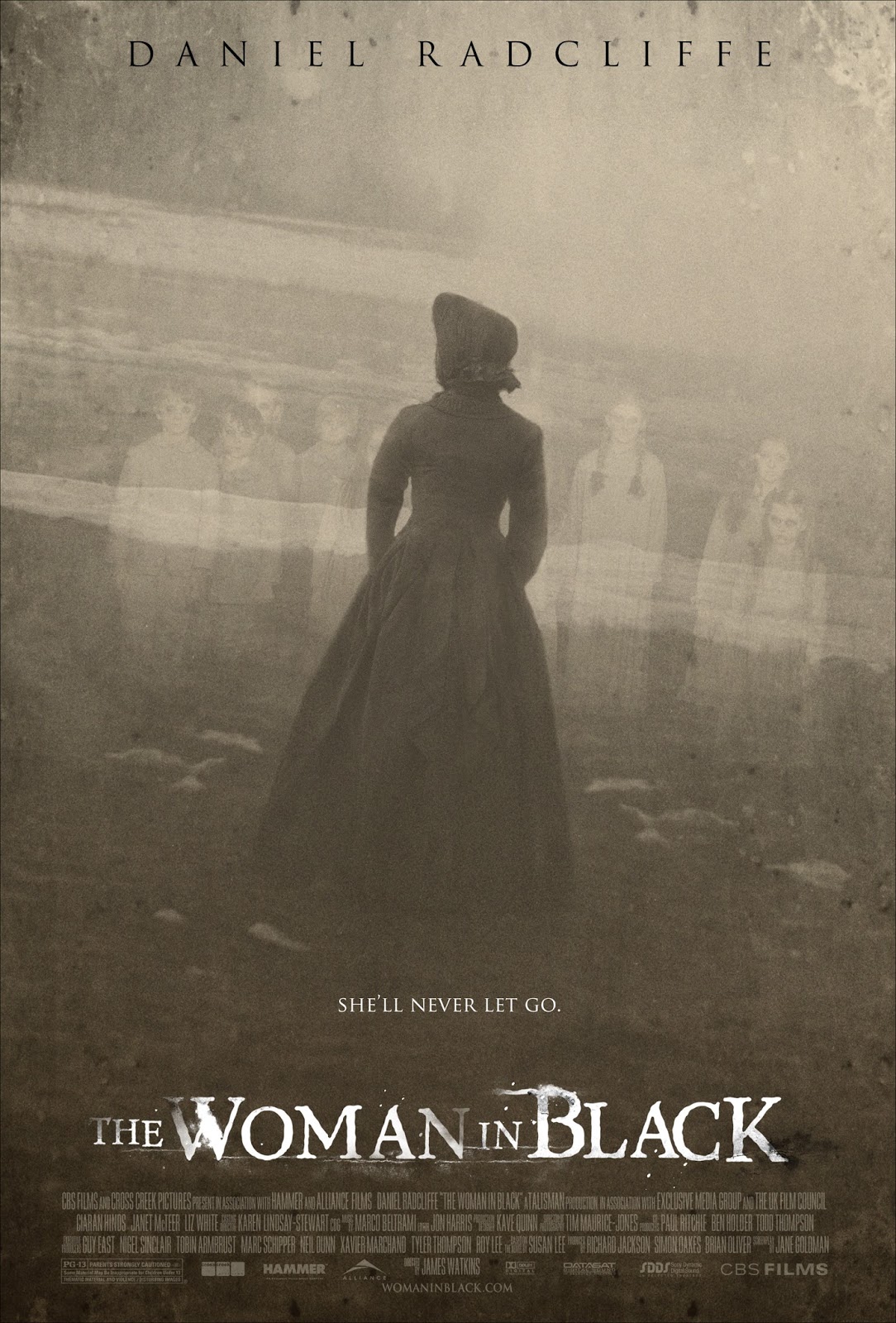
13 Nights of Shocktober: The Woman in Black

by A.J.

This is my favorite time of year, second only to Christmas. Autumn has arrived, the weather is cooling down, and October becomes the month long celebration of scary movies called Shocktober. There are a lot of horror movies out there, but as a genre, horror is still looked down upon by some mainstream critics and moviegoers. It doesn’t help that, admittedly, there are so few quality horror movies made but, like comedy, it’s a very difficult and subjective genre. So, in the days leading up Halloween I’ll be posting some recommendations for scary movies to help you celebrate Shocktober.

Night 7: Hammer Horror Night, “There are those who believe the whole town is cursed/But the house in the marsh is by far the worst.”

The Woman In Black 
The Woman in Black is a film I’ve been wanting to see for a while, but I was hesitant because it was released in theaters in February, which is notoriously a dumping ground for bad and mediocre films. However, it did well at the box office and since then it has been a popular rental every October at the video store where I work,  Vulcan Video. The Woman in Black is also rated PG-13, which horror movie fans will tell you usually indicates a tepid, unfrightening movie. There are exceptions to every rule and The Woman in Black can join the small club of good, scary PG-13 horror movies. 
The Woman in Black was produced by the recently revived Hammer Films and it is a fine, solid entry in the Hammer filmography. Hammer Films is a British production company best known for its horror films of the 1950s and 60s that were shot in Technicolor, typically had Gothic settings, and had violence and special effects more graphic than had been seen in horror films up to that point. Like many of the classic Hammer horror films, The Woman in Black has a period setting and relies on mainly on mood and atmosphere to transport the audience to a world of supernatural horrors, but still casts great British actors to fill out the cast.
Daniel Radcliffe stars as Arthur Kipps, a young lawyer in Edwardian era England who travels to a remote, gloomy village to collect the papers of a recently deceased client. This is Radcliffe’s first post-Harry Potter role and seeing him as someone other than the iconic Harry Potter is easier than you think. Radcliffe has grown into a fine actor and gives a good performance, though there is not much to do with this character. That is not a big problem, however, because this film knows the real star is its mood and atmosphere, which is thick and dreary. Fog and mist float though several scenes. The period setting (the clothes, the old cars, and candlelight) only strengthen the eerie, spooky feel of the movie.
Kipps finds himself staying in the decaying, ominous mansion of his dead client which is on an island accessible only by a road on a sandbar at low tide. The mansion in the marsh is exactly what you hope to see in a haunted house. In addition to being on an island in a marsh, the house is next to a graveyard. The production design of the house itself is incredible. It has long hallways and rooms filled with creepy antiques and dusty old toys. The scenes of Kipps alone in the mansion are the scariest because of the sound design. The best and most frightening sequence in the movie has Kipps being tormented late at night by creepy, unexplainable sounds and flickering ghostly visions. When we finally see her, the woman in black herself is very scary and creepy. There are some CGI effects which is only to be expected in any effects movie made in the 21st century, but The Woman in Black relies most on shadows and whispers to scare us.
Kipps is determined to stay and complete his job as his future at his law firm depends on it and he has a young son to support all on his own; his wife died in childbirth. The locals all want him to leave because the house in the marsh is haunted by a sinister spirit whose apparition signals the death of a child. After village children begin suffering tragic accidents, Kipps begins to investigate the identity of the spirit and the history of the mansion in the marsh.
With its ending, The Woman in Black manages to have its cake and eat it too. It moves towards a logical, satisfying ending but still feels compelled to give us the obligatory “final scare” that typically ruins most horror movies. This movie manages to have a final scare, but also have a satisfying, yet somber ending. If you watch a lot of horror movies, there are scenes you know are going to happen because they are practically required in a scary movies, but even these moments are well done. There is some great macabre imagery, but no gore and nothing too intense for more skittish viewers. This is a fine example of a movie being scary without being violent, or dark, or cynical. 

Saturday, October 24, 2015

13 Nights of Shocktober: The Company of Wolves

by A.J. 

This is my favorite time of year, second only to Christmas. Autumn has arrived, the weather is cooling down, and October becomes the month long celebration of scary movies called Shocktober. There are a lot of horror movies out there, but as a genre, horror is still looked down upon by some mainstream critics and moviegoers. It doesn’t help that, admittedly, there are so few quality horror movies made but, like comedy, it’s a very difficult and subjective genre. So, in the days leading up Halloween I’ll be posting some recommendations for scary movies to help you celebrate Shocktober.

Night 6: Werewolf Party Night, "As you're pretty, so be wise/ Wolves may lurk in every guise/ Now as then, 'tis simple truth/ Sweetest tongue has sharpest tooth."
The Company of Wolves
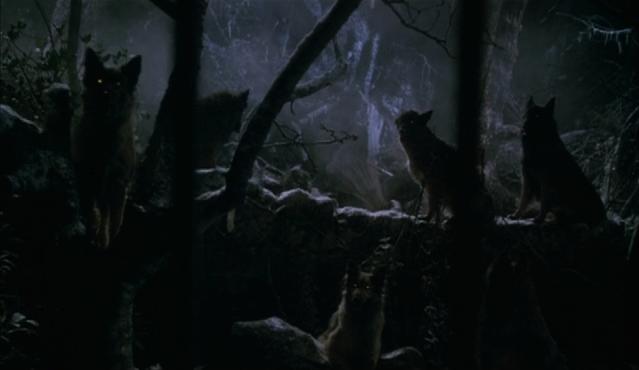
The Company of Wolves, released in 1985, is a fantastically dark and surreal fairy tale about the dangers lurking in the deep, dark woods for young girls, especially ones that wear red hoods and venture to grandmother’s house, but this movie is more than just an adult reworking of Little Red Riding Hood. Directed by Neil Jordan and co-written by Jordan and Angela Carter, from Carter’s story of the same name, The Company of Wolves brings to the forefront the warnings and hidden truths that make fairy tales a fount of childhood nightmares. The entire movie itself is one young girl’s nightmare. 
The film begins at a home in the English countryside but quickly moves into the dream of teenage Rosaleen. Her dream will more than once slip into nightmare territory. No part of the peasant village or the woods where her dream takes place ever feels entirely safe. There is no specific time period for the village setting; it seems to take place “once upon a time…" Everything about her dream, and thus the movie, feels simultaneously familiar and strange. Everything feels like a distorted reflection of a waking counterpart. As her dream begins we see her sister being chased by wolves running past distorted, surreal versions of thing in Rosaleen's room, like the giant stuffed bear that tries to grab her.
Rosaleen spends much of her time with her Granny, played with great but subtle authority by Angela Lansbury, listening to her stories. Granny is full of wisdom both practical (never eat a windblown apple) and cryptic (never trust a man whose eyebrows meet, he’ll show his true nature in the moonlight). She never hides the darker side of life from her granddaughter. Granny begins her stories with, yes, “once upon a time…” When Rosaleen asks if a young bride and groom in a story live happily ever after, Granny replies quickly, “Indeed they did not!” The groom showed his true beastly nature on their wedding night.
Because The Company of Wolves takes place in a dream, many things are possible and it could delve into the wildly fantastic but it is smart enough to restrain itself. The village and surrounding dark woods were built and shot on soundstages and though everything looks clearly artificial it all feels right for Rosaleen’s dream. The sets are dark, nightmarish, and macabre, but also familiar. Since the setting and characters are from the realm of the familiar, we are jarred when the surreal and macabre poke into Rosaleen’s world. She finds that an egg in a bird’s nest hatches into something made of stone. Rosaleen’s father returns from hunting and killing the wolf that killed her sister with its severed paw of as a trophy. It was a paw when he took it, he says, but the trophy has turned into a human hand.
This is a different kind of werewolf movie. It seems that any man can change into a wolf and any wolf can change into a man, not because of a bite or a curse, but because of their true, hidden nature. There is a confrontation at the climax of the film when Rosaleen sets off to Granny’s house in her red hood and on the path meets a man whose eyebrows meet. It plays out very differently than the traditional fairy tale. The words of Rosaleen’s mother echo through the final act: “You pay too much attention to your granny. She knows a lot but she doesn't know everything. And if there's a beast in men, it meets its match in women too.”
The Company of Wolves is a wonderful nightmare. I’ve seen very few films that successfully convey how a dream can feel completely bizarre and utterly real at the same time. Everything makes sense as it is happening even if you don’t know why or how it is happening or what will happen next. You might think that because the movie is a dream there is no weight to the scenes or no real danger to Rosaleen. However, every encounter and experience Rosaleen has are rooted in very real fears and anxieties that the sleeping adolescent Rosaleen likely does not yet fully understand. Even if they came to her in a dream, the lessons of Granny’s stories are very real. This is horror that does not make you jump out of your seat or shut your eyes. This is horror that wants to disturb and stir the thoughts buried deep down in your mind. 

Friday, October 23, 2015

13 Nights of Shocktober: The People Under the Stairs

by A.J.

This is my favorite time of year, second only to Christmas. Autumn has arrived, the weather is cooling down, and October becomes the month long celebration of scary movies called Shocktober. There are a lot of horror movies out there, but as a genre, horror is still looked down upon by some mainstream critics and moviegoers. It doesn’t help that, admittedly, there are so few quality horror movies made but, like comedy, it’s a very difficult and subjective genre. So, in the days leading up Halloween I’ll be posting some recommendations for scary movies to help you celebrate Shocktober.

Night 5: Wes Craven Memorial Night II, "No wonder there's no money in the ghetto..."

The People Under the Stairs
The poster art for Wes Craven’s The People Under the Stairs has stayed with me since I first saw it in the local video stores that once populated my home town. The skull floating in a dark sky above a seemingly normal house is a simple image that suggested more danger and potential terror than the more grotesque posters for other horror movies. Craven has certainly never shied away from the grotesque (Freddy Kruger’s face is more than enough proof of that), but the violence and gore in his films, though they are part of the overall entertainment, is never meant for titillation. The best Wes Craven films are never about the special effects or the scary scenes. They are about the thoughts and feelings those scenes release from the dark, ignored corners in the mind of the viewer. 
Written and directed by Wes Craven and released by Universal in 1991, The People Under the Stairs is a high point in a career with many peaks and valleys. The main character is a young boy named Poindexter, but everyone calls him Fool. He lives in a rundown ghetto apartment building with his sister and dying mother who is in need of an expensive operation. They are behind on rent and the landlord is eager to evict them so the building can be torn down and replaced with an office building. Leroy, Fool’s sister’s boyfriend, played by Ving Rhames, offers to show Fool how to make money to keep his family from being evicted, which involves breaking a few laws. Leroy and his partner in crime, Spenser, robbed a liquor store that happened to be owned by the landlords and found a map of their house that shows a secret room full of money. They plan a dangerous treasure hunt.
Their plan gets derailed almost right away. After Spenser enters the house and does not come back, Leroy and Fool sneak into the house. From the outside, the landlords’ home looks like a normal, nice, big house in the suburbs, but inside there are many dangers and horrors. The landlords are a couple played by Everett McGill and Wendy Robie, who also played a couple in the TV series Twin Peaks. In Twin Peaks they were great as the comically dysfunctional and lovable Big Ed and Nadine, but here they are great and terrifying as the cruel and sadistic nameless couple that refer to each other as “Mommy” and “Daddy.” Fool finds their daughter, Alice, who has been locked up in the house and never let outside. She explains that “Mommy” and “Daddy” have cruel punishments if their rules are broken and have already put several boys who misbehaved under the stairs.
The People Under the Stairs is like a young boy’s adventure dream, complete with a treasure map, turned into a nightmare. The large creepy house is filled with secret passageways, crawlspaces, and booby-traps that give Fool’s journey both excitement and terror. The People Under the Stairs implies more horror than it shows. Craven knows that a little can go a long way; something like the full body leather suit that “Daddy” wears to hunt Roach, one of the mutilated boys that escaped from under the stairs and lives in the walls, is so odd and strange that it will disturb and unnerve the audience more than buckets of blood. Craven adds to the strange nature of this movie by inserting moments of odd humor here and there. In one scene Fool tells Alice, “Your father is one sick mother,” and in another scene he distracts a dog attacking Leroy by insulting the dog’s mother.
Craven even gets across some social commentary on appearances and the gap between rich and poor and the ghetto and the suburbs, but he keeps it in the background of this horror adventure. His best films have themes and ideas that give them substance but he is smart enough to keep them as subtext and let us notice them on our own. His themes are simple, but that only makes them stronger and easier to absorb. This is a well-executed, entertaining film from one of the true masters of horror that works by disturbing you with strange, macabre imagery rather than excessive blood and gore. It may be a Wes Craven film that has slipped by the wayside over the years, but The People Under the Stairs is definitely worth seeking out and watching.