This is my favorite time of year, second only to Christmas. Autumn has arrived, the weather is cooling down, and October becomes the month-long celebration of scary movies called Shocktober. So, in the days leading up Halloween I’ll be posting some horror movie recommendations to help you celebrate Shocktober.
Night 7: Hammer Horror Night
Christopher Lee: I’ve got no lines!Peter Cushing: You’re lucky. I’ve read the script.The Curse of Frankenstein
There are more than a few things that give The Curse of Frankenstein a special place in horror film history. It was the first remake of a classic Universal monster movie by the British film company Hammer and its success led Hammer to produce other Universal monster movie remakes, each with its own line of sequels, and other horror films as well. Throughout the 1950’s, traditional horror films focusing on monsters, ghosts, or curses had taken a backseat to science fiction films that had some horror elements but focused on the fears of the atomic age: monsters from outer space, the effects of nuclear radiation, or experiments gone wrong. The Hammer horror films are credited by some film historians and cinephiles with revitalizing the horror genre and attracting new audiences. They were shot in vivid color, utilized eye-catching period sets and costumes, and contained a level of violence, blood, and sexuality that was new and shocking for the time. It all started with The Curse of Frankenstein. Watching The Curse of Frankenstein today, there are certain aspects that may seem dated or hokey and its shock value has waned but not disappeared. It is easy to see why this film stood out at the time and has become a classic.
Perhaps as significant as its success for Hammer, The
Curse of Frankenstein was the first film to pair Peter Cushing and
Christopher Lee on screen together—they had previously appeared in the same
movie, Hamlet (1948), but in different scenes. Cushing and Lee met for the first
time and became friends by complaining about the script together. They appeared
in numerous films together for Hammer and other studios becoming horror movie
icons and their friendship lasted until Cushing’s death in 1994.
This version of Mary Shelley’s novel begins with Dr.
Frankenstein (Peter Cushing) in prison telling his story to a skeptical priest.
We see a flashback to an arrogant teenage Victor Frankenstein, who inherits his
father’s fortune and aristocratic title and uses the money to hire a
tutor, Paul, to teach him medicine. Over the years they conduct experiments that eventually allow them to resurrect a puppy. Both are thrilled
but for different reasons. Paul (Robert Urquhart) wants to use their discovery to improve medical
care by putting a patient into temporary death to perform a surgery without any
shock to their system and then revive them. Frankenstein, however, wants to
build a bigger, superior being. There’s no reason given for why Frankenstein
wants to do this, but the book also doesn’t explain Frankenstein’s motivations
since there is no good reason for wanting to build a new human out of dead body
parts. Paul reluctantly agrees to go along with Frankenstein’s idea and
together they create the Creature.
Despite his problems with the script, Cushing gives a great
performance as the villainous Dr. Frankenstein. It's tempting to want to think
of Victor Frankenstein as a hero because he pushes the boundaries of science
and fights a monster, but this Frankenstein is a cad and villain. He doesn’t
just rob fresh graves for body parts, he kills people. For a superior brain for
his Creature, Frankenstein invites an old professor to his house then pushes
him to his death. The brain is damaged but he uses it anyway leading to the Creature’s
lumbering movement and murderous behavior. Also, Frankenstein is having an
affair with his maid, Justine (Valerie Gaunt), even though he’s engaged to Elizabeth (Hazel Court). When
Justine threatens to expose his horrendous experiments if he doesn’t marry her,
Frankenstein uses the Creature to dispose of her. Cushing often played the hero
in horror movies, or someone driven to extremes, but he is also really good as
a sinister villain. You want him to stop the monster, but you also want him to
get his comeuppance.
The reveal of the Creature’s face is a striking moment. The
Creature lumbers to life, pulls off the bandage covering its face, and camera
rushes in for a close up. Though Mary Shelley’s novel was in the public domain,
Universal held the rights on the makeup design of the monster from their 1931
version of Frankenstein, one of the most iconic images in film history. So, the
design of the monster here is very different from the Universal monster. This
Creature’s design is nowhere near as memorable as the look of Boris Karloff as the
Monster, but the film is better for trying something different.
Christopher Lee doesn’t have a lot to do as the Creature. It’s obvious that the movie couldn’t decide if it wanted him to be
sympathetic, like in the Universal movie, or just a force of destruction.
Still, Lee’s imposing size gives the Creature a sense of immediate danger. Lee
would get to show off his verbal talents and charismatic screen presence in the
next film he and Cushing starred in together for Hammer, Horror of Dracula,
one of my favorites.
The period 19th century costumes and sets look
great in color. There are some exterior scenes where the background is
obviously a matte painting, but this adds to movie’s fantastical atmosphere
more than it distracts. Frankenstein’s laboratory is filled with bubbling jars
of colored potions and the Creature is kept in a water tank. Nothing in his lab
looks especially scientific but this adds to the unnatural side of his
experiment, and it looks great in color. Terence Fisher directed The Curse of
Frankenstein and while many directors had a hand in Hammer horror movies, his
remain among the best. Seeing the names of Cushing, Lee, and Fisher together
mean that you’re in for a treat.
This is my favorite time of year, second only to Christmas.
Autumn has arrived, the weather is cooling down, and October becomes the
month-long celebration of scary movies called Shocktober. There are a lot of
horror movies out there, but as a genre, horror is still looked down upon by
some mainstream critics and moviegoers. It doesn’t help that, admittedly, there
are so few quality horror movies made but, like comedy, it’s a very difficult
and subjective genre. So, in the days leading up Halloween I’ll be posting some
recommendations for scary movies to help you celebrate Shocktober. Night 1: Hammer Horror Night
Beginning in the late 1950’s, the British film production
company Hammer began making a series of horror films that were essentially
remakes of the Universal Monster movies of the 1930’s. The Hammer films had
different storylines and monster designs, however, being in technicolor and
showing more explicit violence and sexuality is what made them a distinct brand.
The Curse of Frankenstein kicked off the Hammer Horror cycle in 1957,
followed by Dracula (released in the U.S. as Horror of Dracula)
in 1958, and tonight’s recommendation, The Mummy in 1959. Each film
spawned numerous sequels—some more entertaining than others—but none matched
the first in their respective series, all of which were directed by Terence Fisher and paired the great actors Peter Cushing and Christopher Lee.
The plot is pretty straightforward. In the 1890’s, a father and son
archeologist team discover the tomb of the legendary Princess Ananka. The son, John
(Cushing), has a broken leg, so he is not present when his father reads from a
mysterious scroll and witnesses something that drives him mad. An Egyptian man
named Mehemet (George Pastell), a disciple of the god Karnak, follows the
father and son to England to exact revenge for desecrating Ananka’s tomb. Mehemet’s
weapon of choice is... you guessed it, a mummy.
The Hammer Horror films usually cast Peter Cushing as the
protagonist and Christopher Lee as the monster. When Lee began his
acting career, he had difficulty getting good roles because of his imposing
size, a commanding 6’5”. It’s easy to understand why he was cast as Frankenstein’s
Monster, Dracula (his best horror role), and the mummy. While the mummy is a thrilling screen presence, he is not a very interesting
monster since he is just the tool for Mehemet’s revenge. When the mummy sees that John’s
wife, Isobel (Yvonne Furneaux), resembles the Princess Ananka, he begins to act on his
own will. The mummy’s silent, lumbering nature leaves Lee only his eyes to act with and he
does a pretty good job when he gets a close up. In a flashback narrated by
Cushing we see that the mummy was a priest named Kharis that was obsessed with
Ananka and attempted to bring her back to life. Lee gets to use his voice and
whole body in the flashback. It’s a brief scene but it’s good to see Lee really
play a character. Thanks to Lee’s large size, it is easy to believe that this
mummy could pick up someone by neck with one hand or burst through doors and
windows, the only way the mummy enters a room. When he and Cushing fight, it
doesn’t seem like much of a contest—thankfully, just then the mummy catches sight of Isobel.
Cushing and Pastell have a good scene
together when John visits his suspicious new neighbor. Mehemet is the main antagonist
of the movie, more so than the mummy, but his revenge is not without good
reason. He is not wrong that English archaeologists are desecrating sacred tombs and disregarding another culture’s customs, just so people can stare at relics in
the British Museum. John’s counter argument is that nothing would be
known of the ancient Egyptian people or their culture if it were left sealed and
buried. However, everything else he says is purposefully condescending and insulting as
he is trying to provoke Mehemet.
Like all Hammer Horror movies, the period sets and costumes,
especially the ancient Egyptian sets and costumes, look obviously fake. However, this only helps create the movie’s fantasy atmosphere. The bog nearby John’s
country estate is a fun set. Seeing the mummy in the dark, soupy water is a
great sight. The look of the mummy is pretty spooky—wrapped in bandages that
are dirty and tattered and look a thousand years old—especially with Lee’s eyes
behind the costume. Though, I’m pretty sure you can the line for a zipper on the back of the mummy in
certain scenes.
The top tier Hammer Horror films, in which I would include The
Mummy, are great Shocktober viewings because they are fun horror entertainment,
but not so scary as to be intimidating. Whether you are a bit squeamish or a die-hard
horror fan, the Hammer Horror version of The Mummy will help you have a
great Halloween.
This is my favorite time of year, second only to Christmas.
Autumn has arrived, the weather is cooling down, and October becomes the month
long celebration of scary movies called Shocktober. There are a lot of horror
movies out there, but as a genre, horror is still looked down upon by some
mainstream critics and moviegoers. It doesn’t help that, admittedly, there are
so few quality horror movies made but, like comedy, it’s a very difficult and
subjective genre. So, in the days leading up Halloween I’ll be posting some
recommendations for scary movies to help you celebrate Shocktober.
Night 12: Werewolf Party Night/Hammer Horror Night
I’m glad to have come across Hammer Films’ werewolf movie
entry to their series of loose remakes of the Universal Monsters films from the 1930's and 40's. Hammer Films is the British film studio that is most famous for their atmospheric and
often campy horror movies made from the 1950’s through the 70’s. The most
famous of these films are the Dracula and Frankenstein movies and their many
sequels, usually starring Christopher Lee and Peter Cushing. The best of these
films were directed by Terence Fisher, who directs Curse of the Werewolf. Cushing and Lee are absent from this film,
however, Curse of the Werewolf still
ranks in the top tier of Hammer horror.
Curse of the Werewolf
is based on the novel The Werewolf of Parisby Guy Endore, so naturally the film is set in Spain. Perhaps the most
memorable thing about this movie is its unconventional and convoluted method of
creating a werewolf. The film begins with a beggar wandering into a Spanish
village and happening upon the wedding banquette of a cruel and evil Marques.
The Marques pays the beggar to act like a pet and humiliates the beggar before
having him thrown in a dungeon where he is quickly forgotten. The beggar
becomes more and more beastlike the longer he is imprisoned and attacks and
rapes the jailer’s daughter. Then, she attacks and kills the now decrepitly old
Marques. She runs away to the forest and is found by Aldredo (Clifford Evans)
who takes her into his home where she gives birth to a son on Christmas Day.
Alfredo’s maid believes it is an insult for an unwanted child to be born on the
same day as the Lord. Alfredo raises the child, Leon, as if he were his own,
but when Leon is a young boy the village is plague by wolf attacks at night.
Yong Leon has terrible nightmares, thinks that blood tastes sweet, and has fur
growing on his hands and arms.
A priest tells Alfredo about evil spirits that leap into
bodies and battle with the soul for control of the body. Leon has a werewolf in
him and “only love” can cure the inner wolf. Alfredo and his maid raise Leon
well, giving him much love and keeping the inner wolf at bay. More time passes
and Leon, now a young man (Oliver Reed), leaves home to make his own way in the
world. He falls in love with Christina Fernando, the daughter of a wealthy
vineyard owner, who is already engaged to someone else. She falls in love with
Leon but knows her father would never allow their marriage. Then vicious wolf
attacks begin on the nights of the full moon.
Curse of the Werewolf
isn’t actually a remake of the Universal Studios’ film The Wolf Man (1941), but the design of the werewolf is, like all
Hammer monster designs, close to the look of the Universal monsters, but
distinct enough to be fresh and memorable. This werewolf is a classic wolf-man
monster, not just a man that turns into a wolf. Those familiar with The Monster Squad will see a strong
similarity between that film’s wolf-man and the wolf-man in Curse of the Werewolf. There aren’t many
werewolf scenes, this is a low budget movie after all, but the costumes, sets,
performances, and score make up for that and keep the film moody and
atmospheric.
All of the elements of a top notch Hammer horror film are in
Curse of the Werewolf. This film is
set some time in the past but no specific date is given. If I had to guess I
would say it is set sometime in the 19th century, but a specific
time period isn’t necessary. This is a folktale fantasy like a campfire story
that lets you fill in the details. The sets manage to look fake and convincing
at the same time and only add to the atmosphere of the movie. The costumes look
great with vibrant, bold colors that are synonymous with Hammer horror. Blood
in this movie is a bright almost orange-red color. The cast is as tan as British people
can be made to look without being offensive. All of this adds up to a movie
that is a lot of fun. The climax goes on just a bit too long without anything
really happening but that is a small hiccup in an otherwise well-paced,
entertaining film.
It’s hard to go wrong with Hammer for entertaining
atmospheric horror. Curse of the Werewolf
is a great not-so-scary horror movie for people that want a Shocktober movie
that isn’t excessively violent, or gory, or disturbing.
by Lani
Each month, I scour the Turner Classic Movies schedule for upcoming
films that I can't miss. The highlights are posted here for your reading
and viewing pleasure! (All listed times are Eastern Standard, check
your local listings or TCM.com for actual
air times in your area. Each day's schedule begins at 6:00 a.m.; if a
film airs between midnight and 6 a.m. it is listed on the previous day's
programming schedule.)
10/3, 8 PM - Jinnah (1998) TCM Star of the Month for October is British actor Christopher Lee, a fitting honor since Lee is well-known for his horror films. He played Dracula (10 times!), Frankenstein's monster, the Mummy, and a host of other weirdos; sometimes he was even the hero, but there was generally a lot of blood involved. During his long career, Lee's imposing physical presence and booming voice meant he was often cast as a the bad guy - in fact he played a villain in the Star Wars series, The Lord of the Rings trilogy, and opposite James Bond! In tonight's film Lee takes center stage in a very different role portraying Mohammad Ali Jinnah, the founder of the modern nation of Pakistan. The casting of Lee was controversial; not, as you might think, because Lee was a white actor playing an Asian character, but because of his association with Count Dracula. However, audiences in Pakistan ultimately responded positively to Lee's portrayal and the film is broadcast every year on Pakistan's independence day. Unfortunately, it seems that the film never got a proper theatrical release anywhere, so audiences outside Pakistan haven't really had a chance to see it. Tonight's air date is the North American premiere. As a fan of Sir Christopher Lee, I look forward to seeing what he felt was his most important role. BONUS: 10/24, 4:30 AM - Dracula A.D. 1972(1972) My official pick may be an art house biopic, but I can't deny my love for Lee's weird horror movies - especially the ones with frequent partner/foil Peter Cushing. The two actors first appeared opposite each other as Dracula and Van Helsing in 1958's Horror of Dracula. Though Lee would play Dracula several more times over the next 14 years (ruining his reputation as a serious actor in the eyes of the entire nation of Pakistan in the process), this was Cushing's first appearance as Van Helsing since the '58 film. This time around the setting is contemporary "swinging" London where the Count has been resurrected and is hunting the descendants of his old nemesis.
10/11, 8 PM - Hollywood Canteen (1944) The Hollywood Canteen was a special nightclub for serviceman during WWII, where they could get a hot meal, dance with a pretty girl, and meet real film stars before shipping out. Actress Bette Davis was the driving force behind the Canteen, supervising its construction, recruiting fellow stars to volunteer there, and managing it with her agent Jules Stein. Two years after it opened, the Canteen got its own film - a romantic comedy about a young G.I. who falls for starlet Joan Leslie (playing herself). The story was really an excuse to pack the film with star cameos by Davis, Canteen co-founder John Garfield, Joan Crawford, and Jack Benny (and many more), and musical numbers from the Andrews Sisters and Roy Rogers. However, it's an interesting glimpse into how Hollywood contributed to the war effort. With its patriotic message and star power, the film was a big success at the box office and a portion of the profits went back to the Canteen. Davis was rightfully proud of the success of the Canteen and her contribution is recognized during tonight's programming theme of "Actresses Who Made a Difference," part of TCM's month-long spotlight series on Trailblazing Women. If you are interested in learning more about the history of the real Hollywood Canteen (good and bad), check out episode #27 of the You Must Remember This podcast, "Bette Davis and the Hollywood Canteen."
10/19: Presidents on Film 8 PM - Fail-Safe (1964) 10 PM - Advise & Consent (1962) 12:30 AM - Seven Days in May (1964) 2:45 AM - Gabriel Over the White House (1933) With Election Day looming, you may be suffering from presidential fatigue; however, I think it's the perfect time to watch these political films...if only to remind you to vote on November 8th! Each of tonight's films depicts a President under pressure: trying to fend off World War III in Fail-Safe, pushing through a controversial Cabinet nominee in Advise & Consent, as the target of a military coup perpetrated by the Joint Chiefs of Staff in Seven Days in May, and (following a visit from archangel Gabriel) crusading against government corruption and organized crime in Gabriel Over the White House. Depending on the day, any of these scenarios seems unfortunately all too plausible.
10/28: Universal Horror 8 PM - Dracula (1931) 9:30 PM - The Mummy (1932) 11 PM - The Invisible Man (1933) 12:15 AM - The Wolf Man (1941) On Halloween night, TCM will feature several Hammer Studios horror films of the 50s and 60s starring Christopher Lee; however, tonight, you can see the Universal Studios horror films of the 30s which inspired those later films, even more so than any literary sources. The Universal films created the iconic looks of classic literary characters like Dracula, The Invisible Man, and Frankenstein's monster; while also adding new creatures to their rogues gallery like the Mummy and the Wolf Man. If you're in the mood for an atmospheric, spooky chiller - these films deliver. However, if you're in the mood for a laugh, there's plenty to giggle about here, too - from far-fetched plots to hammy acting. BONUS: 1:30 AM - The Black Cat (1934) This creepy, but stylish thriller was "inspired by" Edgar Allan Poe's short story of the same title (and that's where the inspiration ended) and featured the first pairing of horror stars Karloff and Lugosi. The two actors are not playing supernatural monsters this time, but portray a sadistic cult leader and a man out for revenge. The film also features David Manners, the young hero who had previously faced off against both Lugosi in Dracula and Karloff in The Mummy.
This
is my favorite time of year, second only to Christmas. Autumn has
arrived, the weather is cooling down, and October becomes the month
long celebration of scary movies called Shocktober. There are a lot of
horror movies out there, but as a genre, horror is still looked down
upon by some mainstream critics and moviegoers. It doesn’t help that,
admittedly, there are so few quality horror movies made but, like
comedy, it’s a very difficult and subjective genre. So, in the days
leading up Halloween I’ll be posting some recommendations for scary
movies to help you celebrate Shocktober.
Night 10: Meta-Horror Night, “You know what they call my films today? Camp! High camp!”
Targets is a very peculiar film. It is more of a slow burn
thriller than a traditional horror movie, but it is partly about horror films
and meditates on both horror movies and real life horrors. Targets
is director Peter Bogdanovich’s first feature film. He made the film in 1968 for
legendary producer Roger Corman, whose only requirements of Bogdanovich was that
he use actor Boris Karloff (who owed Corman two days’ work), and use stock
footage from Corman’s 1963 film, The Terror(starring Boris Karloff). The story
could be about anything. Bogdanovich wrote the screenplay with then wife Polly Platt, who was also the production designer. The result is a dual story, low
budget movie that moves slow, but is interesting.
Boris Karloff plays an elderly horror movie legend named
Byron Orlok who wants to retire against the wishes of the studio executives and
the director of his latest movie, played by Peter Bogdanovich. The movie begins
with the stock footage from The Terror (which also stars Jack Nicholson)
doubling for footage of Orlok’s latest movie. It is a horror film with a
castle, period costumes, and a terrible thunderstorm. It’s the kind of horror
movie that Karloff himself made throughout his career, and like the films made
by Hammer Films. Orlok is unhappy watching a preview of the film and decides to
retire. He says that he feels like an anachronism and says the world belongs to
the young.
The second story is about a seemingly average, normal, clean
cut looking young man named Bobby Thompson, played by Tim O'Kelly. He is a veteran and likes to collects guns. We see his home
life; he and his wife live with his parents. He starts acting strangely. When
out shooting at cans with a friend he lets the sight of his gun linger on the
other person while their back is turned. He is distant from his wife and smokes
in bed with all of the lights turned out. Then he types a cryptic note
in red ink on his typewriter and begins a killing spree. He takes his rifle
and some other guns, finds a high place, and starts picking off people.
The stories are not related directly but you know that
they will eventually intersect. Bogdanovich works subtly to meld the stories
together. The first time we see the Thompson is in a gun shop across the
street from where Orlok screened his movie. The young man puts Orlok in his
gunsight and lets it linger. It is safe to assume that the two men will have a
confrontation at the premiere of Orlok’s movie at the drive-in theater where he
will make his final public appearance before retiring.
You can tell that Bogdanovich really wanted his movie to be
90 minutes long. Scenes play out a bit longer than they should and sometimes
that helps the narrative, sometimes it doesn’t. There are several extended scenes of the Bobby Thompson’s average home life as he is becoming
slowly and quietly unhinged. These scenes don’t really build character,
but when they work, they have you searching for clues for why he’s cracking up.
Even then, however, these scenes could still be shorter. The most effective of
these lengthy scenes happens when Thompson is up on a refinery tower and
unpacks his lunch. It’s an odd, humanizing moment (even psycho killers need to
eat too), and it means that he planned ahead enough to pack a lunch, which is
unnerving.
The scenes with Boris Karloff work purely because it is
interesting to watch Karloff playing a character loosely based on himself. He
spends his scenes either with his assistant contemplating retirement or with
Bogdanovich, who is trying to convince him not to retire. I get the distinct
feeling that their scenes together exist just because Bogdanovich wanted to
hang out with Boris Karloff. I can’t blame him; I would’ve done the same thing.
The best scene of Targets by far is of Karloff telling an audience an old ghost
story about a man encountering Death.
This movie was made at a time when the country was changing,
culture was changing, and all the while the Vietnam War raged in the
background. Targets is not explicitly about gun control, mental health, or even
Vietnam, though the specter of each looms over every scene. It seems fairly
obvious that the young man is based on Charles Whitman, who killed several
people from the University of Texas tower in Austin only two years prior. That very year,
1968, would see two American political figures, each a symbol of promise and
hope in their own way, gunned down by assassins: Martin Luther King, Jr. and Robert
F. Kennedy. If you read books about film history, Targets will likely be in more
than one of those books. It is not a landmark film like Rosemary’s Baby or
Night of the Living Dead but it is a notable part of the shift that began to occur in horror films in the late 60s.
Up until this time in film history nearly every horror film
was set in the past, in a faraway land, or a large spooky house or castle. The
most notable exception to this was a few horror films produced by Val Lewton in the 1940s and 50s.
That changed in 1968, the same year Targets was released, with movies like
Rosemary’s Babyand George Romero's Night of the Living Dead that set the supernatural in a
modern setting subtly and believably. As George Romero continued to make horror
films, soon joined by Wes Craven, Tobe Hooper, and David Cronenberg, horror
films moved further and further away from costumes and monsters in castles. The
most interesting aspects of Targets are its juxtaposition of real and movie horrors, and its awareness of the fading out of
fashion of Gothic, fantasy horror movies in the character of Byron Orlok.
Karloff as Orlok sees newspaper headlines of shootings and murders and becomes
depressed. “Nobody’s afraid of a painted monster,” Orlok says in one scene. His
horror movies can’t compare to the horrors in the newspaper and, soon, he
feels, the public will feel the same.
This
is my favorite time of year, second only to Christmas. Autumn has
arrived, the weather is cooling down, and October becomes the month
long celebration of scary movies called Shocktober. There are a lot of
horror movies out there, but as a genre, horror is still looked down
upon by some mainstream critics and moviegoers. It doesn’t help that,
admittedly, there are so few quality horror movies made but, like
comedy, it’s a very difficult and subjective genre. So, in the days
leading up Halloween I’ll be posting some recommendations for scary
movies to help you celebrate Shocktober.
Night 9: Christopher Lee Memorial Night II, “The power of darkness is more than just a superstition. It
is a living force which can be tapped at given moment of the night.”
Christopher Lee is most famous for his roles as villains,
which he was great at playing, but occasionally he got to play the hero and
when he did, he was great at that, too. According to a few different websites,
his heroic turn as Nicholas Duc de Richleau in The Devil Rides Out was one of
his favorite roles. Made in 1968 for Hammer Films, The Devil Rides Out was
directed by Terence Fisher with a screenplay written by Richard Matheson, based
on a novel by Dennis Wheatley. In the U.S. this movie was released as The Devil’s
Bride because executives thought the title The Devil Rides Out sounded too much
like a western. Hammer is best known for its remakes of the Universal Monsters
movies (Dracula, Frankenstein, and so on), and the sequels that each remake spawned, but this non-monster, non-remake is
still everything you’d hope for in a Hammer film.
The film begins with Duc de Richleau and his friend, Rex Van Ryn,
checking up on their younger friend, Simon, who has recently joined a
suspicious “astronomical society.” Right away de Richleau, who is an expert on
the occult, sees that this club is actually a satanic cult. He and Rex rescue
Simon from being officially initiated into the cult, along with a young woman
named Tanith, but then they all face the relentless wrath of the cult and their
black magic.
The Devil Rides Out is a campy film now, and may have been even
when it was released, but it is difficult to make a serious film about Satanists
(with all of their magic spells, robes, funny names, and use of farm animals). It
may come off as silly, but that doesn’t mean that the movie isn’t well done or
spooky. The movie is set in 1929 and the production design is as good as
Hammer’s Gothic horror movies. Simon’s room has large imposing windows and
a satanic seal on the tiled floor. The Satanists wear purple robes, sacrifice a
goat out in the woods during a ritual, and then dance around and act crazy. After
breaking up that ritual de Richleau, Rex, Simon, and Tanith hide out at de
Richleau’s niece’s country house. The country house and the English countryside
provide a mood of isolation and slight distance from reality.
Not all of the visual effects hold up (adding to the camp
value), but there is still some effective imagery, including the chilling appearance
of the Angel of Death. The dated effects aren’t a big problem though because this
movie relies mostly on the performances of the actors, especially Christopher
Lee and Charles Gray as the satanic leader, Mocata. Most of the movie feels
like a play; the second half of the movie takes place almost entirely in the
country house.
There are a lot of great moments in this movie. In a car
chase, Mocata uses black magic to lose Rex who is chasing after a possessed
Tanith. First Rex's windshield turns opaque, then a fog is cast as the cars
enter the woods. When Simon invites de Richleau and Rex into his room, Lee
bounds across the room, throws open the closet, and is aghast at the wicker
crate containing a chicken, which confirms his suspicions that his
friend is about to join a satanic cult. At the country house de Richleau conducts
a counter ritual that requires himself, his niece, her husband, and Simon to
lie on the floor with their heads touching. It’s an image that is striking and
silly at the same time. Actually, that’s how most things are in The Devil Rides
Out, but you believe every moment of it because of Christopher Lee’s
performance. He plays de Richleau with a believable authority and a commanding
presence. Only an actor with real talent could be so angry at the sight of a chicken in a basket and somehow not go over the top. Lee is great at leading the rituals and casting spells. His serious
performance gets us to take it seriously too. The Devil Rides Out is
entertaining, spooky, fun, and even a little silly, but the real reason to watch this
movie is for Christopher Lee’s performance.
This
is my favorite time of year, second only to Christmas. Autumn has
arrived, the weather is cooling down, and October becomes the month
long celebration of scary movies called Shocktober. There are a lot of
horror movies out there, but as a genre, horror is still looked down
upon by some mainstream critics and moviegoers. It doesn’t help that,
admittedly, there are so few quality horror movies made but, like
comedy, it’s a very difficult and subjective genre. So, in the days
leading up Halloween I’ll be posting some recommendations for scary
movies to help you celebrate Shocktober.
Night 8: Christopher Lee Memorial Night, "He'll Hold You In A Grasp of Shock!"
The passing of movie icon Christopher Lee earlier this year
was very sad news, but he left us with many, many films to enjoy. He had a long
and impressive career that included both the Star Wars and Lord of the Rings
film series. However, his most famous role is unquestionably as Dracula in a
series of movies for the British production company Hammer. When people think
of Dracula, they either picture Bela Lugosi or Christopher Lee. The first
film in which Lee took on the already legendary character was in 1958
with Horror of Dracula, co-starring fellow horror movie icon and superb
actor Peter Cushing, and directed by
Terence Fisher. When Terence Fisher, Peter Cushing, and Christopher Lee made a
film together for Hammer, audiences were in for a treat.
Horror of Dracula is a loose remake of Todd Browning’s Dracula from 1931, and an even looser adaptation of the Bram Stoker novel. The
movie begins with bright red blood dripping on Dracula’s tomb. Jonathan Harker
arrives at Castle Dracula in Klausenburg to work as the librarian for the
Count, but he is actually a vampire hunter and protégé of Dr. Van Helsing.
Harker becomes trapped in the castle and succeeds in killing the Count’s bride,
but not Dracula himself. Dracula seeks revenge by first trying to take Harker’s
fiancé, Lucy, for his new bride, and then Lucy’s sister, Mina. Van Helsing is
on Harker’s trail and tries to save Lucy and Mina and put an end to the sinister
vampire. Almost none of this happens in the novel. It is almost like Dracula
fan fiction. It takes the already existing characters and then just makes up a
different story and does what it thinks is most entertaining, and it is indeed
very entertaining.
Horror of Dracula was impressive when it was released
because, like other Hammer horror films, it ups the ante on violence, action,
and sexuality. That means that when someone gets stabbed or bitten we see
blood, Dracula’s bride wears a dress revealing her cleavage, and Lee plays
Dracula as a dangerous seducer. This film was shot on Technicolor so the
colors of the sets and costumes are rich and vivid, and red blood is especially
red. All of those elements are still entertaining today, but the reason this
film works, then and now, is because of its reinterpretation of Count Dracula and
Dr. Van Helsing and the screen presence of Christopher Lee and Peter Cushing. Lee’s
tall stature of 6’5” and natural physical appearance give his Dracula a
commanding and imposing presence. Lee's Dracula exudes menace. The danger and threat he poses are
immediate and ever present. In one scene Lee bounds across a large dining room and
over a table to pull his bride away from attacking Harker. Other versions of
Dracula usually give him servants to do his bidding, but this Dracula
drives his own carriage and digs a grave for Mina himself. This is a take charge, action Dracula. In other words, a this is a badass Dracula, and Christopher Lee has the talent to make it believable.
The only match for a badass, action Dracula is a badass, action Van Helsing and that's what Peter Cushing gives us. He makes his first appearance in the movie wearing a very cool, very boss fur collared coat and bowler hat. We spend most of the movie with Van Helsing as he tracks down Dracula. Cushing's performance and screen presence keeps those scenes interesting and entertaining. He believably portrays Van Helsing as learned scholar and fearless vampire hunter. He springs into action too: he leaps over a railing and runs upstairs when he hears someone removed the garlic from Lucy's bedroom. The climactic confrontation between Van Helsing and Dracula does not disappoint; it's action packed and all the while Van Helsing wears his boss coat.
Some people might find Horror of Dracula campy, but it is undeniably entertaining. There is great scenery and the production design does a good job at setting the mood for a Gothic vampire tale set in a far away land. Not every bit of scenery looks completely real but the hint of artificiality only adds to the fantasy element of the movie. Horror of Dracula is a fun movie from beginning to end and never gets
too intense or gross so even squeamish people can enjoy the movie. The blood and horror effects are tame by today's standards but hold up pretty well. There's something for everyone to enjoy in Horror of Dracula, whether you are a horror movie buff or only watch horror movies at Halloween.
This
is my favorite time of year, second only to Christmas. Autumn has
arrived, the weather is cooling down, and October becomes the month
long celebration of scary movies called Shocktober. There are a lot of
horror movies out there, but as a genre, horror is still looked down
upon by some mainstream critics and moviegoers. It doesn’t help that,
admittedly, there are so few quality horror movies made but, like
comedy, it’s a very difficult and subjective genre. So, in the days
leading up Halloween I’ll be posting some recommendations for scary
movies to help you celebrate Shocktober.
Night 7: Hammer Horror Night, “There are those who
believe the whole town is cursed/But the house in the marsh is by far the
worst.”
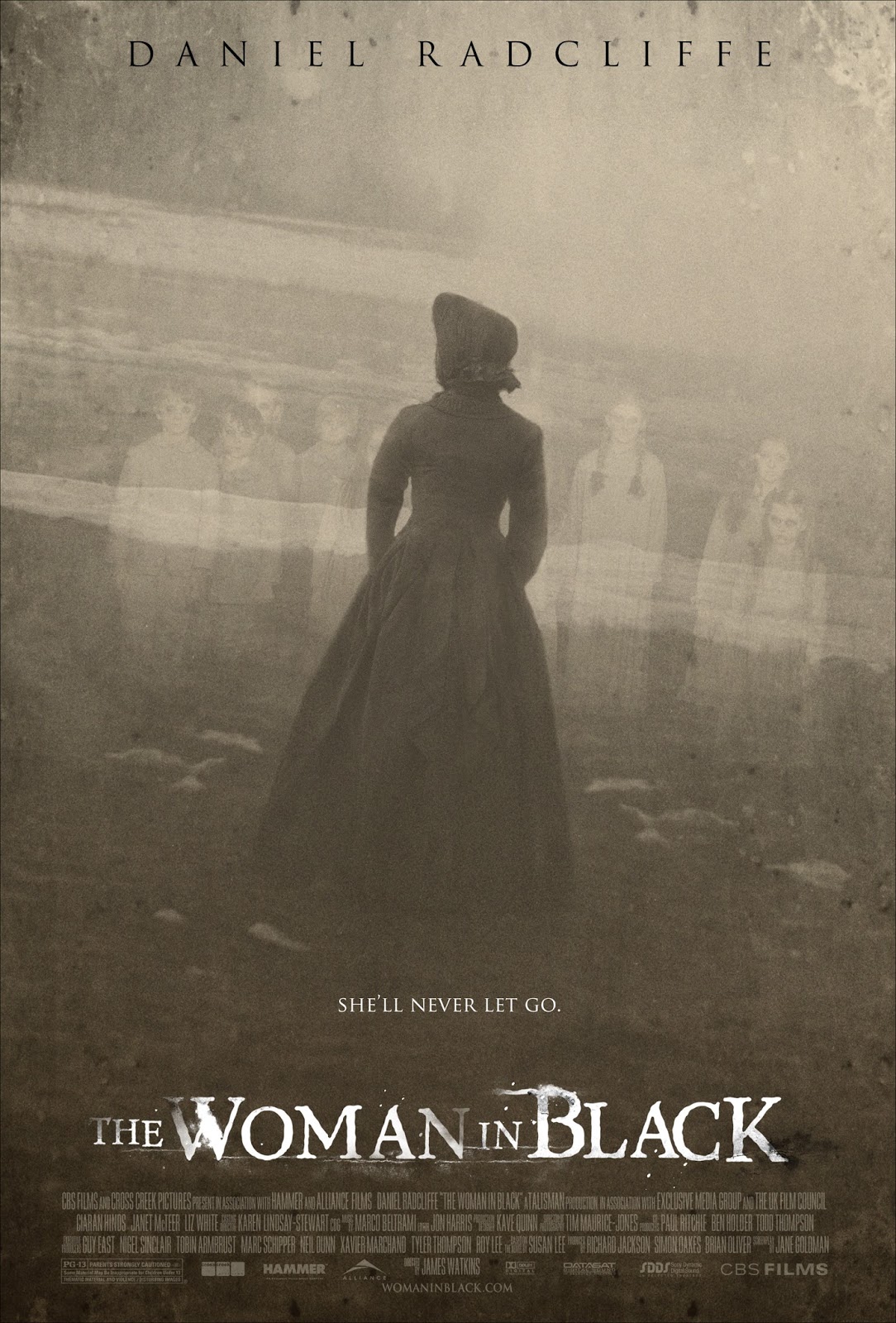
The Woman in Black is a film I’ve been wanting to see
for a while, but I was hesitant because it was released in theaters in February,
which is notoriously a dumping ground for bad and mediocre films. However, it
did well at the box office and since then it has been a popular rental every
October at the video store where I work, Vulcan Video. The Woman in Black is
also rated PG-13, which horror movie fans will tell you usually indicates a
tepid, unfrightening movie. There are exceptions to every rule and The
Woman in Black can join the small club of good, scary PG-13 horror movies.
The Woman in Black was produced by the recently revived
Hammer Films and it is a fine, solid entry in the Hammer filmography. Hammer Films is a British production company best known for
its horror films of the 1950s and 60s that were shot in Technicolor,
typically had Gothic settings, and had violence and special effects more
graphic than had been seen in horror films up to that point. Like many
of the classic Hammer horror films, The Woman in Black
has a period setting and relies on mainly on mood and atmosphere to transport
the audience to a world of supernatural horrors, but still casts great British
actors to fill out the cast.
Daniel Radcliffe stars as Arthur Kipps, a young lawyer in
Edwardian era England who travels to a remote, gloomy village to collect the
papers of a recently deceased client. This is Radcliffe’s first post-Harry
Potter role and seeing him as someone other than the iconic Harry Potter is
easier than you think. Radcliffe has grown into a fine actor and gives a good
performance, though there is not much to do with this character. That is not a
big problem, however, because this film knows the real star is its mood and
atmosphere, which is thick and dreary.
Fog and mist float though several scenes. The period setting (the clothes, the
old cars, and candlelight) only strengthen the eerie, spooky feel of the movie.
Kipps finds himself staying in the decaying, ominous mansion of his
dead client which is on an island accessible only by a road on a sandbar at low
tide. The mansion in the marsh is exactly what you hope to see in a haunted
house. In addition to being on an island in a marsh, the house is next to a graveyard. The production
design of the house itself is incredible. It has long hallways and rooms filled with
creepy antiques and dusty old toys.
The scenes of Kipps alone in the mansion are the scariest because of the sound
design. The best and most frightening sequence in the movie has Kipps being
tormented late at night by creepy, unexplainable sounds and flickering ghostly
visions. When we finally see her, the woman in black herself is very scary and
creepy. There are some CGI effects which is only to be expected in any effects movie
made in the 21st century, but The Woman in Black relies most on
shadows and whispers to scare us.
Kipps is determined to stay and complete his job as his
future at his law firm depends on it and he has a young son to support all on his
own; his wife died in childbirth. The locals all want him to leave because the
house in the marsh is haunted by a sinister spirit whose apparition signals the
death of a child. After village children begin suffering tragic accidents,
Kipps begins to investigate the identity of the spirit and the history of the
mansion in the marsh.
With its ending, The Woman in Black manages to have its cake
and eat it too. It moves towards a logical, satisfying ending but still
feels compelled to give us the obligatory “final scare” that typically ruins
most horror movies. This movie manages to have a final scare, but also have a
satisfying, yet somber ending. If you watch a lot of horror movies, there are scenes you know are going to happen because they are practically required in a scary movies, but even these moments are well
done. There is some great macabre imagery, but no gore and nothing too intense for
more skittish viewers. This is a fine example of a movie being scary without
being violent, or dark, or cynical.