Showing posts with label British Horror. Show all posts

Friday, October 24, 2025

13 Nights of Shocktober: The Uncanny

 by A.J.

Night 6: Anthology Horror Night
“It was the cat that did it.”
It’s good for a horror anthology to have a theme to keep it on track and tie the stories together, even in a loose way; it makes the collection a more satisfying and cohesive experience. The 1977 horror anthology The Uncanny has perhaps the best possible theme: cats. The legendary Peter Cushing plays an author who is finally ready to reveal his latest book, which will make public how cats are actually intelligent and devious creatures who seek to control and even kill humans. His potential publisher, played by Ray Milland, is very skeptical, so Cushing tells him three stories that will prove the murderous nature of cats. If that sounds silly, that’s because, well, it is. If it sounds like not that much of a stretch because cats are clever and intelligent, that’s because, well, they are. The Uncanny takes full advantage of the unlikely combination of  deviousness and cuteness in such a creature. This movie never asks you to take it seriously and thus is quite entertaining. 
The first story is set in London in 1912. Joan Greenwood plays the wealthy Ms. Malkin who has cut her nerdowell nephew out of her will and left everything to her cats. Her housemaid, Janet (Susan Penhaligon), overhears this and alerts the nephew, with whom she is having an affair. He tells her to steal the will and Janet complies but is caught and smothers Ms. Malkin. The only witnesses are the cats who are determined on revenge. In Quebec 1975 young Lucy (Katrina Holden Bronson), whose parents recently died, is sent to live with her aunt, uncle, and cousin. Lucy’s only comfort is her beloved cat Wellington but her aunt can’t wait to get rid of Wellington and Lucy’s books about magic, tarot, and witchcraft. Wellington is sent away to be put down but escapes and returns and for revenge. In the final story, set in Hollywood in 1936, Donald Pleasence stars as Valentine De’ath whose wife tragically dies of an “accident” while on a movie set. He suggests that the production should continue with his mistress, Edina (Samantha Eggar), taking over his late wife’s role. He never paid attention to his wife’s cat, whose name he doesn’t remember, nor is he aware that the cat is actually a female. When he finds that the cat has a litter of newborn kittens, he drowns them in the toilet (off screen). If any cat ever deserved her revenge it is this cat and she gets quite inventive. Neither Cushing’s or Milland’s character seems to realize that the cats in these stories, though murderous, are not actually evil. They only seek revenge after being wronged.
Each of these segments and the interstitials with Cushing and Milland are filled with countless shots of staring cats set to ominous music. The laughs that come when a tiny fake paw darts out and scratches Janet’s hand every time she tries to reach for the will are perhaps unintended but fun. The same goes for shots of the cat in the Hollywood story trotting on the catwalk of the soundstage and chewing through the rope of an overhead light.

The London 1912 story is more of a thriller story. Janet was not able to clean up the crime scene before being attacked by the cats so she cannot answer the door or phone for help and is basically trapped. The Quebec segment is perhaps the weakest. The most shocking revelation of this story should be not that cats understand injustice, but that witchcraft is real. It has a dark joke of an ending that plays like a punchline that doesn’t really work. The third segment has dark humor that works. Pleasence does a great job playing an overly serious hammy actor. 
There’s comedy in every scene where an adult human is outwitted and outfought by a cat. A scene where a cat jumps on a man and rips his throat out and then runs off is ridiculous but also kind of scary. Some of the effects are dated (fake paws and fake cats) but others are still effectively gruesome. Peter Cushing is 100 percent committed to being frightened and paranoid about cats. He is doing the work of believing the incredulous premise so that we can just be entertained. Aside from one or two graphic horror images, this makes for a great and enjoyable movie for the more squeamish crowd.
The Uncanny has everything you’d want in a Shocktober movie: some scares, great acting, a sense of fun, and lots and lots of cats.

The Uncanny is available to stream for free on Tubi and Plex.  

Monday, October 28, 2024

13 Nights of Shocktober: From Beyond the Grave

by A.J.

Night 10: Anthology Horror Night
“All tastes catered for. Oh, and a big novelty surprise goes with every purchase.”

Horror anthologies, or portmanteau films, are maybe my favorite horror subgenre. Multiple stories of different kinds wrapped up for the price of one movie. Many horror stories, in fact most, no matter what kind (monsters, slashers, allegories, whathaveyou) work best in short form simply because there is less time to pick apart details or overthink a thin premise. In the late 1960’s and throughout the 1970’s the British production company Amicus specialized in horror anthologies. Their most famous film is Tales From the Crypt (1972). Their 7th and final production, From Beyond the Grave (1977) did not fare well at the time, but it is quite entertaining and makes for great spooky-not-scary Shocktober viewing. 
From Beyond the Grave has four separate stories following people who visit an antiques store run by none other than horror legend Peter Cushing. Each story is based on a short story by British author R. Chetwynd-Hayes and all have the same director, Kevin Connor, and cinematographer Alan Hume (later to shoot Return of the Jedi and A Fish Called Wanda), so they all have a similar aesthetic while also having just enough variety in tone to feel distinct. Every anthology movie winds up feeling uneven to a certain degree and From Beyond the Grave is no exception, but overall there is more to enjoy than not. 
The first story, “The Gate Crasher”, has David Warner purchasing an old spooky looking mirror. He has some friends over and one of them says the mirror looks like something a medium would have. This prompts someone to suggest they have a séance, so they do, because why not. This calls forth an evil spirit trapped in the mirror who hypnotizes Warner into luring people to his apartment and killing them. The premise feels familiar if you’ve seen enough horror movies but it’s a good start and probably the darkest of the four stories. 
The second story “An Act of Kindness” is probably the best of the four. It stars Ian Bannen as a put-upon office manager with an overbearing wife who befriends a peddler played by Donald Pleasence. The peddler invites the office manager to his flat for dinner and to meet his daughter (played by Pleasence’s real life daughter, Angela). Of course, the peddler and his daughter are not what they seem. This segment benefits from the added layer of the office manager seeming to be a proper gentleman but actually being an undignified, pathetic man (he steals a war medal to impress the peddler) and the lowly peddler actually have the dignity and self respect the office manager only pretends to have. It also benefits from a great performance from Donald Pleasence. This story ends with a twist that plays a bit like a joke and seems to come out of nowhere but it fits the tone of the story. 
The third story has a man switching the price tags on snuff boxes in Cushing’s store. On the train ride home a goofy psychic calling herself Madame Orloff (Margaret Leighton) claims that he has a nasty elemental on his shoulder and gives him her card. When he gets home the dog won’t stop barking at him and his wife gets mysterious scratches, so he calls Madame Orloff to perform an exorcism. The exorcism is Madame Orloff giving him an insane shoulder massage while objects fly around the house. This is clearly a comedy and is a nice tonal switch up.
The final story is relatively straightforward. A young man asks to buy the extremely spooky looking door with a scary gargoyle carving. It’s crazy that this guy wants this; it’s even behind stuff that Cushing has to move out of the way. Perhaps the craziest thing about this story is that the guy uses this door for a simple closet in his otherwise average looking house. Of course later when he opens the closet he finds a big abandoned room covered in layers of dust and cobwebs. The room holds the spirit of a 17th century warlock who needs a body to finish a ritual and escape into the real world. There is not a lot to this story but the old room, lit with an eerie blue light and covered in cobwebs provides a good spooky atmosphere. 
There isn’t anything in From Beyond the Grave that will make you jump or cover your eyes, and there are more than a few moments that will make you laugh or even giggle. However, each story works well on its own and also as part of a larger anthology of people getting more than they bargained for and sometimes deserving what they get. 

From Beyond the Grave airs on TCM on Wednesday, October 30th and 6:15AM CT.

Monday, October 23, 2023

13 Nights of Shocktober: Dr. Phibes Rises Again (1972)

 by A.J.

Night 5: Vincent Price Night
“The incredible legends of the abominable Dr. Phibes began a few short years ago, all of them unfortunately true!”

The Abominable Dr. Phibes is one of the best Vincent Price movies, if not the best. It is a totally fantastic, wildly entertaining movie that I’ve written about before and could write about even more. It has to be seen to be believed. Topping a movie like The Abominable Dr. Phibes is pretty much impossible, but the sequel, Dr. Phibes Rises Again, comes very close. 
If you haven’t seen the first film, not to worry, as the sequel opens with a narration and recap. Dr. Phibes (Price) was an Egyptologist who was horribly disfigured in a car accident and presumed dead. He actually survived but wears an incredibly realistic mask of his former face and can speak only through a special device connecting his neck to a speaker. Due to medical neglect his beloved wife, Victoria, died, but Phibes has her preserved in a suspended state. The Abominable Dr. Phibes had Phibes taking elaborate revenge on the team of doctors who failed to save his wife. Dr. Phibes Rises Again has him seeking the hidden River of Life in Egypt that will revive his wife and give them both eternal life. 
Dr. Phibes’s rival in the search for the River of Life is an archeologist named Darrus Biederbeck (Robert Quarry) who steals an ancient papyrus scroll from Phibes. So, Dr. Phibes unleashes his elaborate wrath on Beiderback and everyone standing in his own path to the River of Life. Biederbeck is arrogant and suspicious, and while he eventually earns some sympathy he never quite comes off as a hero or protagonist. Phibes, of course, is a murderous mastermind whose preferred execution method is elaborate and ridiculous devices, but in this film he comes across as more of an anti-hero; in the first film he was a charismatic and sympathetic villain. The closing credits group Phibes and Biederbeck together under the heading “protagonists” but Phibes is the character you are rooting for, or at least find more entertaining.
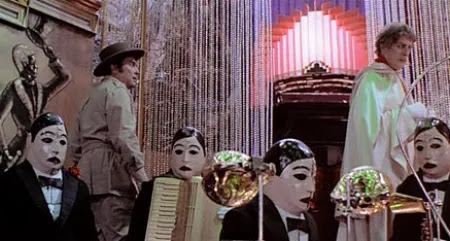
Many of the distinct stylistic elements that made the original film so memorable are also in the sequel. The elaborate art-deco design of Phibes’s lair is replicated in his Egyptian lair. His band of automaton musicians, The Clockwork Wizards, are now The Alexandria Quartet. Phibes’s beautiful but silent assistant, Vulnavia (this time played by Valli Kemp), is once again ready to help. And of course, Phibes still kills with ridiculous methods. One of the simpler kills involves distracting a man with a mechanical snake while a real snake attacks. Other deaths include but are not limited to: a raptor pecking someone's face to death and Phibes and Vulnavia faking a sandstorm to cover up the sounds of a man being crushed in a box. Robert Fuest returns as director for the sequel and once again his background in production design provides an
exquisite, fun, and distinctive look.
Dr. Phibes was one of Vincent Price’s favorite roles and it is easy to understand why. Phibes is technically a villain but is sympathetic; he is vengeful but not hateful. He is devoted to Victoria and thanks to Price’s performance, Phibes’s love comes across as genuine and true instead of obsessive. Phibes is also a silent character, sort of. Since he must be connected to a machine to speak, his lips do not move while he talks, meaning that Price acts along to a recording of his voice. If acting is reacting, then Price gets to do both with the same character in the same scene in the same performance. The phonograph crackle of the speaking machine adds a nice eerie layer to the dialogue and monologues delivered wonderfully by Price. Dr Phibes is indeed one of Price’s best performances. 
The Phibes movies are not scary but they are excellent horror entertainment. They are campy, pseudo-slasher movies. If you ever wondered what the SAW movies would be like if all of the gruesome gore and cynical dread was replaced with fun, you should watch The Abominable Dr. Phibes and/or Dr. Phibes Rises Again. Like the original, the Dr. Phibes Rises Again revels in the ridiculous, the baroque, the weird. In one scene, Phibes puts someone in a catch-22 torture device. In another Vulnavia is wearing a sousaphone for no reason. The first time I  saw The Abominable Dr. Phibes was on Halloween night in 2015. I watched Dr. Phibes Rises Again on also on Halloween night. Watching either film is a perfect way to celebrate the Halloween season.  
For a long time both movies were very hard to find but thankfully they were recently released as a double feature Blu-ray. Both films will air on TCM as part of a late night Vincent Price marathon beginning on Tuesday, October 24th at 11PM CT with
The Abominable Dr. Phibes followed by Dr. Phibes Rises Again at 12:45AM CT Thursday, October 25th. Dr. Phibes Rises Again is also currently streaming on Tubi and Freevee.

Thursday, October 27, 2022

13 Nights of Shocktober: Peeping Tom

 by A.J. 

This is my favorite time of year, second only to Christmas. Autumn has arrived, the weather is cooling down, and October becomes the month-long celebration of scary movies called Shocktober. So, for the days leading up Halloween I’ll be posting some horror movie recommendations to help you celebrate Shocktober.

Night 9: Psychological Horror
“Taking my picture?”
Whether you are interested in horror movies, classic movies, or film history in general, eventually you find Peeping Tom. It is a peculiar film: made in a classic style, shot in bold technicolor, and made at a time when horror, like other genres, was beginning to touch on darker subjects and themes. Too dark for many in 1960. Peeping Tom was so reviled by critics and audiences that it was pulled from theaters and essentially ended the career of Michael Powell, the renowned British director of many revered classics such as The Life and Death of Colonel Blimp, The Red Shoes, Black Narcissus, and The Thief of Bagdad. Powell and Peeping Tom were ahead of their time; a cliché but true. Only eight years later Rosemary’s Baby, a much much darker film, would achieve mainstream success with critics and audiences. In the decades since it’s disastrous release, Peeping Tom has been recognized as a classic, and you’ll find it on many underrated, overlooked, or “best movies you’ve never seen” lists. Of course the standards of what is shocking and vile change so much that the visuals and set pieces in Peeping Tom would be considered tame by the next decade. The real horror in Peeping Tom is in what you don’t see, in what it implies, and in its themes which retain their disturbing and dreadful shock value. 
In a way, Peeping Tom is about making movies. It is certainly about watching movies. Our main character is Mark (Carl Boehm) , a young, handsome Austrian man, who works as a focus puller at a British movie studio. He also moonlights as a smut photographer for pornographic magazines. Also, he is a serial killer who films his victims at the moment of their death. As memorable as Freddy Kruger’s glove with knives or Leatherface’s chainsaw is Mark’s weapon of choice: a knife hidden in the leg of his camera’s tripod. As he moves in for a close up, so does the blade. 
Mark owns the building where he lives, inherited from his father, but he cannot afford the upkeep so he rents the other rooms. His apartment is unassuming, but there is, as you might imagine, a back room where he develops and screens the films of his murders. In the apartment below him live Helen (Anne Massey) and her mother (Maxine Audley). In the excitement of her 21st birthday, Helen invites Mark to her apartment. When he hesitates, she goes to his apartment where she, and we, learn his backstory. We learn that Mark’s father, a famous psychologist, conducted and filmed experiments on Mark as a child to learn about children’s reactions to fear. We see “home movies” of him harshly waking up Mark in the middle of the night by shining a light in his face or dropping  lizards on him. Mark’s killings are part of of own his own documentary on fear and death. It is not until the climax that we realize the full scope of Mark’s documentary of death.
Helen is shy, like Mark, but also full of life. She is a strong enough force on him that she convinces him to go on their date without bringing along his beloved camera. However, after Helen kisses Mark, he responds by kissing the lens of his camera as though he is compelled to do this. Perhaps this is because Mark was not able to film their kiss, or perhaps because experiences are only real for him if is his camera “sees” them, or perhaps because Mark sees himself as a camera. That Peeping Tom allows for multiple pathways to explore its themes and subtexts is what makes it a great film and explains why it has endured through the decades despite its initial unwelcome reception. 
Perhaps the film’s signature sequence involves Mark and Viv (Moira Shearer), an extra in the film currently shooting at the studio, sneaking on set at night. Viv believes they are there so Mark can film her dance. Mark, and we, know the real reason she is there. Shearer, who starred in Powell’s The Red Shoes, dances as Mark rearranges the set and adjusts the lights, making sure everything is just right for the camera. Shearer is so full of life that we feel the full weight of the impending tragedy yet we accept it as a fulfillment. 
It is worth noting that Peeping Tom was released in not only in the same year, but mere months before Alfred Hitchcock’s Psycho. The reaction to the two films could not have been more different. Roger Ebert speculated in his Great Movies essay on Peeping Tom that this was “because audiences expected the macabre from Hitchcock” while Powell was known for “elegant and stylized films.” It’s hard not to compare and contrast the films once they are linked. Both films feature psychologically damaged young men but while Psycho only flirts with voyeurism, Peeping Tom is expressly about voyeurism. Powell employs the POV (point of view) shot that not only shows us exactly what Mark sees when he commits the murders, but implicates the audience in the crime. Countless slasher films from the 1980’s onward would use the POV shot to either not reveal the identity of the killer or for pure sensation. Powell uses the POV shot not only for sensation but as part of an attempt to explore the life and mind of a person who would commit such crimes. However, unlike Psycho, shot in black and white, Peeping Tom is shot in bold and vivid technicolor. I believe that this is major reason why audiences had such an intense negative reaction. 
The saturated technicolor look which Powell had mastered through the 1940’s and 50’s implied a warm, uplifting picture. It was generally used by musicals and comedies while noir films and prestige dramas where shot in black and white. Even dramas shot in technicolor tended to be broad melodramas, well done soap operas on the big screen, like the films of Douglas Sirk (Imitation of Life, Magnificent Obsession, Written on the Wind). Peeping Tom showed people in full technicolor something they would rather leave in the shadows.

Peeping Tom airs on TCM on Sunday, October 30th at 7PM CT and is streaming free on Tubi and the Roku Channel. 

Monday, October 25, 2021

13 Nights of Shocktober: The Curse of Frankenstein

 by A.J.

This is my favorite time of year, second only to Christmas. Autumn has arrived, the weather is cooling down, and October becomes the month-long celebration of scary movies called Shocktober. So, in the days leading up Halloween I’ll be posting some horror movie recommendations to help you celebrate Shocktober.

Night 7: Hammer Horror Night

Christopher Lee: I’ve got no lines! Peter Cushing: You’re lucky. I’ve read the script. The Curse of Frankenstein
There are more than a few things that give The Curse of Frankenstein a special place in horror film history. It was the first remake of a classic Universal monster movie by the British film company Hammer and its success led Hammer to produce other Universal monster movie remakes, each with its own line of sequels, and other horror films as well. Throughout the 1950’s, traditional horror films focusing on monsters, ghosts, or curses had taken a backseat to science fiction films that had some horror elements but focused on the fears of the atomic age: monsters from outer space, the effects of nuclear radiation, or experiments gone wrong. The Hammer horror films are credited by some film historians and cinephiles with revitalizing the horror genre and attracting new audiences. They were shot in vivid color, utilized eye-catching period sets and costumes, and contained a level of violence, blood, and sexuality that was new and shocking for the time. It all started with The Curse of Frankenstein. Watching The Curse of Frankenstein today, there are certain aspects that may seem dated or hokey and its shock value has waned but not disappeared. It is easy to see why this film stood out at the time and has become a classic.
Perhaps as significant as its success for Hammer, The Curse of Frankenstein was the first film to pair Peter Cushing and Christopher Lee on screen together
—they had previously appeared in the same movie, Hamlet (1948), but in different scenes. Cushing and Lee met for the first time and became friends by complaining about the script together. They appeared in numerous films together for Hammer and other studios becoming horror movie icons and their friendship lasted until Cushing’s death in 1994.
This version of Mary Shelley’s novel begins with Dr. Frankenstein (Peter Cushing) in prison telling his story to a skeptical priest. We see a flashback to an arrogant teenage Victor Frankenstein, who inherits his father’s fortune and aristocratic title and uses the money to hire a tutor, Paul, to teach him medicine. Over the years they conduct experiments that eventually allow them to resurrect a puppy. Both are thrilled but for different reasons. Paul (Robert Urquhart) wants to use their discovery to improve medical care by putting a patient into temporary death to perform a surgery without any shock to their system and then revive them. Frankenstein, however, wants to build a bigger, superior being. There’s no reason given for why Frankenstein wants to do this, but the book also doesn’t explain Frankenstein’s motivations since there is no good reason for wanting to build a new human out of dead body parts. Paul reluctantly agrees to go along with Frankenstein’s idea and together they create the Creature.
Despite his problems with the script, Cushing gives a great performance as the villainous Dr. Frankenstein. It's tempting to want to think of Victor Frankenstein as a hero because he pushes the boundaries of science and fights a monster, but this Frankenstein is a cad and villain. He doesn’t just rob fresh graves for body parts, he kills people. For a superior brain for his Creature, Frankenstein invites an old professor to his house then pushes him to his death. The brain is damaged but he uses it anyway leading to the Creature’s lumbering movement and murderous behavior. Also, Frankenstein is having an affair with his maid, Justine (Valerie Gaunt), even though he’s engaged to Elizabeth (Hazel Court). When Justine threatens to expose his horrendous experiments if he doesn’t marry her, Frankenstein uses the Creature to dispose of her. Cushing often played the hero in horror movies, or someone driven to extremes, but he is also really good as a sinister villain. You want him to stop the monster, but you also want him to get his comeuppance.
The reveal of the Creature’s face is a striking moment. The Creature lumbers to life, pulls off the bandage covering its face, and camera rushes in for a close up. Though Mary Shelley’s novel was in the public domain, Universal held the rights on the makeup design of the monster from their 1931 version of Frankenstein, one of the most iconic images in film history. So, the design of the monster here is very different from the Universal monster. This Creature’s design is nowhere near as memorable as the look of Boris Karloff as the Monster, but the film is better for trying something different.
Christopher Lee doesn’t have a lot to do as the Creature. It’s obvious that the movie couldn’t decide if it wanted him to be sympathetic, like in the Universal movie, or just a force of destruction. Still, Lee’s imposing size gives the Creature a sense of immediate danger. Lee would get to show off his verbal talents and charismatic screen presence in the next film he and Cushing starred in together for Hammer, Horror of Dracula, one of my favorites.
The period 19th century costumes and sets look great in color. There are some exterior scenes where the background is obviously a matte painting, but this adds to movie’s fantastical atmosphere more than it distracts. Frankenstein’s laboratory is filled with bubbling jars of colored potions and the Creature is kept in a water tank. Nothing in his lab looks especially scientific but this adds to the unnatural side of his experiment, and it looks great in color. Terence Fisher directed The Curse of Frankenstein and while many directors had a hand in Hammer horror movies, his remain among the best. Seeing the names of Cushing, Lee, and Fisher together mean that you’re in for a treat.

Tuesday, October 19, 2021

13 Nights of Shocktober: Curse of the Demon (aka Night of the Demon)

 by A.J.

This is my favorite time of year, second only to Christmas. Autumn has arrived, the weather is cooling down, and October becomes the month-long celebration of scary movies called Shocktober. So, in the days leading up Halloween I’ll be posting some horror movie recommendations to help you celebrate Shocktober.

Night 1: Classic Horror Night
“I know the value of the cold light of reason, but I also know the deep shadows that light can cast.”
Curse of the Demon is not among the most well-known classic horror films, and it’s from the late 50’s, well past the golden age horror of the 1930’s and 40’s, but it is definitely deserving of “classic” status. Based on the story Casting the Runes by M.R. James, this British production was written by Charles Bennett, who also wrote the Alfred Hitchcock films The Man Who Knew Too Much (1934) and The 39 Steps, and directed by Jacques Tourneur, who directed the low-key horror films Cat People and I Walked with a Zombie for producer Val Lewton and RKO studios. The leads are Dana Andrews, from the mystery classic Laura, and Peggy Cummins, co-star of the Noir cult classic Gun Crazy. So, all together this film has impressive credentials. Despite creative differences between Bennett, Tourneur, and producer Hal E. Chester over the titular demon, the result is a memorable and eerie film that successfully combines psychological horror with more overt horror elements.
Dana Andrews plays Dr. Holden, an American psychologist in England investigating a satanic cult and its sophisticated but nefarious leader, Dr. Karswell. Joanna (Cummins) believes that the mysterious death of her uncle, a psychologist who was also investigating the satanic cult, is not only linked to the Karswell but caused by dark supernatural forces. Dr. Holden is skeptical, even about the death curse Karswell put on him, but then he begins having strange experiences. As the calendar counts down his demise, Joanna and Holden search for a way to reverse the curse.
It is not a spoiler to reveal that Karswell is in fact summoning a demon to do away with his enemies since this is made clear in the opening scenes. In fact, this is the creative choice that divided Bennett and Tourneur against producer Hal E. Chester. Both Bennett and Tourneur believed that less was more when it came to horror. They believed that suspense, ambiguity, and the power of suggestion allowed the audience to scare themselves more than any monster or special effects. Chester had the opposite perspective. I can understand both points of view. Relying on atmosphere, suspense, and tricks that only suggest a monster are what make Tourneur’s films Cat People and I Walked with a Zombie so great. A Hitchcock film like The 39 Steps relies on well-established characters in tense situations instead of effects. On the other hand, Curse of the Demon still has plenty of eerie atmosphere thanks to Tourneur’s style and smart characters thanks to Bennett’s screenplay, and it is still suspenseful but in a different way. Instead of being unsure about black magic like Holden, we know that the curse and demon are real. The longer it takes for Holden to accept this, the less time he has to figure out how to stop Karswell.
The demon is pretty impressive. It is big, has a scary monster face, and appears in eerie light and fog. The movie would have a different tone if the demon was only suggested, but its inclusion does not undercut any of the low-key elements. The demon is only used twice, each time to great effect. Seeing it at the beginning establishes a high level of danger for the characters and its appearance at the end is a satisfying payoff. If there’s a monster that threatens to undercut the movie it’s the housecat that turns into a panther (big stuffed animal) that Dana Andrews has to wrestle. It doesn’t ruin the movie but it is the only moment where the seams show. Brief as it is, this moment is up there with Christopher Lee fighting a stuffed dog in The Hound of the Baskervilles (1959). The creepiest and most impressive special effect is the glowing ball of fog that chases Andrews through a forest at night.
Dana Andrews does a good job playing a skeptical psychologist, so you don’t become frustrated with how long it takes him to believe in the supernatural. Peggy Cummins also gives a good performance and her character helps to drive the plot instead of just being the woman along for the ride. There are some nice touches of humor like when we first meet Dr. Holden on a plane trying to sleep. He covers his face with a newspaper that has a story about him. The séance that Joanna takes Dr. Holden to begins with two women singing a song about cherry pie and the medium goes through a few different accents before finding the right spirit guide. The final confrontation between Dr. Holden and Karswell is excellently written and acted. Each character is trying to outsmart the other without letting on that he knows what the other is doing. Just when you think one character has the upper hand, the scene continues.
Though it is only in two scenes, you’ll find the demon’s face on the movie poster, DVD art, and streaming service thumbnail images. That image combined with a sensational title like Curse of the Demon might make you expect a schlock B-movie, but this a well-done, creepy horror film that relies on suspense, atmosphere, convincing characters, and clever writing more than special effects, though the effects are well-done too. When he collaborated with producer Val Lewton on horror movies, Jacques Tourneur also created films that surpassed their sensational (or silly) titles and frightened audiences in unexpected ways. He did the same again with Curse of the Demon.
There are two versions of this film. It was released first in the U.K. as Night of the Demon in 1957. A year later it was released in the U.S. as Curse of the Demon because Columbia studio executives were afraid audiences would get it confused with the John Huston film Night of the Iguana and 13 minutes were cut so it could play as a double feature. No matter which version you watch, you’re in for a spooky and satisfying night.