Showing posts with label Psychological Horror. Show all posts

Wednesday, October 23, 2024

13 Nights of Shocktober: The Witch Who Came From the Sea

by A.J.

Night 5: Serial Killer Night II
“Why did she come out of the sea?”

I must admit that I was completely unaware of The Witch Who Came From the Sea before coming across it randomly on the streaming site Tubi and was only interested because of the outrageous title. I was more than surprised by what I saw. This low budget proto-slasher film from 1976 qualifies as a horror movie because of its bloody violence and cerebral imagery. However, two more things separate and even elevate this movie from other serial killer and slasher movies. The first and most obvious: it flips the gender of the killer, so the psychologically damaged killer is a woman. The second: the screenplay focuses on the troubled emotional and psychological state of the killer, turning this would be exploitation movie into a compelling character study, even though the psychology is fairly basic. 
Millie Perkins stars as Molly, an average working class woman who lives by the sea. She adores her two nephews and despises how few “heroes” there are for young boys. She idolizes her deceased father, but remarks from her sister hint at a less than ideal father. Disturbing flashbacks reveal his true abusive relationship with Molly.
By 1976 there had already been many films, especially Italian giallos (mystery films) that, inspired by Hitchcock’s Psycho, were about a killer who was driven to kill their intense and conflicted feelings of attraction and repulsion to women stemming from abuse suffered as a child. Molly is driven by the same conflict but from the perspective of a female character it feels fresh and revealing. The screenplay by Robert Thom provides a great showcase for the talents and skills of Millie Perkins, Thom’s wife at the time, by making Molly a multifaceted character who draws our sympathy or at least our understanding as she murders. 
To be sure, this was created as an exploitation movie. There is a lot of sex and nudity and violence; though not all of the sex and nudity is sexy and not all of the violence is sensational or fun. Molly seduces two very muscular football players and drugs them. One passes out. She ties down the other and he realizes too late this is not a sexual game and he is in trouble. She grabs at his Achilles tendon and fretting over having only a small safety razor and complains, “this is going to take forever.” There is some squirting blood but most of the violence is off screen and we are thankful for it. 
There is also humor too: intentional, unintentional, and awkward. The oddball tattoo artist Jack Dracula reveals that people call him that because that’s his real name. The opening sequence has Molly with her nephews at the beach but she is distracted by ultra muscular men exercising nearby. The camera cuts to close ups of their speedo clad bulges then back to Molly in the throws of desire and disgust. This movie isn’t afraid to turn on a dime from humor to horror. 
The stylistic choices by director Matt Climber pay great attention to Molly’s complex emotional and psychological state. In one scene, a handsome mostly nude man in a TV commercial talks directly to her. There are flashes shown in psychedelic colors of a woman tied to a stake on a raft adrift at sea with dismembered body parts all around her. These surreal touches are captivating and put you in the same bewildered headspace as Molly.
The psychology is simple, perhaps even too simple by even a common understanding today, but unlike slasher movies before or since, this movie cares about its antihero/killer protagonist. Her backstory and past abuse and trauma are more than just an excuse for murder. This movie cares more about Molly’s peace of mind than sensational kills. The ending, like the rest of the movie , is unconventional for the genre, but it is fitting for this story and character.
The Witch Who Came From the Sea is available to stream for free on Tubi.

Monday, October 21, 2024

13 Nights of Shocktober: Cape Fear (1962)

by A.J.

Night 3: Thriller Night
“You still don’t get it, do you, counselor?”

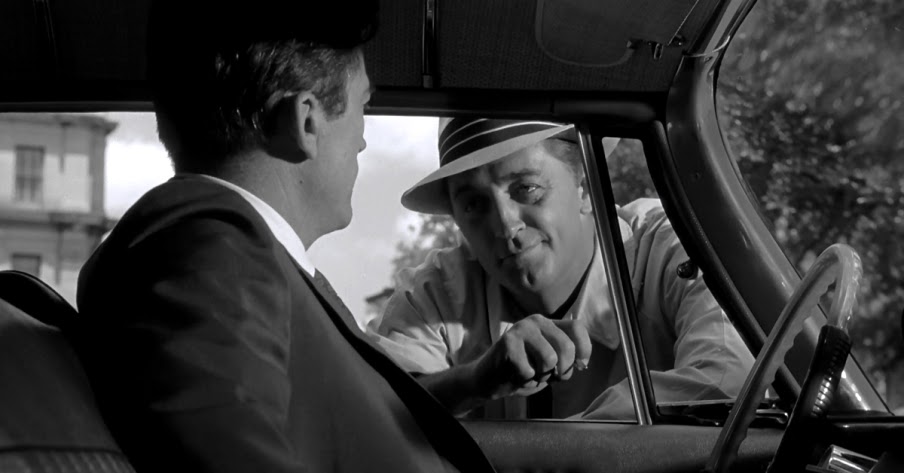
The original classic Cape Fear is a thriller, not a horror movie, but there is enough suspense and deep dread to make it a great alternative to bloody slashers or graphic horror movies. Little about it is dated; there are scenes that will make your skin crawl. The two elements that make Cape Fear so effective are the powerful, ominous score by the legendary Bernard Herrmann and the chilling performance of Robert Mitchum as one of the screen's most sinister and dangerous villains: Max Cady. 
In the same year that the great Gregory Peck played the upstanding, righteous southern lawyer Atticus Finch in To Kill a Mockingbird, he also played another upstanding, righteous southern lawyer, the admittedly less memorable Sam Bowden, in Cape Fear. Seemingly out of the blue, Sam finds himself and his family stalked and menaced by Max Cady, who recently completed an 8 year prison sentence and blames Sam for testifying against him. Even though Cady is a violent man, his revenge is slow and insidious and skirts the edges of the law. As Cady’s menace grows, so does the question of how far Sam will go–whether or not he will break the law–to protect his family.   
In the making-of featurette on the Blu-ray, Peck says, "I played a good guy. More or less a predictable guy… When [Cady] walked into a scene everyone was on guard, so to speak, wondering what he might do next." He knew that even though he was playing the hero, he was not really the lead of the movie. Whoever was cast as Max Cady would be the lead and Robert Mitchum really is the star of the movie. He plays Cady as someone who is a brute and is also clever. He enjoys the psychological torment he inflicts as well as physical violence. His menace and danger grows subtly until at the climax when he more or less becomes a primordial force emerging from the waters of the Cape Fear River. Mitchum gets to show off with low key scenes and also in more confrontational scenes but he never goes over the top. The scariest thing about this character is how believable Mitchum makes him. 
It seems that Cady lives for only one reason, which is to take revenge on Sam. Despite never directly stating it, because of Production Code censorship, director J. Lee Thompson still makes it clear that Cady’s revenge plan is to torture and rape Sam’s wife and young daughter. By far the most uncomfortable scene in the movie is Cady standing on a pier eating ice cream and watching Sam's daughter clean their boat. Cady tells Sam that his daughter is almost as juicy as his wife. Sam punches him but Cady does not fight back and there is now a whole pier full of witnesses to Sam hitting him first. In another scene, shocking only because it is in a movie made in 1962, Cady uses his sinister charm to seduce a woman who he later rapes and beats (offscreen) knowing that she won't file charges or testify because it would mean recounting and explaining the details of the assault publicly. Cady does this merely to demonstrate what he is capable of. Thompson walked a tightrope with the censors with scenes like this in addition to scenes of actual physical violence.
Early in his career, Thompson worked with Hitchcock and often approached a scene by asking himself what Hitchcock would have done. He makes great use of suspense, letting the audience know what the characters do not. He also includes some fake-out jump scares, like Sam's wife being startled by a hatrack in the shadows late at night. A much more consequential fake out happens later in the movie. 
When Thompson was asked if had any objections to hiring Bernard Herrmann to compose the score, his response was, "I should think not!" Herrmann, who had already composed memorable scores for Hitchcock's Vertigo, North by Northwest, and Psycho, created another ominous and evocative score. It still packs a punch with its powerful horns and suspenseful strings. Like Herrmann’s most famous scores, there's a good chance that you've heard it even if you haven't seen the movie. When Martin Scorsese remade Cape Fear in 1991, he reused much of Herrmann's original score. 
This might sound like a pro-vigilante or “extra-legal” justice movie. After all, the law keeps failing the upstanding citizen and protecting the outsider instead, but ultimately this is not a cynical movie. I must admit I was reminded of the idealistic duel played by Batman and the Joker in Christopher Nolan's The Dark Knight. The Joker and Cady essentially have no goal other than to cause pain and destruction and goad their opponents into breaking their moral codes. If Batman or Sam breaks their code to defeat and punish their antagonist, then they have lost. Of course, Peck's Sam is much less exciting than Batman. 
Peck also worked as a producer on film and even chose the source material, a pulp novel by John D. MacDonald titled The Executioners. He chose a new title by looking at a map until he found an interesting name because sometimes, he said, “geographical titles” were successful like Casablanca or Dodge City. I think only the Coen brothers with Fargo have had as much success with picking a random city as the title of their movie.
Cape Fear (1962) is airing on TCM on Sunday, October 27th at 1AM CT. It is also available to stream on Prime Video.

Tuesday, October 24, 2023

13 Nights of Shocktober: Gothic (1986)

 by A.J. 

Night 6: Horror Origins Night/Julian Sands Memorial Night
“As long as you are a guest in my house you shall play my games.”

I have long been fascinated by the “haunted summer of 1816,” when Percy and Mary Shelley, her stepsister Claire Clairmont, Lord Byron, and his traveling companion Dr. John Polidori challenged each other to create ghost stories over an unnaturally dreary and stormy summer at Byron’s vacation villa on the shores of Lake Geneva. Byron wrote only a fragment of a story, Polidori wrote the short story The Vampyre, and Mary Shelley wrote Frankenstein. Adding an extra layer of eerie lore to this true story is that their “haunted summer” was caused by the “Year Without a Summer,” when a volcanic eruption from the previous year threw so much dust and ash into the atmosphere that all over the northern hemisphere of the globe summer never really happened. Temperatures were far cooler than average, even frosty and winterlike, and storms and cloudy days were more prevalent. Ken Russell’s film Gothic is a speculative exploration of what inspired those young poets and authors and what ultimately inspired Mary Shelley to create Frankenstein and change the literary world forever. 
Ken Russell is perhaps the only filmmaker who could give John Waters a run for his money in terms of works of sincere camp, and sincere sleaze for that matter. His films are often broad, range from mildly to especially ridiculous, are highly sexual, blasphemous, and explore the origins of myths, as well as the psychological effect of imposed norms on complex persons. In Gothic, the characters grapple with their inner demons and fears, enhanced by cabin fever, until everyone reaches a psychological, nightmarish breaking point during one especially stormy night. With its strange sights and not so subtle subtext, this film might be hard to take seriously, but Ken Russell is perhaps the only filmmaker not afraid to indulge the at times outrageous nature of these characters. 
The cast is great with performances to match. The less famous figures of the bunch, Polidori and Claire, have the most memorable performances by Timothy Spall and Myriam Cyr. Lord Byron is well played by Gabriel Byrne as a sinister but alluring and magnetic figure. Julian Sands as Percy Shelley is perfect as an “artist” type. He is obsessed with his own death, completely overtaken by the wonders of nature, and still is believably worthy of the affection and care of Mary Shelley. Natasha Richardson is great as Mary Shelley–actually Mary Godwin since she and Percy were not legally married at this point–who seems like the only normal or sane person on this vacation filled with eccentrics. She may also seem like the most boring character, but she is not; she is just the best at hiding her neuroses. She may also be the only character with the greatest reason for anxiety and introspection and despair: the recent loss of her newborn baby. Her complexities are buried deep and as the film goes on they rise to the surface. 
Surreal sexual images abound: a woman whose breasts have eyes instead of nipples, a suit of armor with a pointed codpiece, and the anthropomorphized image of an imp, a miniature humanlike demon, sitting on the chest of a woman in her bed–a recreation of the famous painting The Nightmare by Henry Fuseli. There is palpable homoeroticism between Byron and Polidori, and also Bryon and Percy Shelley. Polidori’s story
The Vampyre is about a vampire disguised as an English gentleman who drains the life of a young woman–Byron had an affair with Polidori’s sister that proved ruinous for her, a mere incident for him. Bryon is more than hinted at as being a vampire, living off attention and lives of those around him. Claire Clairmont is obsessed with Bryon and pregnant with his child; Percy and Mary go to visit him essentially as an excuse for Claire to see Byron again. Since her and Polidori’s affections have been already won, Bryon has little interest in them and makes advances on Mary. 
The climax is a great psychological symphony of horrors. Every character is on the brink of madness or beyond. Gothic is about people that created works of horror, who are themselves haunted by fears and anxieties that come to the forefront of their psyches during one dreary and stormy summer. In a wild, swirling sequence the characters are each confronted with their own fears. 
This is a period movie that does not feel like a period movie due in large part to the style of Ken Russell and his willingness to actually depict fantasies and nightmares for more than pure sensation. All of these characters are young, free thinking Bohemian individuals who act like young Bohemian individuals so they do not seem to belong in the costumes we associate with a time of reserve and manners. These elements give
Gothic an incongruous but lively feeling. This is a strange movie but for their time these were strange people.

Gothic is currently streaming on Tubi.

Thursday, October 27, 2022

13 Nights of Shocktober: Peeping Tom

 by A.J. 

This is my favorite time of year, second only to Christmas. Autumn has arrived, the weather is cooling down, and October becomes the month-long celebration of scary movies called Shocktober. So, for the days leading up Halloween I’ll be posting some horror movie recommendations to help you celebrate Shocktober.

Night 9: Psychological Horror
“Taking my picture?”
Whether you are interested in horror movies, classic movies, or film history in general, eventually you find Peeping Tom. It is a peculiar film: made in a classic style, shot in bold technicolor, and made at a time when horror, like other genres, was beginning to touch on darker subjects and themes. Too dark for many in 1960. Peeping Tom was so reviled by critics and audiences that it was pulled from theaters and essentially ended the career of Michael Powell, the renowned British director of many revered classics such as The Life and Death of Colonel Blimp, The Red Shoes, Black Narcissus, and The Thief of Bagdad. Powell and Peeping Tom were ahead of their time; a cliché but true. Only eight years later Rosemary’s Baby, a much much darker film, would achieve mainstream success with critics and audiences. In the decades since it’s disastrous release, Peeping Tom has been recognized as a classic, and you’ll find it on many underrated, overlooked, or “best movies you’ve never seen” lists. Of course the standards of what is shocking and vile change so much that the visuals and set pieces in Peeping Tom would be considered tame by the next decade. The real horror in Peeping Tom is in what you don’t see, in what it implies, and in its themes which retain their disturbing and dreadful shock value. 
In a way, Peeping Tom is about making movies. It is certainly about watching movies. Our main character is Mark (Carl Boehm) , a young, handsome Austrian man, who works as a focus puller at a British movie studio. He also moonlights as a smut photographer for pornographic magazines. Also, he is a serial killer who films his victims at the moment of their death. As memorable as Freddy Kruger’s glove with knives or Leatherface’s chainsaw is Mark’s weapon of choice: a knife hidden in the leg of his camera’s tripod. As he moves in for a close up, so does the blade. 
Mark owns the building where he lives, inherited from his father, but he cannot afford the upkeep so he rents the other rooms. His apartment is unassuming, but there is, as you might imagine, a back room where he develops and screens the films of his murders. In the apartment below him live Helen (Anne Massey) and her mother (Maxine Audley). In the excitement of her 21st birthday, Helen invites Mark to her apartment. When he hesitates, she goes to his apartment where she, and we, learn his backstory. We learn that Mark’s father, a famous psychologist, conducted and filmed experiments on Mark as a child to learn about children’s reactions to fear. We see “home movies” of him harshly waking up Mark in the middle of the night by shining a light in his face or dropping  lizards on him. Mark’s killings are part of of own his own documentary on fear and death. It is not until the climax that we realize the full scope of Mark’s documentary of death.
Helen is shy, like Mark, but also full of life. She is a strong enough force on him that she convinces him to go on their date without bringing along his beloved camera. However, after Helen kisses Mark, he responds by kissing the lens of his camera as though he is compelled to do this. Perhaps this is because Mark was not able to film their kiss, or perhaps because experiences are only real for him if is his camera “sees” them, or perhaps because Mark sees himself as a camera. That Peeping Tom allows for multiple pathways to explore its themes and subtexts is what makes it a great film and explains why it has endured through the decades despite its initial unwelcome reception. 
Perhaps the film’s signature sequence involves Mark and Viv (Moira Shearer), an extra in the film currently shooting at the studio, sneaking on set at night. Viv believes they are there so Mark can film her dance. Mark, and we, know the real reason she is there. Shearer, who starred in Powell’s The Red Shoes, dances as Mark rearranges the set and adjusts the lights, making sure everything is just right for the camera. Shearer is so full of life that we feel the full weight of the impending tragedy yet we accept it as a fulfillment. 
It is worth noting that Peeping Tom was released in not only in the same year, but mere months before Alfred Hitchcock’s Psycho. The reaction to the two films could not have been more different. Roger Ebert speculated in his Great Movies essay on Peeping Tom that this was “because audiences expected the macabre from Hitchcock” while Powell was known for “elegant and stylized films.” It’s hard not to compare and contrast the films once they are linked. Both films feature psychologically damaged young men but while Psycho only flirts with voyeurism, Peeping Tom is expressly about voyeurism. Powell employs the POV (point of view) shot that not only shows us exactly what Mark sees when he commits the murders, but implicates the audience in the crime. Countless slasher films from the 1980’s onward would use the POV shot to either not reveal the identity of the killer or for pure sensation. Powell uses the POV shot not only for sensation but as part of an attempt to explore the life and mind of a person who would commit such crimes. However, unlike Psycho, shot in black and white, Peeping Tom is shot in bold and vivid technicolor. I believe that this is major reason why audiences had such an intense negative reaction. 
The saturated technicolor look which Powell had mastered through the 1940’s and 50’s implied a warm, uplifting picture. It was generally used by musicals and comedies while noir films and prestige dramas where shot in black and white. Even dramas shot in technicolor tended to be broad melodramas, well done soap operas on the big screen, like the films of Douglas Sirk (Imitation of Life, Magnificent Obsession, Written on the Wind). Peeping Tom showed people in full technicolor something they would rather leave in the shadows.

Peeping Tom airs on TCM on Sunday, October 30th at 7PM CT and is streaming free on Tubi and the Roku Channel. 

Monday, October 24, 2022

13 Nights of Shocktober: The Exorcist III & Legion (Director's Cut)

 by A.J.

This is my favorite time of year, second only to Christmas. Autumn has arrived, the weather is cooling down, and October becomes the month-long celebration of scary movies called Shocktober. So, for the days leading up Halloween I’ll be posting some horror movie recommendations to help you celebrate Shocktober.

Night 6: Sequel Night
“And Jesus said to the man who was possessed 'what is your name?' and he answered, 'Legion, for we are many.'" 

The Exorcist III & The Exorcist III: Legion 
When author William Peter Blatty got the chance to direct an adaptation of his novel Legion, an indirect sequel of sorts to his infamous novel turned horror cinema touchstone, The Exorcist, he made a pretty faithful adaptation, as you might expect. However, unhappy executives at Warner Bros. demanded reshoots, including adding an exorcism and changing the title to The Exorcist III. The final theatrical version was dismissed by audiences at the time and has only recently received a fair reevaluation by cinephiles and horror fans. When I finally saw The Exorcist III last year, I was pleasantly surprised, and chilled, even despite obvious scenes of studio interference. 
In 2016, Shout Factory released a Blu-ray restoration, including a director’s cut with Blatty’s original footage, long thought to be lost. To restore the missing scenes, the director’s cut, titled The Exorcist III: Legion, used footage from VHS copies of the original dailies, so there is a dramatic shift in quality at times. It may not be exactly Blatty’s original version but is closer to his novel. Overall, the two versions are not drastically different, until the climax, even the intensely creepy tone is mostly unchanged. 
George C. Scott plays Lt. Kinderman, a Washington, D.C. detective investigating a series of brutal Christian themed murders. The forensic evidence points to a different killer for each murder but the similarities between the killings point to the infamous Gemini Killer, who was executed years ago on the same night a certain exorcism was performed on a certain girl resulting in the death Father Karras, a Jesuit priest and friend of Lt. Kinderman. The case takes an even stranger turn when Kinderman finds a mysterious patient in a hospital psychiatric ward, Patient X, who claims to be the Gemini Killer and resembles Father Karras (Jason Miller reprising his role from the first film). 
Blatty’s novel is a murder mystery that meditates on theology and good and evil. Both film versions play like a mystery whose solution happens to be supernatural with the theatrical emphasizing the horror aspects and Legion emphasizing the psychological. The ending of the theatrical version doesn’t feel so much tacked on as it feels poorly set up. A priest character added in reshoots is introduced at the beginning and then is forgotten about until the climax when it seems like he shows up out of nowhere. Still, the exorcism sequence makes good use of special effects and bloody, gruesome sights, even if they are out of step with the rest of the movie. The ending of Legion is a low key, almost anticlimactic note that leaves you wondering about Kinderman’s final action. 
Without a doubt the reason to watch either version is for the chilling and frightening performance of Brad Dourif as the Gemini Killer/Patient X, though only Legion contains his full performance. He really steals the whole movie and keeps it from being just another middling sequel. Even though he’s restrained in a straightjacket, Dourif exudes such intensity that he still comes across as a real malevolent danger. These scenes with light pouring though windows of his cell are wonderfully creepy. In one shot Dourif leans back into the shadows and his eyes become glowing red dots. Amongst all of the horror effects and other chilling scenes, his performance, even in its reduced form in the theatrical version, is either movie’s most terrifying element. 
The Exorcist III works as a slow build to a spectacle laden finale and Legion works as an intriguing psychological horror film. The Exorcist III is now widely available on Blu-ray and various streaming services. The director’s cut is only available as a bonus feature of the Blu-ray release for now. Of course, neither version comes anywhere close to the terrifying level of The Exorcist, directed by William Friedkin, but both succeed on their own terms.

Friday, October 21, 2022

13 Nights of Shocktober: The Night House

 by A.J. 

This is my favorite time of year, second only to Christmas. Autumn has arrived, the weather is cooling down, and October becomes the month-long celebration of scary movies called Shocktober. So, for the days leading up Halloween I’ll be posting some horror movie recommendations to help you celebrate Shocktober.

Night 3: Haunted House Night 
“I think there’s something in my house.”
The Night House is a perfect movie to watch late at night when the tiny creaks and groans of your house or apartment become suspicious and ominous. Like the best haunted house stories, it creates an eerie atmosphere at odds with an ordinary setting and puts us in the same mindset as the confused and frightened protagonist. I wouldn’t be surprised if the budget was low, but the quality of the production and craft and scares are high. 
The setting, a quiet lakeside house at the onset of summer, certainly should be idyllic but for recently widowed Beth (Rebecca Hall), whose husband, Owen (Evan Jonigkeit), left a cryptic suicide note, a cloud of foreboding looms over the house. Beth has a supportive group of friends, especially Claire (Sarah Goldberg) and her neighbor, Mel (Vondie Curtis-Hall), but she spends most of her days and nights at home alone. After Beth receives mysterious phone calls and text messages that seem to be from Owen, she goes through his things and finds a picture of a woman that resembles her and a book on the occult. The most disturbing thing she discovers is a secret house identical to her own except reversed in design on the other side of the lake. The idea of the ghost of her beloved husband trying to contact her from beyond should be comforting, but it never feels right and an aura of malevolence and danger swirls around Beth’s house at night.
The Night House works as a low-key but effective psychological horror thanks to the emphasis on mood and atmosphere. Director David Bruckner shows great confidence in the character driven screenplay by Ben Collins and Luke Piotrowski as well as the talents of Rebecca Hall. This is the kind of role that some actors would take full advantage of to showcase their total emotive range, but Hall’s skill here is in holding back while making clear the emotions swirling just beneath the surface. Beth is not the kind of person who would show what she is really feeling to others or even herself. Hall is the rare kind of performer who, with the right role, makes you believe you are watching a real person.
Is the haunting Beth experiences a metaphor? Sure, every horror movie works as a metaphor or allegory in one way or another, even the schlock movies. However, unlike many recent arthouse or “elevated” horror movies, the subtext is where it belongs, in the background lurking like a shadow. Yes, The Night House is a horror movie about trauma and grief but it is also a creepy and scary one. It is about the search for meaning after a devastating loss, but that search leads to a spooky secret house and unseen malevolent forces. It grabs you with the scares and it stays with you because of the themes and the great performance at the center. 
Like the classic The Haunting, (1963) directed by Robert Wise, The Night House uses sound design and limited visual effects to build suspense and put you in the same unnerved state as the main character. You don’t need elaborate effects when you have a red-light filter and Rebecca Hall. As she makes one chilling discovery after another, The Night House goes from being a creepy drama to frightening horror movie. 
The Night House slipped under the radar in 2020/2021, like many films, thanks to the COVID-19 pandemic and confusion about what films were on what streaming services, or DVD, or theaters. It is currently streaming on HBOmax.

Thursday, October 28, 2021

13 Nights of Shocktober: Santa Sangre

 by A.J.

This is my favorite time of year, second only to Christmas. Autumn has arrived, the weather is cooling down, and October becomes the month-long celebration of scary movies called Shocktober. So, in the days leading up Halloween I’ll be posting some horror movie recommendations to help you celebrate Shocktober.

Night 10: Surreal Horror Night “My hands…my hands.”
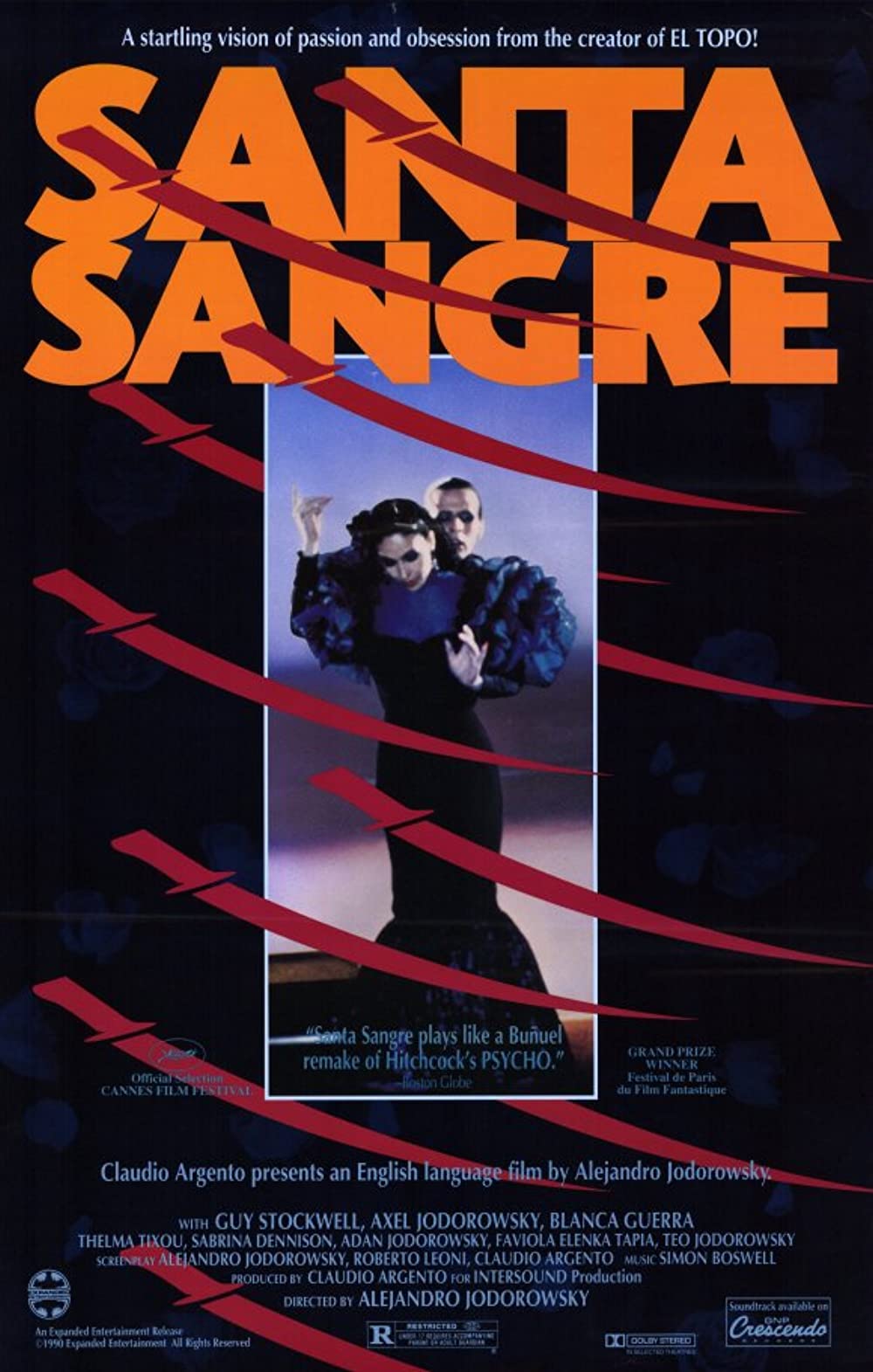
It is hard for me to articulate why the films of avant-garde director Alejandro Jodorowsky fascinate and captivate me so much even though many of their defining traits are things that frustrate me in other art films. His films are strange and surreal, heavy on symbolism, magical realism, and absurd and grotesque but striking imagery. They are not subtle about their themes or symbols or attitudes towards politics, or religion, or society in general and aim to challenge artistic and filmmaking conventions. They are also filled with tenderness and sincerity. His films can be described as challenging, but Jodorowsky only means to challenge to audience only up to a point. It feels like his real intention is to change the way we view movies, art, and the wider world so that we can challenge those things together. There is no pretention or condescension in his films, only a welcoming invitation to a new experience and a new perspective. This is especially true of Santa Sangre, one of the strangest and most compassionate films I have seen.
Santa Sangre isn’t exactly a horror film, but it isn’t exactly any other kind of film either. There is violence, drama, humor, cruel characters, bizarre scenes, psychological horror, even elements of a slasher film, but also many moments of great emotion and sympathy. All of this is put together and handled so delicately that it feels like a magic trick.
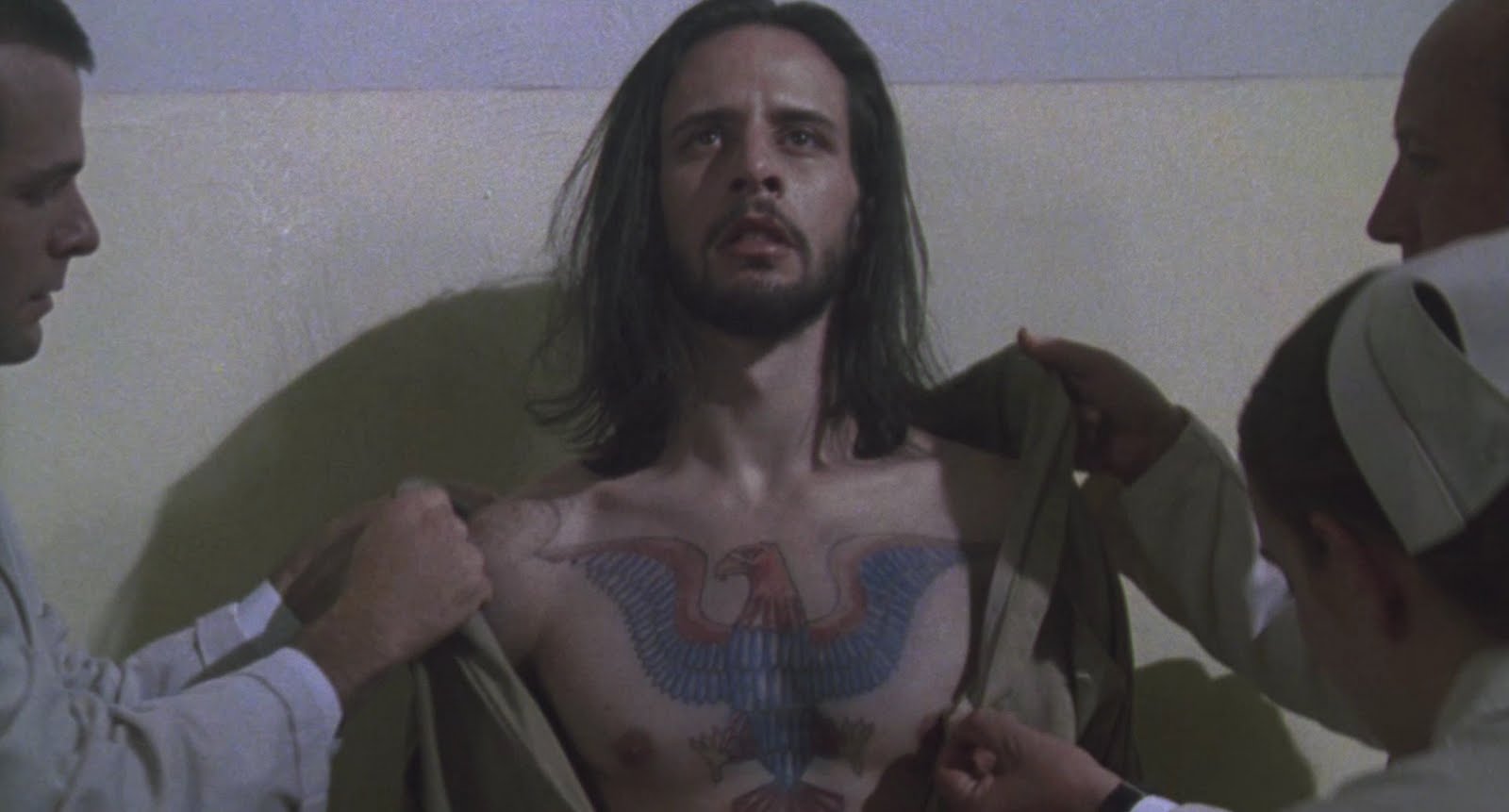
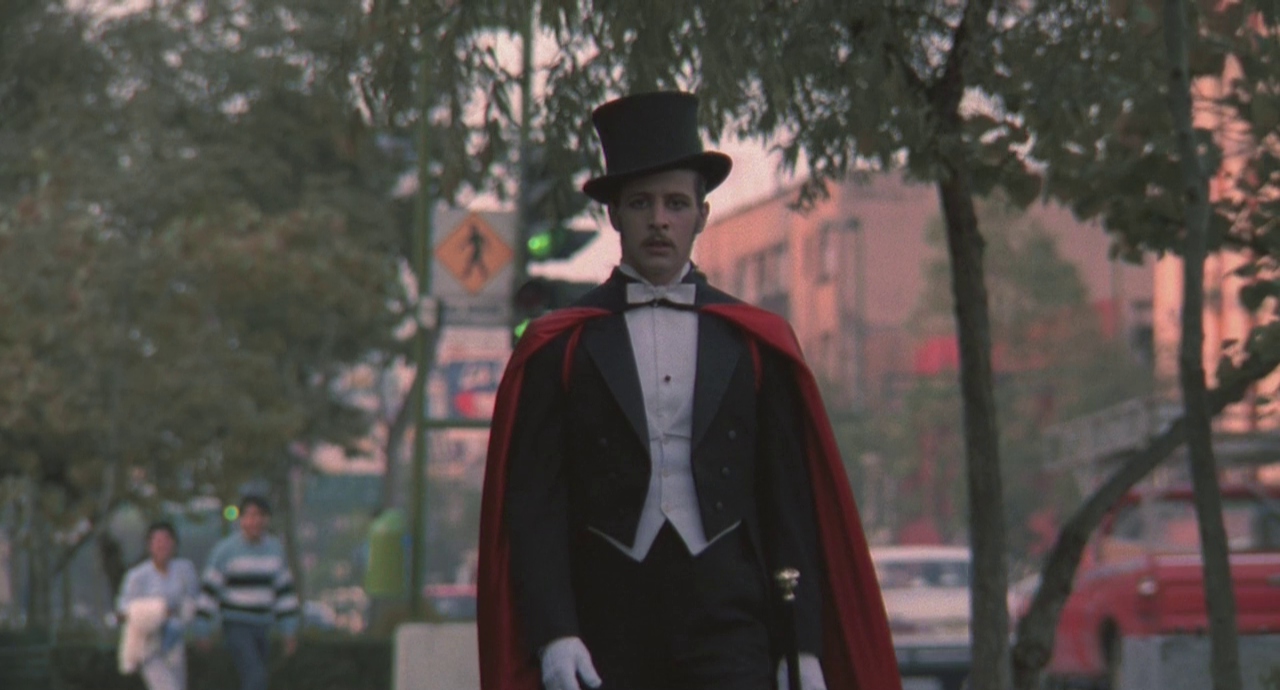
The film opens with image of a nude man posed like bird on an oversized perch in a mental institution. In an extended flashback we see Fenix's traumatic childhood in a circus where he was the boy magician. His mother, Concha (Blanca Guerra), was the trapeze artist and also the leader of a religious sect that worships a saint whose arms were cut off by her rapists. His father, Orgo (Guy Stockwell), was the circus owner and knife thrower. He is crude, excessively macho, and having an affair with the tattooed woman, who is the mother of Fenix’s mute friend, Alma. One night Concha discovers Orgo's affair and throws acid on Orgo's genitals. He cuts off her arms and then cuts his own throat. Somehow, despite all of that, the most traumatic moment of that horrible night is the tattooed woman driving away with Alma in the backseat, her face against the window looking back at Fenix.  They watch each other being separated in a heartbreaking exchange.
When Fenix, now an adult, is beckoned by his mother, he escapes from the mental institution. Hiding behind her, he acts as her arms and hands in a stage show and also in their private moments. In these scenes the actors have so well-choreographed their movements that Concha really does seem to be controlling his hands and Fenix seems to know beforehand what Concha wants to do. Concha’s control over Fenix is domineering and somewhat mystical. Through controlling him psychologically she controls him physically, and this is how she exacts her revenge.
The first slashing is, like many things in this movie, a paradox: it is gruesome but also hokey. The victim stands behind a sheer curtain and a knife wielding hand stabbing in a cliched, mechanical motion. Bodies pile up, but unlike a slasher movie, the kill scenes are not the crux of the movie. Concha’s desire for complete control over her son results in any other woman being a threat. The slashings are a result of the horror and trauma Fenix has suffered and continues to suffer, so he is able to draw our sympathy even though he is also a murderer.  
This is a movie where a funeral march through town square for an elephant that ends with the elephant corpse being thrown into a canyon were residents of a shantytown cut it up for food is a footnote to the actual plot. Fenix paints the body of a victim white and buries her in a grave that glows and a bird rises out. A scene of a group of patients from the institution being taken to a red-light district with drugs and sex workers actually turns out alright. A large, muscular trans-woman wrestler turns out to be a gentle soul. Every scene contains something unexpected.
Santa Sangre was written by Jodorowsky, Robero Leoni, and Claudio Argento (brother of Italian filmmaker Dario Argento). I suppose this is technically a slasher movie, but it is a slasher movie as only Jodorowsky could make. It doesn’t feel like a traditional horror movie because of its emphasis on emotion and sympathy for its main character. Adult Fenix is played by Axel Jodorowsky, Alejandro’s son, and he does an amazing job playing a tortured, conflicted character. He is a gentle soul and you want desperately for him to be treated as such and be freed from his trauma. There are horror movies that have strong characters, likeable characters, characters you root and cheer for, but I don’t think there is another horror film that loves its main character as much as Santa Sangre loves Fenix, and that love is contagious.    
So why recommend Santa Sangre for Shocktober if it is not exactly horror movie? Well, if this movie is a magic trick, then I guess I want other people to see the trick. Santa Sangre is a dark fairy tale. No matter how bizarre or surreal, we accept the sights we see because they serve something more that just the images. Fairy tales use harsh situations and grim scenarios to teach a simple lesson or moral. So too does Santa Sangre use its garish, striking, but always memorable imagery and scenarios to convey something so simple we can only accept it if it is wrapped up in fantasy. At the climax there is a reveal that may not be a surprise but it is not meant to be. It is a revelation for Fenix and as such is deeply satisfying. It’s the moment we’ve been waiting for. What a unique character study. What a gentle and loving movie. The world is cruel and there are cruel people but kindness and love can still exist and we need not be cruel to ourselves; that only leads back to cruelty to others. This is a beautiful film, a reaction I’ve had only a handful of times.