Showing posts with label thrillers. Show all posts

Friday, March 13, 2026

Best Pictures #127: 2025 Academy Awards Best Picture Nominee: One Battle After Another

by A.J. 

Best Pictures #127: 2025 Academy Awards Best Picture Nominee

“Do the revolution, baby. Go do it.”
At first glance One Battle After Another can seem like an intimidating film. Certain images and plot points seem like they have been ripped from the headlines and reflect current news coverage almost too strongly. The plot is serious but the main character is out of his depth to a comedic but frightening degree. There is also the lengthy runtime of 2hours 42 minutes. Yet, from the first shot to the last, master filmmaker Paul Thomas Anderson has crafted a thoroughly engrossing and captivating one of a kind film. This is an action movie, a satire, a thriller, a family drama, a comedy, a chase movie. It received an impressive 13 Oscar nominations, including Best Picture, Director, and Actor for Leonardo DiCaprio, and is indeed a most Oscar worthy movie. 
The runtime is long but need not be intimidating. The first 30 minutes breeze by like the first 10 minutes of most other movies. This is all the more impressive since so much information is clearly and cleanly delivered without feeling rushed. This steady pace continues throughout the rest of the movie. The Best Editing nomination for Andy Jurgensen is certainly deserved. The shifts in tone may sound jarring–one scene will be serious and tense, another will be slapstick comedy–but they are never abrupt or take you out of the experience. No scene or character feels out of place because this was meant to be a strange movie. 
Plotwise and character-wise there is a lot to unpack, but nothing is ever hard to follow. From what I understand, Anderson’s screenplay is only loosely based on the Thomas Pynchon novel Vineland, about a group of Nixon-era radicals dealing with living in the Reagan-era. Anderson moves the story to a time resembling the present day, even when the story jumps forward 16 years; it’s worth noting that no specific year is ever given. In the world of this movie, the military seems to be the police or the police have been so militarized that there is no difference. The branch of the military that the villain, Col. Stephen J. Lockjaw (Sean Penn, in one of his best performances), belongs to is never stated. He uses all the resources at his disposal, including unnecessary immigrant raids and inciting a riot, to pursue a personal vendetta against the main characters and secure a place in the secret right-wing white supremacist cabal that runs the country and calls themselves the Christmas Adventurers Club. They greet each other by saying “Hail Saint Nick.” Again, this movie is meant to be strange.
Lockjaw’s vendetta stems from his hate and desire for a member of the revolutionary group The French 75 named Perfidia Beverly Hills (Supporting Actress nominee Teyana Taylor in an extremely memorable but brief performance). After she disappears, Lockjaw then pursues her romantic partner, who now goes by Bob (Leonardo DiCaprio) and spends his days getting stoned and watching old movies, and Perfidia’s now teenage daughter, Willa (Chase Infiniti), who thinks her dad’s talk about secret codes and surveillance is just paranoia. Lockjaw swoops in, Willa goes on the run, and Bob has to spring back into action, but the springs are 50 years old and very rusty.  
Leonardo DiCaprio is great at playing a dad, especially the type that thinks they are the “cool dad.” One of the funniest scenes of any movie from last year is Bob grilling Willa’s friends who stop by to take her to the school dance; the way he calls one of them “homie” is comedic gold. I think the one quick moment that best encapsulates his character is when he greets a group of Hispanics not with hello but with a very earnest, “Viva Zapata.” Maybe the biggest hurdle Bob faces is remembering the password to get the location of the rendezvous point from the annoying and obdurate revolutionary hotline operator.  His main ally, and in many ways the secret hero of the movie, is Sensei Sergio (Benicio Del Toro), whose unshakable calmness is a much needed counterpoint to Bob’s franticness and is very funny in its own way. 
For some viewers and critics this movie is too political, for others it is not political enough. There are no didactic scenes or speeches. Anderson’s screenplay makes no attempt to solve the issues and political situations that force the characters into their positions. Such an attempt would be reductive to the real world issues the movie mirrors and come across as foolish, no matter how sincere. The core of the story is a parent trying to protect their child. The main theme, which again is never stated, is that the good fight is never done. These are the things that will give One Battle After Another a lasting resonance beyond the current time.  
The look of the movie is absolutely fantastic with Oscar nominated cinematography by Michael Bauman. Two sequences in particular stand out. The first is the nighttime run across rooftops of Bob and a group of Hispanic teenagers as they are lit by fiery chaos below. The second is the climactic car chase over the sharp hills of a lonely stretch of desert road. This is one of the best photographed scenes of action in years (maybe only Top Gun: Maverick comes close in comparison). 
With Hard Eight and Punch Drunk Love being the (still superb) exceptions, Paul Thomas Anderson always finds a way to give his movies a sprawling epic feel. No matter the story or the setting, his films do not unfold the way you might expect. Also, no matter the story or setting, he finds humor in the most unlikely scenarios, which goes a long way to making his films approachable and entertaining. I’m not sure where I would rank One Battle After Another in Anderson’s filmography, but among the movies of 2025 it ranks at the top. 

One Battle After Another is available to stream on HBOmax.
Nominees: Adam Somner, Sara Murphy, Paul Thomas Anderson, producers Director: Paul Thomas Anderson Screenplay: Paul Thomas Anderson Cast: Leonardo DiCaprio, Sean Penn, Benicio del Toro, Regina Hall, Teyana Taylor, Chase Infiniti Production Companies: Warner Bros. Pictures, Ghoulardi Film Company Distributor: Warner Bros. Pictures Release Date: September 26th, 2025 Total Nominations: 13, including Best Picture Other Nominations: Actor-Leonardo DiCaprio; Director-Paul Thomas Anderson; Supporting Actor-Benicio Del Toro; Supporting Actor-Sean Penn; Supporting Actress-Teyana Taylor; Adapted Screenplay-Paul Thomas Anderson; Cinematography-Michael Bauman; Production Design Florencia Martin (production designer), Anthony Carlino (set decorator); Editing-Andy Jurgensen; Original Score-Jonny Greenwood; Sound-José Antonio García, Christopher Scarabosio, Tony Villaflor; Casting-Cassandra Kulukundis

Thursday, October 23, 2025

13 Nights of Shocktober: Shadow of a Doubt

 by A.J. 

Night 5: Hitchcock Night/Suburban Horror Night II
“Do you know if you ripped the front off houses you’d find swine? The world is a hell.”

Master filmmaker Alfred Hitchcock directed so many truly great movies that even several of his less famous movies are among his greatest and the greatest of any era. Shadow of a Doubt is not as famous as Rear Window, Vertigo, Psycho, or North by Northwest, but it is secretly one of his greatest movies. At first it may seem like a slight or minor movie given its small scale and quaint setting, however these aspects belie its dark and unsettling plot. It is also the epitome of Hitchcock’s ultimate career long theme: danger is always lurking and will come at the most unexpected time in the most unexpected form to someone who feels completely safe.
The stars, Joseph Cotton and Teresa Wright, are two of my favorite classic era performers. This movie is where I first saw them. The setting is Santa Rosa, California, a town so average it could be Anytown, USA. It is so idyllic and cozy that things like crime and murder and even war don’t seem possible there, even though the year is 1943. There is no trace of darkness in the home of Young Charlie, that is until Uncle Charlie arrives. 
Teenage Young Charlie (Teresa Wright) is discontent with the mundanity of suburban comfort and longs for something to rejuvenate her family. The change comes with the arrival of lively and charming Uncle Charlie (Joseph Cotton), who does indeed recharge the household dynamic. He also brings darkness that Young Charlie could not have imagined. Though mother Emma (Patricia Collinge)–Hitchcock’s last sympathetic portrayal of a mother–delights in having her brother with her, the real connection is between the two Charlies. The very morning she planned on sending him a telegram to come visit, the family receives a telegram that Uncle Charlie is on his way. No one has any suspicions that he is possibly The Merry Widow Murderer.
There are a lot of things I like about Shadow of a Doubt, but what makes it special are the performances of Teresa Wright and Joseph Cotton. They are excellent choices to play average Americans while still being distinct. Joseph Cotton rarely played a villain but he does a fantastic job playing a complex character that is as sinister as he is charming. He never does anything forthrightly villainous, at least not for most of the movie, but he behaves just suspicious enough for Young Charlie to have doubts about him. In Cotton’s best scene Uncle Charlie’s jovial mask begins to slip and delivers a speech brimming with contempt and disgust about rich windows: “[Husbands] die and leave their money to their wives, their silly wives, .... these useless women...drinking the money, losing the money… faded, fat, greedy women.”
As Young Charlie, Teresa Wright is fresh-faced and lively, at first. She is perhaps naïve but she is not dull or dim. Once her suspicions are raised, she does detective work of her own and puts the pieces and clues together. The scene where she finds the newspaper story about the Merry Widow Murderer that Uncle Charlie hid from the family is an effective one. Hitchcock wanted the camera instead of Wright to gasp so it pulls back from a close-up to a wide overhead shot. My favorite moment comes when Young Charlie finally makes her appearance at a dinner party as Uncle Charlie is about to give a toast. She descends the stairs wearing the ring he gave her, a ring she now realizes is evidence. The camera pushes in from a wide shot of Charlie to a close up of the ring. Neither she nor Uncle Charlie say anything about the ring, but the tone of the entire scene changes for her and him and the audience though it remains the same for the other characters. 
That things are not what they seem and pleasant appearances and behavior belie a hidden menace were frequent themes of Hitchcock’s movies. Just about every Hitchcock movie dealt with the dark side of human nature and society to some degree. This is especially pronounced in Shadow of a Doubt. Perhaps the darkest sequence is when Uncle Charlie takes his niece to a seedy bar to confront her about her suspicions. Smoke fills the bar and their waitress is a former classmate of Young Charlie’s who wears a bitter, dour expression, looks at her and says, “I never thought I’d see you here.” When he realizes that he cannot charm her any longer, Uncle Charlie tells her how little she knows about the world. His words are harsh and cynical but they sting because there is truth in them. This scene is similar to the sequence in David Lynch’s Blue Velvet where young and naïve Jeffery (Kyle MacLachlan) goes to Lincoln Avenue, the bad and dangerous part of his small, quaint town, and sees and learns harsh realities. I do not know for sure how much Shadow of a Doubt influenced Blue Velvet but the two films share similar themes and would make a great double feature. (Shadow of a Doubt certainly had a more direct influence on the film Stoker, a previous Shocktober recommendation, which is also about a newly arrived sinister Uncle Charlie who casts a spell over his niece). The ending might feel anticlimactic but it turns out to be a subversive conclusion fitting for this surprisingly dark and challenging classic.

Shadow of a Doubt airs on TCM on Sunday, October 26th at 9PM CT and might be at your local library.

Sunday, March 2, 2025

Best Pictures #116: 2024 (97th) Academy Awards Best Picture Nominee: Conclave

by A.J.

Best Pictures #116: 2024 (97th) Academy Awards Best Picture Nominee

“No sane man would want the papacy.”
A movie about the college of cardinals meeting in conclave, the paradoxically famous and secretive gathering to elect the new pope, could be so reverent and serious as to be pandering and dull or it could be so artificially sensational as to be tawdry and disrespectful. Director Edward Berger's Conclave, based on the novel by Robert Harris, finds a delicate and wonderful balance. This isn’t an exposé of the Catholic church, nor is it a Christ-sploitation movie. This is an exciting and thrilling film full of intrigue and secret conversations, incredible performances, and excellent filmmaking on every level. The result is an absorbing and electrifying film, without a doubt one of the best of 2024. 
After the death of the pope (from natural causes), the task of assembling and running the conclave falls to the dean of the college of cardinals, Cardinal Lawrence played by Ralph Fiennes. We learn early on that he is dealing with doubts, not so much in faith but in himself, and tried to resign from his position at the Vatican but the pope refused his resignation. He is dedicated to doing his job well, but everyone and everything seems to be against the conclave running smoothly. All the better for us. The candidates emerge: the liberal Bellini (Stanley Tucci), the conservative Adeyemi (Lucian Msamati), the ultra-conservative Tedesco (Sergio Castellitto), the opportunist Tremblay (John Lithgow), and the drama and infighting begins. 
The cast is an incredible collection of great performers, some well known, others lesser known but no less impressive. The breakout performance belongs to Sergio Castellitto as the ultra-conservative Italian Cardinal Tedesco. He arrives with such force that wind billows under his red coat making it look like a cape. At one point he howls with laughter and is constantly vaping. Carlos Diehz finds the exact notes necessary for the quiet and mysterious Cardinal Benitez, who no one knew about and arrived only at the last minute. Brían F. O'Byrne as O'Malley, Cardinal Lawrence’s right hand man, gets to play the only character who is maybe more stressed out than Cardinal Lawrence and provides some comic relief. Isabella Rossellini lends her great screen presence to a small and mostly silent role. Nevertheless she has a stand out scene and curtseys like it is a mic drop. Of course Tucci and Lithgow shine at every moment. 
At the head of the incredible ensemble is Ralph Fiennes, giving one of his best performances in a very impressive career. His Best Actor nomination is most deserved. It is clear Lawrence does not want his job, and he certainly doesn’t want votes when they start coming his way, but he also wants everything to go the way it should and the most worthy man to be elected. When his frustrations boil over, even his outbursts feel constrained, but Fiennes conveys everything that Lawrence tries to conceal. Lawrence does not have the most lines. He is a character who observes and reacts. Fiennes makes a would-be passive character into a sympathetic and relatable leading man.
Many reviews have called Conclave pulpy, trashy, even like an airport novel, but I have a word that better describes Conclave: fun. I suspect that this caught many people off guard and will continue to do. For several scenes Cardinal Lawrence has to be a detective, searching for information and answers without directly breaking the sequester. Characters gossip, scandals are uncovered; there are whispers in hallways late at night, and shouts in the cafeteria. The pageantry and rituals of the Vatican provide a certain level of class and seriousness, but the brilliance of this story is that it remembers that all of these aged holy men are just people and people can be petty, ambitious, deceitful, secretive, and sometimes even righteous. The Oscar nominated screenplay by Peter Straughan (who also wrote the adaptation for the brilliant character piece Tinker Tailor Soldier Spy) provides for nuance as well as showpieces and speeches. Nothing that happens in Conclave feels contrived or unbelievable. Even an explosion (shown in the trailers) does not feel out of place.
Of course you don’t have to be Catholic or religious or familiar with anything about the church to enjoy Conclave. Neither director Berger or Straughan’s screenplay condescend to the audience. Explanations arise as they would in the natural course of events. When Lawrence tries to cardinal-splain simony to Bellini, Bellini responds curtly, "I'm aware of what simony is." If you are not aware of what simony is it becomes apparent a few scenes later. At its core, this is a movie about a stressed out manager, which is something that is very relatable.
Nominees: Tessa Ross, Juliette Howell and Michael A. Jackman, Producers
Director: Edward Berger
Screenplay: Peter Straughan; based on the novel by Robert Harris
Cast: Ralph Fiennes, Stanley Tucci, John Lithgow, Isabella Rossellini
Production Companies: FilmNation Entertainment, House Productions, Indian Paintbrush
Distributor: Focus Features
Release Date: October 25th, 2024
Total Nominations: 8, including Best Picture
Other Nominations: Actor-Ralph Fiennes; Supporting Actress-Isabella Rossellini; Adapted Screenplay-Peter Straughan; Editing- Nick Emerson; Production Design-Suzie Davies (production designer), Cynthia Sleiter (set decorator); Costume Design-Lisy Christl; Original Score-Volker Bertelmann

Monday, October 21, 2024

13 Nights of Shocktober: Cape Fear (1962)

by A.J.

Night 3: Thriller Night
“You still don’t get it, do you, counselor?”

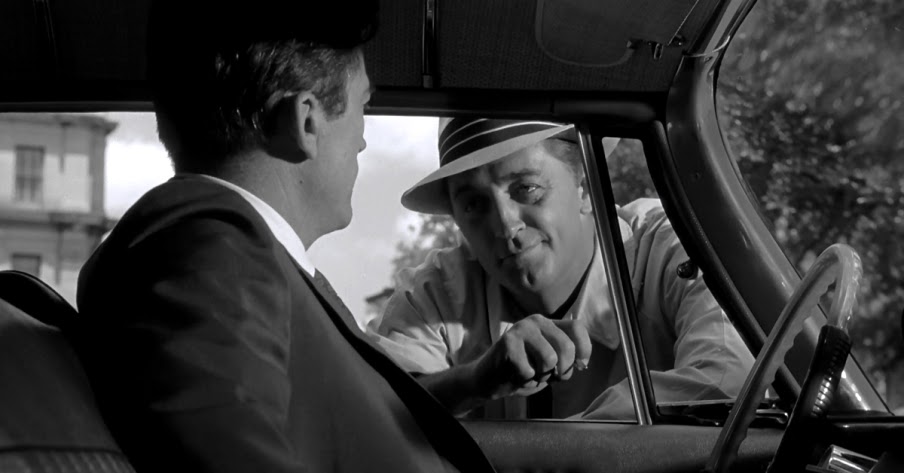
The original classic Cape Fear is a thriller, not a horror movie, but there is enough suspense and deep dread to make it a great alternative to bloody slashers or graphic horror movies. Little about it is dated; there are scenes that will make your skin crawl. The two elements that make Cape Fear so effective are the powerful, ominous score by the legendary Bernard Herrmann and the chilling performance of Robert Mitchum as one of the screen's most sinister and dangerous villains: Max Cady. 
In the same year that the great Gregory Peck played the upstanding, righteous southern lawyer Atticus Finch in To Kill a Mockingbird, he also played another upstanding, righteous southern lawyer, the admittedly less memorable Sam Bowden, in Cape Fear. Seemingly out of the blue, Sam finds himself and his family stalked and menaced by Max Cady, who recently completed an 8 year prison sentence and blames Sam for testifying against him. Even though Cady is a violent man, his revenge is slow and insidious and skirts the edges of the law. As Cady’s menace grows, so does the question of how far Sam will go–whether or not he will break the law–to protect his family.   
In the making-of featurette on the Blu-ray, Peck says, "I played a good guy. More or less a predictable guy… When [Cady] walked into a scene everyone was on guard, so to speak, wondering what he might do next." He knew that even though he was playing the hero, he was not really the lead of the movie. Whoever was cast as Max Cady would be the lead and Robert Mitchum really is the star of the movie. He plays Cady as someone who is a brute and is also clever. He enjoys the psychological torment he inflicts as well as physical violence. His menace and danger grows subtly until at the climax when he more or less becomes a primordial force emerging from the waters of the Cape Fear River. Mitchum gets to show off with low key scenes and also in more confrontational scenes but he never goes over the top. The scariest thing about this character is how believable Mitchum makes him. 
It seems that Cady lives for only one reason, which is to take revenge on Sam. Despite never directly stating it, because of Production Code censorship, director J. Lee Thompson still makes it clear that Cady’s revenge plan is to torture and rape Sam’s wife and young daughter. By far the most uncomfortable scene in the movie is Cady standing on a pier eating ice cream and watching Sam's daughter clean their boat. Cady tells Sam that his daughter is almost as juicy as his wife. Sam punches him but Cady does not fight back and there is now a whole pier full of witnesses to Sam hitting him first. In another scene, shocking only because it is in a movie made in 1962, Cady uses his sinister charm to seduce a woman who he later rapes and beats (offscreen) knowing that she won't file charges or testify because it would mean recounting and explaining the details of the assault publicly. Cady does this merely to demonstrate what he is capable of. Thompson walked a tightrope with the censors with scenes like this in addition to scenes of actual physical violence.
Early in his career, Thompson worked with Hitchcock and often approached a scene by asking himself what Hitchcock would have done. He makes great use of suspense, letting the audience know what the characters do not. He also includes some fake-out jump scares, like Sam's wife being startled by a hatrack in the shadows late at night. A much more consequential fake out happens later in the movie. 
When Thompson was asked if had any objections to hiring Bernard Herrmann to compose the score, his response was, "I should think not!" Herrmann, who had already composed memorable scores for Hitchcock's Vertigo, North by Northwest, and Psycho, created another ominous and evocative score. It still packs a punch with its powerful horns and suspenseful strings. Like Herrmann’s most famous scores, there's a good chance that you've heard it even if you haven't seen the movie. When Martin Scorsese remade Cape Fear in 1991, he reused much of Herrmann's original score. 
This might sound like a pro-vigilante or “extra-legal” justice movie. After all, the law keeps failing the upstanding citizen and protecting the outsider instead, but ultimately this is not a cynical movie. I must admit I was reminded of the idealistic duel played by Batman and the Joker in Christopher Nolan's The Dark Knight. The Joker and Cady essentially have no goal other than to cause pain and destruction and goad their opponents into breaking their moral codes. If Batman or Sam breaks their code to defeat and punish their antagonist, then they have lost. Of course, Peck's Sam is much less exciting than Batman. 
Peck also worked as a producer on film and even chose the source material, a pulp novel by John D. MacDonald titled The Executioners. He chose a new title by looking at a map until he found an interesting name because sometimes, he said, “geographical titles” were successful like Casablanca or Dodge City. I think only the Coen brothers with Fargo have had as much success with picking a random city as the title of their movie.
Cape Fear (1962) is airing on TCM on Sunday, October 27th at 1AM CT. It is also available to stream on Prime Video.

Friday, October 20, 2023

13 Nights of Shocktober: Roadgames (1981)

 by A.J. 

Night 2: Road Trip Horror Night
“That’s the trouble with you Australians, you take your games too seriously.”

Though it stars Americans Stacy Keach and Jamie Lee Curtis, Roadgames is an Australian film and a unique one to say the least. This is not strictly a horror movie though there are some slasher elements. Probably the best way to describe Roadgames is as Rear Window as a road trip through the Australian outback. Even though it is only rated PG, what Roadgames lacks in violence, it makes up for in interesting characters, top notch suspense, and an over the top climax.
Stacy Keach stars as Quid, a truck driver hauling frozen pork through the deserts of Western Australia. He spends most of his time having surprisingly interesting one sided conversations with his pet dingo, the famously silent wild dog of Australia. After hearing radio reports of a killer preying on female hitchhikers he begins to suspect that a man in a van traveling on the same road as him is the killer. At one point he sees the man stopped by side of the road about to bury a cooler. The man sees Quid and flees. Both Quid and the killer are males traveling alone and picking up hitchhikers. This will cause a lot of trouble for Quid. 
The first hitchhiker Quid picks up is Frita (Marion Edward), a housewife deserted on the side of the road by her husband. They both like to talk so they get on each other’s nerves and Quid’s talk of serial killers puts her on edge. The second hitchhiker he picks up is Pamela (Curtis), though he calls her “Hitch” for hitchhiker. They actually get along and speculate on the serial killer together. In an incredibly suspenseful scene worthy of comparison to Hitchcock's best work, she investigates the mysterious van at a rest stop while Keach thinks he is about to confront the killer. The danger for each is palpable. Director Richard Franklin no doubt drew on Hitchcock for many scenes in Roadgames; it's also worth nothing that Franklin would go on to direct the surprisingly smart and thrilling
Psycho II.
Stacey Keach typically plays the heavy or lovable tough guys so it is great to see him play an unlikely hero. He excels at the solo scenes and monologues and holds our sympathy and attention all through the story. Probably the most enjoyable parts of the movie are Keach talking to the dingo, philosophizing or coming up with a profile of the killer. Of course there are the scenes of him sounding like a madman as he tries to explain about the killer, but he is hardly a stock character and this is hardly a by the numbers movie. Jamie Lee Curtis, no doubt cast to cash in on her fame as the reigning scream queen of the era, has a much more interesting role than in some of the other horror movies that gave her that title. As Pamela/Hitch she is a rebellious but mature young person, the runaway daughter of an American diplomat. When she ventures into the possible killer’s van, it fits with her character instead of coming across as a dumb decision by a horror movie character.
There are long stretches of Roadgames that really feel like just a road trip movie with Quid and his dingo and maybe a hitchhiker passing time as they drive to their destination. These stretches are plenty entertaining and they are where the movie’s odd sense of humor comes through. 
The climax is ridiculous and over the top as Quid barrels through a town in his truck and a mob gathers but it still fits thanks to the movie's offbeat sensibility. It is as though the movie has been low key for so long that it can’t stand it anymore. So if you find those road scenes dull, just know that the ending makes up for it. Roadgames works best as a horror/thriller but it is memorable because of its non-horror elements. The lack of violence makes this a great movie to watch with anyone squeamish or horror hesitant, but the great scenes of mystery and suspense, entertaining characters, and oddball humor make it a great movie for anyone to watch. 
Roadgames is currently streaming on Tubi, Peacock, PlutoTV, Shout-TV, Freevee, and The Roku Channel.