Showing posts with label Shadow of a Doubt. Show all posts

Thursday, October 23, 2025

13 Nights of Shocktober: Shadow of a Doubt

 by A.J. 

Night 5: Hitchcock Night/Suburban Horror Night II
“Do you know if you ripped the front off houses you’d find swine? The world is a hell.”

Master filmmaker Alfred Hitchcock directed so many truly great movies that even several of his less famous movies are among his greatest and the greatest of any era. Shadow of a Doubt is not as famous as Rear Window, Vertigo, Psycho, or North by Northwest, but it is secretly one of his greatest movies. At first it may seem like a slight or minor movie given its small scale and quaint setting, however these aspects belie its dark and unsettling plot. It is also the epitome of Hitchcock’s ultimate career long theme: danger is always lurking and will come at the most unexpected time in the most unexpected form to someone who feels completely safe.
The stars, Joseph Cotton and Teresa Wright, are two of my favorite classic era performers. This movie is where I first saw them. The setting is Santa Rosa, California, a town so average it could be Anytown, USA. It is so idyllic and cozy that things like crime and murder and even war don’t seem possible there, even though the year is 1943. There is no trace of darkness in the home of Young Charlie, that is until Uncle Charlie arrives. 
Teenage Young Charlie (Teresa Wright) is discontent with the mundanity of suburban comfort and longs for something to rejuvenate her family. The change comes with the arrival of lively and charming Uncle Charlie (Joseph Cotton), who does indeed recharge the household dynamic. He also brings darkness that Young Charlie could not have imagined. Though mother Emma (Patricia Collinge)–Hitchcock’s last sympathetic portrayal of a mother–delights in having her brother with her, the real connection is between the two Charlies. The very morning she planned on sending him a telegram to come visit, the family receives a telegram that Uncle Charlie is on his way. No one has any suspicions that he is possibly The Merry Widow Murderer.
There are a lot of things I like about Shadow of a Doubt, but what makes it special are the performances of Teresa Wright and Joseph Cotton. They are excellent choices to play average Americans while still being distinct. Joseph Cotton rarely played a villain but he does a fantastic job playing a complex character that is as sinister as he is charming. He never does anything forthrightly villainous, at least not for most of the movie, but he behaves just suspicious enough for Young Charlie to have doubts about him. In Cotton’s best scene Uncle Charlie’s jovial mask begins to slip and delivers a speech brimming with contempt and disgust about rich windows: “[Husbands] die and leave their money to their wives, their silly wives, .... these useless women...drinking the money, losing the money… faded, fat, greedy women.”
As Young Charlie, Teresa Wright is fresh-faced and lively, at first. She is perhaps naïve but she is not dull or dim. Once her suspicions are raised, she does detective work of her own and puts the pieces and clues together. The scene where she finds the newspaper story about the Merry Widow Murderer that Uncle Charlie hid from the family is an effective one. Hitchcock wanted the camera instead of Wright to gasp so it pulls back from a close-up to a wide overhead shot. My favorite moment comes when Young Charlie finally makes her appearance at a dinner party as Uncle Charlie is about to give a toast. She descends the stairs wearing the ring he gave her, a ring she now realizes is evidence. The camera pushes in from a wide shot of Charlie to a close up of the ring. Neither she nor Uncle Charlie say anything about the ring, but the tone of the entire scene changes for her and him and the audience though it remains the same for the other characters. 
That things are not what they seem and pleasant appearances and behavior belie a hidden menace were frequent themes of Hitchcock’s movies. Just about every Hitchcock movie dealt with the dark side of human nature and society to some degree. This is especially pronounced in Shadow of a Doubt. Perhaps the darkest sequence is when Uncle Charlie takes his niece to a seedy bar to confront her about her suspicions. Smoke fills the bar and their waitress is a former classmate of Young Charlie’s who wears a bitter, dour expression, looks at her and says, “I never thought I’d see you here.” When he realizes that he cannot charm her any longer, Uncle Charlie tells her how little she knows about the world. His words are harsh and cynical but they sting because there is truth in them. This scene is similar to the sequence in David Lynch’s Blue Velvet where young and naïve Jeffery (Kyle MacLachlan) goes to Lincoln Avenue, the bad and dangerous part of his small, quaint town, and sees and learns harsh realities. I do not know for sure how much Shadow of a Doubt influenced Blue Velvet but the two films share similar themes and would make a great double feature. (Shadow of a Doubt certainly had a more direct influence on the film Stoker, a previous Shocktober recommendation, which is also about a newly arrived sinister Uncle Charlie who casts a spell over his niece). The ending might feel anticlimactic but it turns out to be a subversive conclusion fitting for this surprisingly dark and challenging classic.

Shadow of a Doubt airs on TCM on Sunday, October 26th at 9PM CT and might be at your local library.

Tuesday, October 28, 2014

13 Nights of Shocktober: Stoker

by. A. J.

This is my favorite time of year, second only to Christmas. Autumn has arrived, the weather is cooling down, and October becomes the month-long celebration of scary movies called Shocktober. There are a lot of horror movies out there, but as a genre, horror is still looked down upon by some mainstream critics and moviegoers. It doesn’t help that, admittedly, there are so few quality horror movies made but, like comedy, it’s a very difficult and subjective genre. So, in the days leading up Halloween I’ll be posting some recommendations for scary movies to help you celebrate Shocktober.

Night 10: Do Not Disturb the Family: Stoker
Stoker is a film with unlikely credentials. It is the only writing credit for actor Wentworth Miller, of the TV series Prison Break. It is the first English language film from Korean director Park Chan-Wook, famous for his ultra-violent revenge trilogy (Sympathy for Mr. Vengeance, Oldboy, and Lady Vengeance). It borrows the premise of Alfred Hitchcock’s 1942 film Shadow of a Doubt: Uncle Charlie, equal parts menacing and alluring, enters and disrupts the idyllic home life of his teenage niece. But Stoker is not a remake of Hitchcock’s movie, it begins with that premise then takes off into a creepy family drama and psychological thriller.  
Matthew Goode plays Uncle Charlie Stoker, Nicole Kidman plays Evelyn Stoker, his brother’s wife, but the subtle star of this film is Mia Wasikowska as his niece, India Stoker. On India's 18th birthday, her father Richard (Dermot Mulroney) dies in a car accident. On the day of the funeral Uncle Charlie, whom India did not know existed, returns from traveling the world and moves in with her and her distant, unstable mother. While India remains cold to her Uncle Charlie, her mother warms up to him nicely, perhaps too nicely. For her 18th birthday she received a key. We wonder with her who it is from and what it unlocks.
India wonders about things teens often ponder over. Are you in control of your nature or has it already been decided for you? The film opens with a narration by India telling us that she hears things other people don’t hear and sees things others don’t see. We hear exposition from characters whispering so that India won’t hear, but she still hears. Her watchful eyes and quiet nature allow her to spy on characters that think they’re hiding their actions, but India already knows what others are trying to hide. They just confirm her suspicions. She slowly warms up to Uncle Charlie as they learn each other’s secrets. We see them play the piano together in a creepy and uncomfortable duet.
Stoker has a distinct, effective sound design. The sound of hair being brushed turns into the rustling of tall, dry grass. The beautiful, bold production design and cinematography makes every scene feel like an uncanny painting. All of this emphasizes India’s heightened senses and gives the film an unreal, dreamlike tone. India’s home is upper class and impeccably kept but its aesthetic seems unlike an actual home. The other teenagers she goes to school with don’t act quite like average teenagers. The trees and the grass and flowers are idyllic like a pastoral dream. There is something disquieting about all of this that adds to the underlying and unspoken menace surrounding the characters
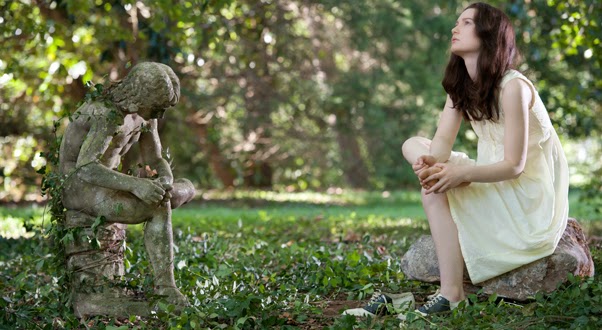
Stoker feels like it is an adaptation of a Gothic novel. It takes place in a seemingly normal environment that feels like a fantasy. This is a film that, like its main character, is quiet and does not directly tell us much. We learn about the characters and plot, like India, from listening and watching. There is a lot that Stoker does not show us forgoing the shock value other films seize upon with misguided eagerness. Stoker shows us static images of seemingly benign things that we know carry heavy implications. When violence finally happens it is striking, but underplayed. This is a film shot and staged with meticulous care and sharp skill. Stoker may be a slow burn thriller, but this character based story builds to a satisfying, but perhaps unsettling, ending.