Good ghost stories on film are hard to come by, especially haunted house stories. They usually end up pivoting to demons or possession/exorcism stories. It doesn’t help that any recent haunted house movie has two spectacular pillars to stand up against, each on opposite ends of the spectrum: Poltergeist (1982) on the macabre, even grotesque, special effects heavy end and The Haunting (1963) on the minimalist, atmospheric, psychological end. Spanish writer-director Alejandro Amenàbar’sThe Others (2001) rests firmly and comfortably alongside The Haunting''s end of the haunted house spectrum in both the style of ghost story and its quality.
Set on the English Channel island of Jersey at the end of the Second World War, Nicole Kidman plays Grace, an Englishwoman living in an isolated house with her children, Anne and Nicholas. She does everything she can to protect her children from sunlight because of their dangerous photosensitivity for which there is no cure (though it is not mentioned in the film, this is a real condition called Xeroderma Pigmentosum, or X.P., and before the modern era, children with this condition rarely lived to adulthood). She hires three new servants and instructs them that the curtains must be kept closed at all times and doors must be locked before another one is opened to keep the light out. But things go bump in the night and during the daytime too. The piano which Grace keeps locked up is played mysteriously at night. Anne, the oldest of the children, says she sees and talks to a boy, Victor, who says that the house belongs to his family and Anne and her family will have to leave. The servants seem suspicious, especially Mrs. Mills (Fionnula Flanagan), who is certainly keeping a secret or two from Grace. This is all typical haunted house stuff; almost by the numbers haunted house stuff. The trick director Amenàbar pulls off is staging these scenes effectively through building a foreboding gothic atmosphere. At the center of everything is Nicole Kidman’s performance; we feel her fear so a thing like seeing all of the curtains suddenly missing becomes a frightening sight.
Anne’s drawing of the Others is appropriately creepy but also a believable child’s drawing. Grace teaching the children the grimmer parts of religion, of the different levels of hell, and a story of two child martyrs and children’s limbo adds as much to the eerie atmosphere as the perpetual fog. There is something inherently spooky about a woman holding a candle or lantern walking down a dark hallway or into a dark room. Since the house has no electricity there are several moments like this. The movie’s signature scene happens when Grace leaves Anne alone in a room wearing her communion dress then comes back and finds something wrong. In a brilliant stroke, the resolution to this scene has the camera swish pan from Kidman not to her daughter but across the room to Kidman’s reaction reflected in a mirror. My favorite scene is simple and expertly done. Grace hears loud footsteps and noises upstairs. She sees that the servants are outside and her children are not upstairs, yet the noises persist. It is a perfect blending of cinematic technique and an actor's performance that puts the audience in the mental and emotional state of the character, allowing us to feel the character’s fear and creating horror.
In the wake of The Sixth Sense it felt like every movie about the supernatural had to have a twist, whether it worked or not. Fortunately, like The Sixth Sense, the secret of The Others enhances the overall viewing experience. Everything that has happened before is cast in a new light, but, most important of all for any twist, it makes sense. The Others plays fair. Whether you guess the conclusion or have seen it before, The Others remains highly effective and very spooky.
The Others is available to stream on The Criterion Channel and Shudder. It is also available on Blu-ray/DVD from The Criterion Collection and is probably at your local library.
This is my favorite time of year, second only to Christmas. Autumn has arrived, the weather is cooling down, and October becomes the month-long celebration of scary movies called Shocktober. So, for the days leading up Halloween I’ll be posting some horror movie recommendations to help you celebrate Shocktober.
The Night House is a perfect movie to watch late at
night when the tiny creaks and groans of your house or apartment become
suspicious and ominous. Like the best haunted house stories, it creates an
eerie atmosphere at odds with an ordinary setting and puts us in the same
mindset as the confused and frightened protagonist. I wouldn’t be surprised if
the budget was low, but the quality of the production and craft and scares are
high.
The setting, a quiet lakeside house at the onset of summer,
certainly should be idyllic but for recently widowed Beth (Rebecca Hall), whose
husband, Owen (Evan Jonigkeit), left a cryptic suicide note, a cloud of
foreboding looms over the house. Beth has a supportive group of friends,
especially Claire (Sarah Goldberg) and her neighbor, Mel (Vondie Curtis-Hall),
but she spends most of her days and nights at home alone. After Beth receives
mysterious phone calls and text messages that seem to be from Owen, she goes
through his things and finds a picture of a woman that resembles her and a book
on the occult. The most disturbing thing she discovers is a secret house identical to her own except reversed in design on the other side of the lake. The idea
of the ghost of her beloved husband trying to contact her from beyond should be
comforting, but it never feels right and an aura of malevolence and danger
swirls around Beth’s house at night.
The Night House works as a low-key but effective
psychological horror thanks to the emphasis on mood and atmosphere. Director
David Bruckner shows great confidence in the character driven screenplay by Ben Collins and Luke Piotrowski as well as the talents of Rebecca Hall. This is the
kind of role that some actors would take full advantage of to showcase their total emotive range, but Hall’s skill here is in holding back while
making clear the emotions swirling just beneath the surface. Beth is not the
kind of person who would show what she is really feeling to others or even
herself. Hall is the rare kind of performer who, with the right role, makes you believe you are watching a real person.
Is the haunting Beth experiences a metaphor? Sure, every
horror movie works as a metaphor or allegory in one way or another, even the
schlock movies. However, unlike many recent arthouse or “elevated” horror
movies, the subtext is where it belongs, in the background lurking like a
shadow. Yes, The Night House is a horror movie about trauma and grief
but it is also a creepy and scary one. It is about the search for meaning after
a devastating loss, but that search leads to a spooky secret house and unseen
malevolent forces. It grabs you with the scares and it stays with you because
of the themes and the great performance at the center.
Like the classic The Haunting, (1963) directed by
Robert Wise, The Night House uses sound design and limited visual
effects to build suspense and put you in the same unnerved state as the main
character. You don’t need elaborate effects when you have a red-light filter
and Rebecca Hall. As she makes one chilling discovery after another, The
Night House goes from being a creepy drama to frightening horror
movie.
The Night House slipped under the radar in 2020/2021,
like many films, thanks to the COVID-19 pandemic and confusion about what films
were on what streaming services, or DVD, or theaters. It is currently streaming
on HBOmax.
This is my favorite time of year, second only to Christmas. Autumn has arrived, the weather is cooling down, and October becomes the month-long celebration of scary movies called Shocktober. So, in the days leading up Halloween I’ll be posting some horror movie recommendations to help you celebrate Shocktober.
I may seem like I’m repeating myself but I cannot emphasize
enough how with a Roger Corman movie, more so than with any other filmmaker,
you never know what you’re going to get: B-movie dreck, campy fun, or
something genuinely good, even great. The Pit and the Pendulum is
definitely in the top tier of Roger Corman/Vincent Price movies. Like all of
Roger Corman’s Edgar Allen Poe adaptations, you’ll find period costumes and
sets, a spooky castle, occasionally stiff acting, low budget charm, and a great
performance from Vincent Price.
Unsurprisingly, the screenplay by Richard Matheson adds
quite a bit to Poe’s very short story, which is mainly an elaborate description
of the titular torture devices and light on plot. Set in Spain during
the 1500’s, Francis Barnard (John Kerr) arrives at the castle of Don Nicolas Medina
(Price) to investigate the sudden death of his sister Elizabeth (Barbara Steele), the Don’s
beloved wife. Don Medina is still in mourning and heartbroken over
Elizabeth’s death, but the lack of details about her death raises Barnard’s
suspicions. As Don Medina, his sister Catherine (Luana Anders), and the doctor
who treated Elizabeth each fill in the details, the cause of Elizabeth’s death
only becomes more mysterious. We also learn that Don Medina’s father was
involved with the Spanish Inquisition and the dungeon of the castle still has
the torture devices. In a blue tinted flashback, the young Nicolas witnesses
his father torture and kill his mother and uncle for their adultery.
If your plan involves driving Vincent Price insane, it’s not
going to work out for anyone. Usually, though not always, Price played the
villain or ended up becoming the villain through spirit possession or madness.
Don Medina begins as a seemingly sympathetic character, but there is also an
air of suspicion around him. As the plot unfolds it becomes clear that Don
Medina was not involved in Elizabeth’s death but his paranoia and misplaced
guilt threaten to drive him to a nervous breakdown. This gives Price some great
scenes to show off. He gets to play a heartbroken widower, a
doting husband in flashbacks, a man losing his sanity, and, finally, an all-out
mad villain.
The opening titles play over a swirl of psychedelic colors
and ominous music. The costumes and sets create the atmosphere but the
performances and story provide the tension and excitement. The titular
pendulum, the swinging blade slowly lowering itself closer and closer to a
bound victim, is genuinely intimidating. The clank of the gears that lower the
blade and the whoosh as it swings through the air make the whole scene very
tense.
The Roger Corman/Vincent Price films are great to watch anytime, but they are especially fun to watch around Halloween. The additions to the original story are in keeping with Poe’s themes like a lost love, fear of premature burial, and madness. So, the connection back to Poe feels merited (unlike like Roger Corman’s The Raven). This may not be exactly scary, but it is a great old fashioned gothic horror story, thoroughly entertaining and thrilling.
This is my favorite time of year, second only to Christmas. Autumn has arrived, the weather is cooling down, and October becomes the month-long celebration of scary movies called Shocktober. So, in the days leading up Halloween I’ll be posting some horror movie recommendations to help you celebrate Shocktober.
Night 8: Youth Horror Night
Don’t you ever laugh as a hearse goes by/For you may be the
next to die
A movie based on the Scary Stories to Tell in the Dark
book series has a lot to live up to. These stories, a collection of folktales,
urban legends, songs, and poems written by Alvin Schwartz and the frightening, nightmarish
drawings by Stephen Gammell are indeed scary, so much so that they fully
traumatized and fascinated an entire generation of children, myself included.
If you read only a few of the stories or saw any of the drawings, you never forgot
them. The books, published between 1981 and 1991, caused all sorts of
controversies and protests from parents and sold millions and millions of
copies. A wonderful and impressive oversight by my Catholic elementary school
meant that I bought my copies at the school book fair. My mother thought some
of the stories were amusing but they thoroughly disturbed me as a first grader, so she gave them to a friend whose child was very excited by them. I’ve
seen the movie twice now, but I’ve never revisited the books.
The Scary Stories books would have made for a great
anthology film but the team behind the camera, including producer Guillermo Del Toro, who receives a screen story credit with Patrick Melton and Marcus Dunstan, screenwriters Dan and Kevin Hageman, and director Andre Ovredal give us a
compelling narrative worked around the short stories. Set in the Autumn of 1968, during that extra spooky time between Halloween and Election Day, the plot follows high schooler Stella and her friends Auggie and Chuck. On Halloween
Night while fleeing a malicious and dangerous bully, they meet Ramon, a teenage
drifter, and end up hiding out in the town’s old haunted house. Stella finds a book full of stories handwritten by Sarah Bellows, the dreadful witch that poisoned children at the turn
of the century. Then new stories appear in the book, written in fresh, wet
blood that tap into the fears of teens and foretell their doom.
Scenes involving the monsters are
legitimately frightening. Perhaps the most well-known is Harold the scarecrow,
who the bully encounters in a cornfield on Halloween night. The most
frightening and disturbing scene for me had one of the characters trapped in a red
room with a pale faced woman coming towards him from every end of every
hallway. The blend of computer generated and practical effects is very well done. The creatures of Harold and the Pale Faced Woman are as
frightening and haunting as the original drawings. The climax combines action, scares, and monsters with a full realization of the themes and subtext in a compelling and masterful way.
Scary Stories to Tell in the Dark believes that if stories
are told enough, they become real, even if they are about yourself. This is
what Stella, played wonderfully by Zoe Margaret Coletti, with Velma from
Scooby-Doo glasses and smarts to match, comes to realize about her town’s
legendary witch and even about herself. Her mother left mysteriously when she
was little and the town has circulated rumors ever since. Ramon (Michael Garza) is pegged by the all-American looking
bully as a “wet-back” and by the well-intentioned but misguided town sheriff
(Gil Bellows) as a suspicious person to blame the recent misfortunes on. Ramon
is on the run from something, but there is more to the truth than first
assumptions.
The young actors are especially good and believable at
playing teenagers. Most of the movie is Stella, Ramon, Auggie, and Chuck
investigating the history of Sarah Bellows and her book of stories to save
themselves before it is too late. Being 1968, this means that they look at
microfiche newspaper archives and old records buried away in forgotten rooms.
These scenes reminded me of the better episodes of The X-Files and the
scenes of them snooping around an old house reminded me of the original
Scooby-Doo series. There are lighter moments and levity that not only relieve tension but build the characters and their relationships with each other.
The screenplay and performers do a great job creating characters we want to
see escape the monsters, which is something rare for horror films.
Scary Stories to Tell in the Dark is also that most elusive
and improbable kind of horror movie: a scary PG-13 movie. The
confrontations with the monsters and other horrors are as creepy and scary as
anything in an R-rated horror movie. You don’t need blood and gore when you
have impending, inescapable dread. The visual style and aesthetic sets the film firmly in the real world, so when
the characters are confronted with the supernatural it is all the more disconcerting
and frightening. This movie is something quite rare these days, a horror movie
for kids. Not just a horror themed movie for kids, but a movie with real
frights and scares, with compelling themes and enough substance to become
something that every great horror movie is: haunting. In that way, the movie is
very true to the books.
This is my favorite time of year, second only to Christmas. Autumn has arrived, the weather is cooling down, and October becomes the month-long celebration of scary movies called Shocktober. So, in the days leading up Halloween I’ll be posting some horror movie recommendations to help you celebrate Shocktober.
Night 6: Vampire Night
“Can you imagine enduring centuries, and each day experiencing
the same futilities?”
Nosferatu the Vampyre(or,
Nosferatu: Phantom of the Night) is German director Werner Herzog’s not quite remake of
F.W. Murnau’s 1922 silent horror masterpiece. Murnau was not able to secure the
rights to Bram Stoker’s novel, Dracula,
so he changed the character names and locations and some plot points to avoid legal troubles. Herzog does not consider his film a remake, but he follows the structure
of Murnau’s film more than Stoker’s novel. Werner Herzog is the kind of
filmmaker incapable of making a simple genre picture. His version of Nosferatu
is not straightforward horror, but it is haunting and transfixing.
The plot is familiar enough. Jonathan Harker (Bruno Ganz), a
young real estate attorney, is sent to Transylvania to oversee the purchase of
an estate, close to his own home in Wismar, Germany, by the mysterious Count Dracula. The Count falls in love with a
picture of Jonathan’s wife, Lucy (Isabelle Adjani), imprisons Jonathan, and
sets off to claim the young bride as his own.
Klaus Kinski plays Count Dracula as a forlorn creature of menace and despair. His look is the same as Count Orlok, played by Max Schreck, in Murnau’s Nosferatu, one of the most iconic images in film history, instantly recognizable whether you've seen the film or not. His skin is bone white, with a head like an animated skull, fingers like slender claws, and two pronounced fangs are front and center in his mouth. The vampire in Murnau’s film was only a monster, but here he is presented as a pitiful, melancholy creature. This Dracula has no brides or servants. He tells Harker that there are worse things than death, like enduring centuries repeating the same futile nights. In Wismar, he tells Lucy that he wishes to partake of what she and Jonathan share.
Count Dracula is a supernatural creature but still seems to be tied into Herzog’s fascination with the unrelenting and overwhelming force that nature has over humankind (see Aguirre, the Wrath of God, Fitzcarraldo, and Grizzly Man for more intense and unrelenting nature). Harker’s journey through ageless mountains and canyons to Dracula’s castle is an extended sequence set to Richard Wagner’s prelude to Das Rheingold, a choice that enhances the natural landscape’s sense of beauty and awe and foreboding. Hidden deep in that intimidating landscape is Dracula.
Bram Stoker’s novel has Harker’s wife, Mena, as a perfect
Victorian era woman that needs to be preserved and protected. Here, Harker’s
wife, Lucy, mostly absent from the first half of the film, becomes the main character in the second half and is the only person willing to
take action to stop Dracula and the plague spreading rats he has unleashed on the
city. This version of Lucy is an agent not only for her own destiny but the
whole city.
Herzog and cinematographer Jörg Schmidt-Reitwein use a
handheld camera for many scenes, adding a degree of uncomfortable authenticity and realism to
the supernatural story. Unlike the Universal Studios and Hammer productions of
Dracula, these locations and sets look and feel real and lived in. Everything from the chairs and silverware
to Dracula’s macabre clock feel like real, functional things and imply that he
can exist outside of fantasy.
Watching this film in 2021, it is especially horrifying that
Dracula’s arrival in Wismar doesn’t just mean the arrival of a vampire. Dracula also brings a
huge swarm of bubonic plague spreading rats. A scene of Lucy wandering through plague-ridden
Wismar has her encountering a group of people in their finest clothes having
their last supper; one tells her that all of the guests are infected with the
plague so they are enjoying what they have while they can. The procession of
coffins through the town square is like an endless macabre parade.
Herzog was tasked with producing two versions of this film:
one in German and one in English, for international markets. After a scene was
done in German it would be shot again with the same actors speaking English.
Herzog has said that he views the German language version as more authentic
since it was his attempt to link classic and modern German filmmaking. There is
obviously some dubbing for the minor characters but, overall, I got the same
effect from both versions. I recommend this film in general, but I highly
recommend it for an atmospheric but not-so-scary night.
This is my favorite time of year, second only to Christmas. Autumn has arrived, the weather is cooling down, and October becomes the month-long celebration of scary movies called Shocktober. So, in the days leading up Halloween I’ll be posting some horror movie recommendations to help you celebrate Shocktober.
The 1945 horror film Isle of the Dead, from director
Mark Robson and auteur producer Val Lewton, makes for a peculiar viewing
experience in era of the COVID-19 pandemic. The story concerns a group of
people quarantined on a small island after one of them dies suddenly of the plague.
Making their situation even more tense, is the growing suspicion that one of
them may be a vorvolaka, a mythic vampire-like creature that feeds on the
living.
The story takes place in Greece during the war of 1912.
Boris Karloff stars as General Pherides, a stern, cold, even tyrannical general
referred to as the “Watchdog” of his country. In the opening scene we see him
sentence a subordinate to death by suicide for letting his troops lag behind.
An American reporter, Davis (Marc Cramer), accompanies Pherides to an island
cemetery to visit the tomb of his long dead wife. Mysterious singing leads them to the house of an
archeologist, Dr. Aubrecht (Jason Robards, Sr.), and his guests, including the ailing Mrs. St. Aubyn (Katherine Emery) and her young travelling companion,
Thea (Ellen Drew). Kyra, the superstitious housekeeper, believes they
are the victims not of a plague but of a vorvolaka and that Thea is the
mythic, life draining creature. One of the guests dies suddenly that
night. Dr. Drossos diagnosis the cause as septicemic
plague (the most lethal form of the plague/Black Death) and General Pherides
orders a quarantine.
Almost everyone in the group thinks that the General’s
quarantine order (which includes forbidding gatherings of more than two people)
is an overreaction. They challenge him, claiming they do not have to
follow his orders since they are civilians. Dr. Drossos says when the warm south winds come, the fleas carrying the plague will die
and they will be safe to leave the island. The archeologist is
overly skeptical, saying that the doctor’s claims sound as ridiculous as old
superstitions. He even lights a fire to the old gods he says will be as
effective as the quarantine. General Pherides believes in the law, science, and
medicine but as the plague spreads and people die, including Dr. Drossos, he
begins to believe science has failed. The persistent claims from Kyra about a
vorvolaka consume his mind until he too targets Thea as the cause of the
plague.
From 1945 until the COVID-19 pandemic, Isle of the Dead
surely played differently. The film’s sympathy is on the side of the characters
who think the General’s quarantine and ban on gatherings are an overreaction
and unnecessary. When the General stops Thea from escaping the island, it is meant
to show his cruelty. Watching this film now, the most tense and anxious moments came from characters ignoring the
General’s orders, which he made according to medical advice. In 1945, Isle
of the Dead was a film about how the right situation can lead to a single
person seizing control and becoming mad with power. It is still about that, to be sure, but
in 2021 it is also about how an event like an epidemic spurs different
reactions, including dangerous ones. In both views of the film, General
Pherides is an unsympathetic man who loses his mind and goes from trying to
protect people to trying to kill the same people. He is also a man that becomes
dangerous as he loses confidence in science and medicine and gives into
superstition.
Isle of the Dead falls into the second tier of the
series of low budget horror films Val Lewton produced for RKO in the 1940’s.
The horror classics Cat People(1942) and I Walked With a Zombie
(1943) are firmly in the top tier. Those films partnered Lewton with director
Jacques Tourneur, who made use of eerie imagery to emphasize the
fear felt by the characters. Director Mark Robson does a fine job at the helm
of Isle of the Dead but lacks the stylistic touches and eye for eerie
imagery that made the previous Tourneur/Lewton films great. For a film set on
an island cemetery there is a disappointing lack of creepy or
eerie imagery depriving the film of a richer atmosphere. Despite these flaws
Isle of the Dead is still an intriguing, low key horror movie and an
interesting one to watch during a pandemic.
This is my favorite time of year, second only to Christmas. Autumn has arrived, the weather is cooling down, and October becomes the month-long celebration of scary movies called Shocktober. So, in the days leading up Halloween I’ll be posting some horror movie recommendations to help you celebrate Shocktober.
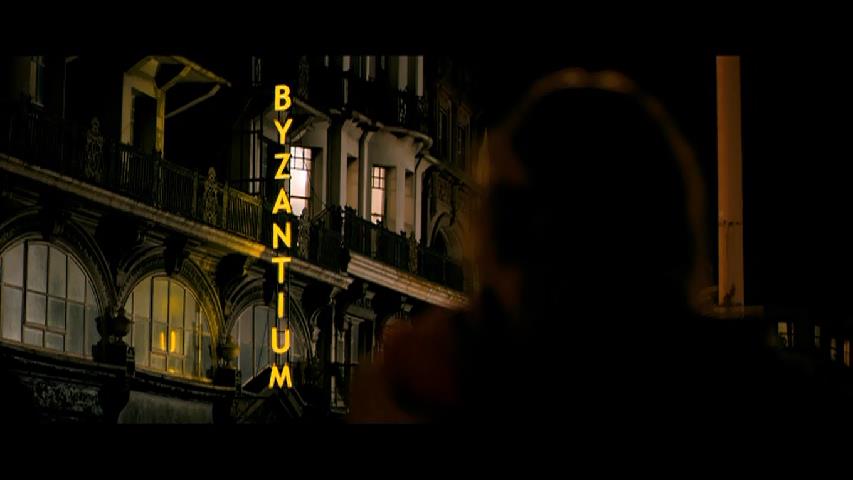
Night 11: Vampire Night “When I was born there were only seven planets.” Byzantium
Director Neil Jordan’s approach to horror avoids sensationalism and lurid indulgence even in moments of violence and terror. His surreal dark fantasy film, The Company of Wolves, a retelling of Little Red Riding Hood based on the works of author Angela Carter, is one of my absolute favorite horror films, and, in my opinion, the best werewolf movie. His adaptation of Anne Rice’sInterview with the Vampire is melancholy and overwrought at times, but memorable for its portrayal of vampires as sympathetic and pitiful creatures. Jordan’s best horror films have two things in common: they examine well known movie monsters from a different perspective while still being effective horror movies, and they are based on the work of female authors. Byzantium, written by Moira Buffini based on her play, A Vampire Story, gives us, once again, a different kind of vampire movie about a different kind of vampire, and, again, one of my absolute favorite horror movies.
“Humans need to tell stories. It’s a fundamental and uniting thing,” says the teacher of Eleanor Webb, a teenager whose aloof demeanor suggests a much older soul. Eleanor is in fact over two hundred years old. She is a vampire, of sorts. She doesn’t sleep in a coffin and can be out in daylight. She has no fangs but an unnaturally sharp fingernail to puncture the wrist or neck of a victim to drink their blood. Eleanor, played wonderfully by Saorise Ronan, may not be human but she longs to tell her story. She writes her life story down then tears up the pages and scatters them in the wind. Eleanor’s mother, Clara (Gemma Atherton), also a vampire, hides a dark secret about their origin and why they live like nomads, fleeing at a moment’s notice. Eleanor is tired of telling made up stories about herself and her mother to the people they encounter. She wants to tell someone the truth. So, she tells us.
Saorise Ronan has always possessed a preternatural acting talent and it is on full display here. She does a great job of playing a weary old soul; someone who despite her young face conveys a profound wistfulness. Still, Eleanor, not knowing all of the facts, makes foolish mistakes that teenagers often make. She hides truths in plain sight, saying things like “She got bitten by a vampire” or that she has been playing piano for 200 years, so plainly that you wonder how people could think she is joking.
Gemma Atherton as Eleanor’s mother, Clara, is very protective of their secrecy, which their lives depend on. She preys on lascivious predatory men that would take advantage of her, taking their cash and blood instead. Atherton plays the different layers of Clara with great believability. She is a determined survivor, vengeful, protective, cold, and also kind. Atherton runs after the men that have kidnapped her daughter with an unquestionable urgency and fierceness that only a mother could possess.
Clara has the opposite approach to immortality from her daughter. She possesses all of the lively youthfulness that her daughter lacks. Clara’s big mistake is one that only a parent could make: she thinks that not telling Eleanor the whole story will protect her, but instead it leads Eleanor into danger. We see in flashbacks to the late 18th and early 19th centuries that as a young girl Clara met two British navy officers: Darvell (Sam Riley), a young officer that shows her kindness and Ruthven (Johnny Lee Miller), an older officer that forces her into prostitution. We also learn that, unbeknownst to Eleanor, she and her mother are being pursued by a vampire brotherhood determined to kill them for violating the brotherhood's code (i.e. not being men).
Moira Buffini’s story is greatly influenced by the gothic atmosphere and language of the stories written by Lord Byron and Dr. John Polidori during the “haunted summer” of 1816 as part of a contest with Mary Shelley. The vibe of Byzantium is indeed best described as modern gothic. Lines of dialogue like “Does the light offend you?,” “Knowledge is a fatal thing,” and “She was morbidly sexy” could be ridiculous but are delivered with intrigue and casual confidence by major and minor cast members alike.
Byzantium was released in 2012 in the wake of the angsty teen vampire-romance Twilight movies and suffered unfairly from comparisons at the time. There is a romantic subplot as Eleanor is drawn to a meek but persistent young man recovering from leukemia played by Caleb Landry Jones. Eleanor certainly qualifies as an angsty teen longing for a connection and disillusioned with the way she lives, but having lived in such a way for so long, conveyed convincingly by Ronan’s performance, gives serious weight to her emotions.
This is a brilliantly made film with poetry in its words, imagery, and music. There are a few bloody and graphic scenes but overall Byzantium has an exquisite visual aesthetic. You could pause this movie at any given moment and have a beautiful still image. The locations feel lived in but not gritty. The look of every scene is muted but not dour. This is a great horror film to watch with people that don’t like graphic or intense horror. The violent scenes are few and far between and, so, more powerful when they do occur. At certain moments the flowing blood even accentuates the poetic tone of a scene. Like The Company of Wolves, Byzantium has an ethereal, dreamlike tone. It is a dark fairytale that leaves you lying awake, haunted but deeply satisfied. I am fascinated by the “haunted summer” of 1816 that inspired Mary Shelley to write Frankenstein, changing the course of science-fiction and horror forever,and John Polidori to write The Vampyre: A Tale, allegedly the first story to portray a vampire as a sophisticated seducer. Byzantium also feels like a story that also would have been inspired by that dreary haunted summer.
This is my favorite time of year, second only to Christmas. Autumn has arrived, the weather is cooling down, and October becomes the month-long celebration of scary movies called Shocktober. So, in the days leading up Halloween I’ll be posting some horror movie recommendations to help you celebrate Shocktober.
Night 7: Japanese Horror Night “The Hole, deep and dark. Its darkness has lasted since ancient times.” Onibaba
For most of its runtime, the period Japanese film Onibaba does not feel like a horror movie. Then the final act puts its characters in an unsettling situation and unleashes chilling and frightening imagery. Onibaba, which translates to Demon Woman, was directed by Kaneto Shindo, who also directed one of my favorite Japanese horror movies, Kuroneko (Black Cat), a moody and haunting ghost story. While Onibaba takes its time before delving into horror, the entire film is dark and eerie.
Set in war torn feudal Japan, two women, one older (Nobuko Otowa) and one younger (Jitsuko Yoshimura), live in a hut in a seemingly endless field of tall grass. They survive by ambushing and killing samurai soldiers lost in the grass and selling their armor and weapons for food. They dispose of the bodies by dumping them in a mysterious pit also in the field of grass. Neither of the women are given names but we learn that they are in-laws. Their son and husband, Kichi, was kidnapped, along with his friend Hachi (Kei Satô), and forced to join a warlord’s army. Only Hachi returns. The mother is immediately suspicious of Hachi and even thinks he may be responsible for her son’s death. She also immediately notices that Hachi is flirtatious with her daughter-in-law. Hachi is a gross, lascivious scoundrel but the daughter-in-law is attracted to him anyway, perhaps because he is the only man close to her age not away at war. It is unclear if the mother is jealous of Hachi’s attraction to her daughter-in-law or if she is just afraid of being left to fend for herself. The daughter-in-law sneaks out at night and runs through the reeds to Hachi’s hut and they begin a torrid affair. Soon after, the mother begins telling her daughter-in-law about demons and ghosts and punishments for sins.
The turn to horror comes when a lone samurai general breaks into the mother’s hut while her daughter-in-law is with Hachi. The samurai wears an odd, creepy mask that he refuses to take off because he claims it protects his beauty. The mother eventually steals the mask and uses it to appear as a demon in the field of grass blocking her daughter-in-law’s way to Hachi’s hut. This plan works, until it goes horribly wrong. The mask is so strange that it might be comical if it wasn’t so creepy. Even though you know it is just the mother in disguise, the image of her appearing out of the dark floating through the grass wearing the mask and long robes is still scary.
The unnatural black hole in the sea of swaying grass is completely incongruous with the surrounding landscape; it’s an uncanny sight. The tall grass looms ominously over the heads of the characters and sways hypnotically in unceasing whistling winds. That constant whistling becomes part of the soundtrack and the world of the characters. The moody atmosphere this creates in just the opening shots never abates, even when the characters are indoors. Every image, eerie or normal, is beautifully photographed in high contrast black and white by cinematographer Kiyomi Kuroda. In certain shots the background is pitch black so it looks like the actors are on a bare stage. The ending is abrupt and disquieting; it’s final image and dialogue are haunting. Through atmosphere and a few well selected visuals Onibaba and Kuroneko create memorable and frightening movie watching experiences.
This is my favorite time of year, second only to Christmas.
Autumn has arrived, the weather is cooling down, and October becomes the
month-long celebration of scary movies called Shocktober. So, in the days leading up Halloween I’ll be posting some horror movie recommendations to help you celebrate Shocktober.
Night 10: Werewolf Party Night! “It’s the she-wolf herself!”
Good werewolf movies are hard to find, so even a decently
made, entertaining movie that may, or may not, have a werewolf is quite welcome.
Made by Universal in 1946, She-Wolf of London took a different approach
to the Universal Monster movie. The heyday of the Universal Monster movies (Dracula,
Frankenstein, The Mummy, and their many sequels) began in the early 1930's and now was on the
decline. The monsters were already meeting each other, though they wouldn’t
meet Abbott and Costello until the 1950’s. Thanks to producer Val Lewton, RKO
was the big name in horror movies. Lewton’s approach to horror was nearly
the opposite of the Universal model. His films were more psychological often
only hinting at the supernatural, emphasizing mood and atmosphere over
monsters. She-Wolf of London was almost certainly made to compete with
the RKO Val Lewton horror pictures. Like Lewton’s Cat People or I
Walked With a Zombie, She-Wolf of London takes a sensational title and
delivers something more than just a monster movie. Though admittedly, She-Wolf
of London doesn’t match the substance or quality of the better RKO Lewton
movies, it is still a solid and entertaining mystery and thriller.
Set in London during the early years of the 20th
century, She-Wolf of London centers on Phyllis Allenby (June Lockhart),
the sole living descendant of a wealthy family with a dark history. She lives
with her cousin Carol (Jan Wiley), and stern aunt, Mrs. Winthrop (Sara Haden), who
became the guardian of Phyllis and caretaker of the the Allenby estate after Phyllis’s parents died. Now
Phyllis is about to be married to a wealthy lawyer, Barry (Don Porter), but she
worries that the Allenby curse is now affecting her. The family dogs bark at
her angrily and constantly. She has dreams of turning into a wolf and wakes up
with her hands covered in dirt and blood.
The next morning, Carol reads
newspaper reports of night time attacks by a wolf in the nearby park. We also
see the family dogs escape at night, presenting the possibility that Phyllis
might not be responsible for the attacks. Mrs. Winthrop isn’t much
comfort or help and won’t let Barry visit Phyllis. Detective Latham (Lloyd Corrigan) believes that the animal attacks are being done by a werewolf,
specifically a female werewolf. He is not exactly comic relief, but he does not
come across as especially sharp either. He simply has a hunch based on witness reports
that he believes is worth pursuing, even if it is outlandish.
Don Porter gets top billing over June Lockhart though she is
clearly the main character and even Carol and Mrs. Winthrop have bigger role
than him, or at least more interesting ones. Barry is a pretty dull hero. There
is not much to him aside from being a decent man and good fiancé. Lockhart
gives a good performance as the distraught Phyllis; she has big, wide eyes great
at conveying worry and anxiety. She is just on the cusp of a nervous breakdown
but never goes into shrieking hysterics, drawing out her anxiety and fright.
The period setting gives the story several elements that
create an eerie fantasy atmosphere. Costumes, horse drawn carriages, foggy
roads and woods lend this movie a visual style. Fog and shadows obscure the attacks which adds to the atmosphere
and saves on special effects. This may not be the straight up horror werewolf
movie you would expect from the classic era of Universal, but it works as a
mystery and thriller and effectively uses the possibility of the supernatural
to create tension and suspense and atmosphere. This is definitely a less well-known
horror movie from the classic era but I’ll count it as one of the better
werewolf movies.