This is my favorite time of year, second only to Christmas. Autumn has arrived, the weather is cooling down, and October becomes the month-long celebration of scary movies called Shocktober. So, in the days leading up Halloween I’ll be posting some horror movie recommendations to help you celebrate Shocktober.
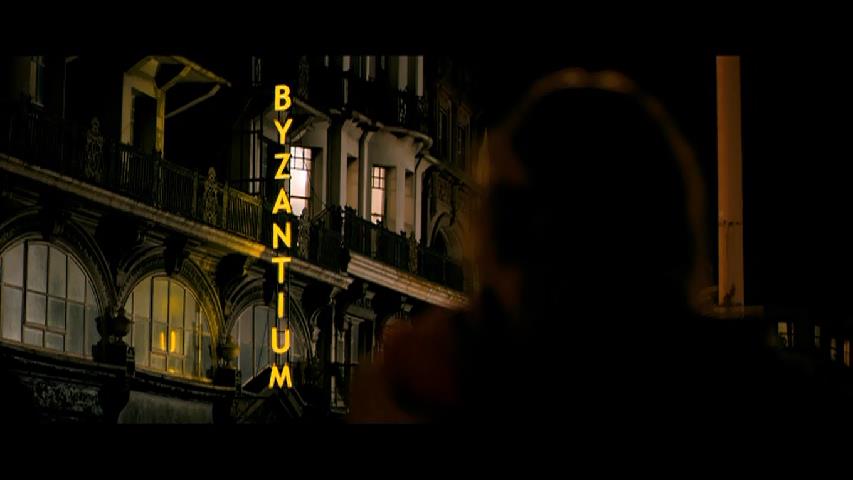
Night 11: Vampire Night “When I was born there were only seven planets.” Byzantium
Director Neil Jordan’s approach to horror avoids sensationalism and lurid indulgence even in moments of violence and terror. His surreal dark fantasy film, The Company of Wolves, a retelling of Little Red Riding Hood based on the works of author Angela Carter, is one of my absolute favorite horror films, and, in my opinion, the best werewolf movie. His adaptation of Anne Rice’sInterview with the Vampire is melancholy and overwrought at times, but memorable for its portrayal of vampires as sympathetic and pitiful creatures. Jordan’s best horror films have two things in common: they examine well known movie monsters from a different perspective while still being effective horror movies, and they are based on the work of female authors. Byzantium, written by Moira Buffini based on her play, A Vampire Story, gives us, once again, a different kind of vampire movie about a different kind of vampire, and, again, one of my absolute favorite horror movies.
“Humans need to tell stories. It’s a fundamental and uniting thing,” says the teacher of Eleanor Webb, a teenager whose aloof demeanor suggests a much older soul. Eleanor is in fact over two hundred years old. She is a vampire, of sorts. She doesn’t sleep in a coffin and can be out in daylight. She has no fangs but an unnaturally sharp fingernail to puncture the wrist or neck of a victim to drink their blood. Eleanor, played wonderfully by Saorise Ronan, may not be human but she longs to tell her story. She writes her life story down then tears up the pages and scatters them in the wind. Eleanor’s mother, Clara (Gemma Atherton), also a vampire, hides a dark secret about their origin and why they live like nomads, fleeing at a moment’s notice. Eleanor is tired of telling made up stories about herself and her mother to the people they encounter. She wants to tell someone the truth. So, she tells us.
Saorise Ronan has always possessed a preternatural acting talent and it is on full display here. She does a great job of playing a weary old soul; someone who despite her young face conveys a profound wistfulness. Still, Eleanor, not knowing all of the facts, makes foolish mistakes that teenagers often make. She hides truths in plain sight, saying things like “She got bitten by a vampire” or that she has been playing piano for 200 years, so plainly that you wonder how people could think she is joking.
Gemma Atherton as Eleanor’s mother, Clara, is very protective of their secrecy, which their lives depend on. She preys on lascivious predatory men that would take advantage of her, taking their cash and blood instead. Atherton plays the different layers of Clara with great believability. She is a determined survivor, vengeful, protective, cold, and also kind. Atherton runs after the men that have kidnapped her daughter with an unquestionable urgency and fierceness that only a mother could possess.
Clara has the opposite approach to immortality from her daughter. She possesses all of the lively youthfulness that her daughter lacks. Clara’s big mistake is one that only a parent could make: she thinks that not telling Eleanor the whole story will protect her, but instead it leads Eleanor into danger. We see in flashbacks to the late 18th and early 19th centuries that as a young girl Clara met two British navy officers: Darvell (Sam Riley), a young officer that shows her kindness and Ruthven (Johnny Lee Miller), an older officer that forces her into prostitution. We also learn that, unbeknownst to Eleanor, she and her mother are being pursued by a vampire brotherhood determined to kill them for violating the brotherhood's code (i.e. not being men).
Moira Buffini’s story is greatly influenced by the gothic atmosphere and language of the stories written by Lord Byron and Dr. John Polidori during the “haunted summer” of 1816 as part of a contest with Mary Shelley. The vibe of Byzantium is indeed best described as modern gothic. Lines of dialogue like “Does the light offend you?,” “Knowledge is a fatal thing,” and “She was morbidly sexy” could be ridiculous but are delivered with intrigue and casual confidence by major and minor cast members alike.
Byzantium was released in 2012 in the wake of the angsty teen vampire-romance Twilight movies and suffered unfairly from comparisons at the time. There is a romantic subplot as Eleanor is drawn to a meek but persistent young man recovering from leukemia played by Caleb Landry Jones. Eleanor certainly qualifies as an angsty teen longing for a connection and disillusioned with the way she lives, but having lived in such a way for so long, conveyed convincingly by Ronan’s performance, gives serious weight to her emotions.
This is a brilliantly made film with poetry in its words, imagery, and music. There are a few bloody and graphic scenes but overall Byzantium has an exquisite visual aesthetic. You could pause this movie at any given moment and have a beautiful still image. The locations feel lived in but not gritty. The look of every scene is muted but not dour. This is a great horror film to watch with people that don’t like graphic or intense horror. The violent scenes are few and far between and, so, more powerful when they do occur. At certain moments the flowing blood even accentuates the poetic tone of a scene. Like The Company of Wolves, Byzantium has an ethereal, dreamlike tone. It is a dark fairytale that leaves you lying awake, haunted but deeply satisfied. I am fascinated by the “haunted summer” of 1816 that inspired Mary Shelley to write Frankenstein, changing the course of science-fiction and horror forever,and John Polidori to write The Vampyre: A Tale, allegedly the first story to portray a vampire as a sophisticated seducer. Byzantium also feels like a story that also would have been inspired by that dreary haunted summer.
“I'm so sick of people saying that love is just all a woman
is fit for.”
With Little Women, first published in 1868, Louisa May Alcott crafted a story so nearing perfection that not only has it become a
classic, but it is difficult to mess up when retelling it. The fourth big
screen adaptation Alcott’s novel, written and directed by Greta Gerwig, finds a
fresh approach to the lives of the March sisters without making any major
changes to the well-loved story. Gerwig uses a flashback structure, a steady
and lively pace, equally lively performances, and a lovely score by Alexandre
Desplat to make this period drama easily engaging to a modern audience.
Gerwig begins her film near the end of Alcott’s story with
Jo (Saoirse Ronan) living in New York trying to carve out a career as a fiction
writer. Her sisters are scattered and wrapped up in their adult lives. Meg (Emma Watson) is raising a family and keeping a house while struggling with money.
Amy (Florence Pugh) is learning painting in Europe. Only selfless and caring
Beth (Eliza Scanlen) remains with their parents at the March family home in
Massachusetts. Then the film flashes back to where to the novel and other film
versions begin, with the sisters as adolescents living together under one roof
with their mother, Marmie (Laura Dern, with infinite patience and warmness and
wisdom). Their father is away serving with the Union army in the Civil War. It
is seven years before we began with Jo living in New York.
There is real joy and emotion in the scenes of the March
sisters together (that’s the appeal of watching any version of Little Women)
but we get time with each of the sisters on their own. We get to know them as
individuals and are privy to what is in their minds and hearts. Gerwig put
together a fine ensemble but Saoirse Ronan and Florence Pugh have been singled
out by the Academy with Oscar nominations in the Lead and Supporting categories,
respectively. This is no surprise since Jo and Amy are the two showy
roles.
Ronan brings just the right kind of energy to the
rebellious, strong willed, sometimes abrasive, but always charming, Jo. She is
full of life and personality without becoming a caricature. On the other hand, I
found Florence Pugh’s performance as the youngest sister Amy (a child when the
novel begins) so broad as to be distracting. Pugh plays Amy throughout the
film, but the younger Amy’s behavior and actions have not been altered in any
significant way. So, in the flashbacks we see an adult Florence Pugh speaking
and acting like a child even though she looks like a teenager at the youngest
(even with her Cindy Brady haircut). This unfortunately makes the younger Amy
come off as odd and extra bratty.
Timothèe Chalamet is a perfect fit for the role of Laurie,
the dreamy and charming boy next door destined to be intertwined with the March
sisters. Chalamet brings a lively physicality to his performance, moving his
long, slender body with a lilt that matches the energy of the movie. In smaller
but no less entertaining roles are Meryl Streep and Tracy Letts. Streep plays
the intimidating and acerbic Aunt March, who is rich enough to be able to speak
her mind. She is full of 19th century quips and zingers that are
delivered wonderfully. Letts plays a grumpy New York publisher that is willing
buy Jo’s stories if they are spicy and if Jo’s female main characters get
married at the end, or die. Jo’s conversations with him are entertaining but
also come right up against being too meta for the movie's own good (if you weren’t sure about Jo
being a stand-in for Alcott, these scenes leave no doubt).
I have to admit that as much the jumps back and forth in
time work for the overall structure of the film some of the cuts are not
immediately apparent and it takes a moment to figure out where you are in the
timeline. Once you get into the rhythm of the pacing, however, you’ll find
yourself caught up in the film’s enthusiasm and love for its characters. Right
from the start this version of Little Women lets you know that it is not
a pageant, not just another recreation of a familiar story, but a new
perspective on a classic story that gets to the core of what makes this story
timeless. The climax of Gerwig’s adaptation, is not whether or not Jo gets
married and to whom, but how she is able to stay true to herself and her dreams
and her family.
Nominees: Amy Pascal, producer
Director: Greta Gerwig
Screenplay: Greta Gerwig, based on the novel by Louisa May
Alcott
Cast: Saoirse Ronan, Emma Watson, Florence Pugh, Eliza
Scanlen, Laura Dern, Timothée Chalamet
Production Companies: Columbia Pictures, Regency Enterprises,
Pascal Pictures
Distributor: Sony Pictures
Release Date: December 25th, 2019
Total Nominations: 6, including Best Picture
Other Nominations: Actress-Saoirse Ronan; Supporting Actress-Florence
Pugh; Adapted Screenplay-Greta Gerwig; Costume Design-Jacqueline Durran; Original
Score-Alexandre Desplat
Brooklyn is not
just set in New York and Ireland of the early 1950s, it is set in versions of
those places that only exist in nostalgic memories or what your imagination
conjures up when looking at an old photograph. The landscape of Ireland and the
cityscape of Brooklyn are rich in bold colors and pretty clothes (which get
brighter in America), but there is much more to Brooklyn than appearances.
Saoirse Ronan plays Eilis (pronounced like “A-lish”), a
young woman who moves to America, specifically to Brooklyn, from a small
village in Ireland. The move is set into motion by Eilis’s older sister, Rose,
because the opportunities for a young person, especially a woman, in their
village are rather narrow. Rose wants Eilis to have experiences that she never
had; a step that their small-minded mother would never have taken. On the ocean
voyage to New York Eilis gets seasick and in Brooklyn she gets homesick, but
slowly she finds comfort in her new life. She lives in a boarding house run by
a stern, but funny landlady (Julie Walters) who believes that giddiness is the eighth
deadly sin. A friendly priest (Jim Broadbent) helps her find a job at a
department store and enroll in night classes for bookkeeping. Easing her
homesickness most of all is Tony (Emory Cohen), a sweet Italian-American
plumber who attends the Irish dance at the parish hall because he really likes
Irish girls.
There is not a drop of cynicism in Brooklyn. It has no villain and takes no dark turns. The conflict
in Brooklyn comes when Eilis and
Tony’s romance is interrupted because she must return to Ireland after a death
in the family. Once back in the familiar surroundings of her homeland, her
dreary town seems warmer. She sees a quiet Irish beach like she never had
before. She’s offered a job as a bookkeeper, and, more significantly, finds a
kind, handsome suitor in Jim, played by Domhnall Gleeson.
Eilis’s defining moment comes when she is presented with
something far more important than the choice between two different men. She has
to choose between two different lives and where she feels home is for her.
There is no correct, obvious decision here as there often is when a movie gives
a woman a choice between two different men or places to live. Both Jim and Tony
are good, decent men that would be good, decent husbands. In Jim there is
everything positive about a familiar life in Ireland. In Tony there is a new,
different, and warm life in Brooklyn. Eilis’s arc is believable because it is understated.
There is no grand scene of an epiphany. The inner workings of her mind and
heart are shown rather than stated in Saoirse Ronan’s wonderful performance. Ronan’s
performance is not showy, but she makes us feel more by doing less. We aren’t
aware of how much she’s grown and matured until suddenly, but quietly we notice
the change.
Brooklyn is an
immigrant’s story, a love story, and most of all, a young woman’s coming of age
story. The phrase “this is a movie you can see with your parents or
grandparents” was thrown around a lot when it was first released, and it is
true. Brooklyn is as inoffensive as
it is romantic, but I hope being a well-made romance and coming of age story
won’t keep anyone away from watching this movie. You won’t find many dark
corners in this movie. It is a light drama, but drama doesn’t have to be heavy
and dark for it to affect and move a viewer. Brooklyn is a wonderful, sweet, romantic movie in which everything
is done well -- from the screenplay by Nick Hornby and direction by John Crowley, to the performances, production and costume design – and the result is
far from saccharine.
Nominees: Finola Dwyer and Amanda Posey, Producers
Director: John Crowley
Screenplay: Nick Hornby, based on the novel by Colm Tòibìn