Friday, February 3, 2017

A.J.'s Top 10 Movies of 2016

by A.J.

January is the time to catch up on all the movies that were released at the very end of the last year to qualify for the Academy Awards. Now that it is February, I've (mostly) caught up. This year, the Academy nominated nine films for Best Picture of 2016, but there were 10 movies from last year that I found exceptionally entertaining.

10. Hell or High Water
Hell or High Water is a modern day western about a pair of bank robbers and the lawman pursuing them. This movie has great cinematography of the Texas plains, great performances, and a screenplay that divides our sympathies between both cops and robbers. It doesn’t reinvent or shake up the genre, but it doesn’t need to, it’s executed extremely well.

Released in the first half of 2016, The Witch is the story of an isolated family living in colonial America being menaced by seemingly supernatural events. I recommended this film a lot during Shocktober at the video store and wrote about it for 13 Nights of Shocktober 2016.

In New Zealand, a delinquent young boy, Ricky, is sent to live with a kind woman named Bella, and her husband, Hec, a gruff, grumpy outdoorsman (played by Sam Neill). After Bella dies suddenly, Ricky is scheduled to go back into the state foster system, but he and Hec go on the run and live in the wilderness while evading the authorities. This is a wonderful, sweet, and charming movie with a broad, offbeat sense of humor. Written and directed by Taika Waititi, who co-wrote and directed the hilarious What We Do In the Shadows, it delivers a fun story that is heartwarming without being saccharine.

I wasn’t planning on seeing this Disney animated movie, but I’m very glad I did. Judy Hopps, voiced by Ginnifer Goodwin, is the first rabbit to be accepted into the Zootopia police force, but she feels underused, stuck on menial traffic duties. She ends up teaming up with a fox conman (confox?) voiced by Jason Bateman to solve a missing persons case that uncovers something more sinister. Zootopia ends up being a film noir that deals with race and gender issues while being a great buddy cop movie. It is also about a young woman that is living on her own for the first time in the big city and has to work 10 times harder to prove everyone’s underestimations of her wrong.

Writer-director John Carney, who brought us Once, one of the best films of the last decade with equally fantastic music, has created another non-musical musical set in Ireland and it is an absolute joy. Sing Street is a sincere tribute to 80s new wave music, a genre much looked down on. We follow Conor, who is dealing with his parent’s divorce and starting a new school run by a cruel, petty priest whose discipline is actually bullying. Conor wants to impress the pretty and mysterious Raphina, so he tells her that he’s in a band and asks her to be in their music video. When she accepts, he actually has to form a band, write songs, and make a video. The songs they make are genuinely good and their music videos are amusingly amateurish, but accurately capture the style of professional videos of the era. This movie never laughs at its characters or their ambitions. This is a wonderful coming of age film without a single cynical frame.

We’ve been lucky enough to have had some excellent science fiction films recently (Interstellar in 2014, and The Martian in 2015 come to mind), and Arrival is among them. Mysterious alien spacecrafts appear at different locations all over the world and a renowned linguist, played by Amy Adams, is brought in by the government to try to communicate with the alien beings. Adams turns in a great performance (entirely deserving of an Oscar nomination that she did not receive) that grounds the entire film in genuine emotion even as it moves into heady sci-fi territory. Even though Arrival does not go out of its way to simplify or explain itself, it never becomes inaccessible and only becomes more intriguing and entertaining as the story unfolds.

1. Four-Way Tie
There were four movies I saw last year that I found so completely wonderful and well-made from beginning to end that I couldn't place them in an order. So, here is my four-way tie for the best movie of 2016.

Annette Bening is at the center of this ensemble comedy-drama that is the freshest coming of age film I’ve seen in quite some time. Bening plays a single mother of a 15-year-old son living in Southern California in 1979. She isn’t exactly a hippie parent, but she is certainly nontraditional and open to whatever may be the best way to raise her son. She enlists the help of the motley group of misfits (Greta Gerwig, Elle Fanning, Billy Crudup) that lives with them. Each helps in their own way to raise Bening’s son and together form a makeshift family. Each role is well written and well-acted. Director Mike Mills throws in some stylistic touches that not only evoke the era, but also reflects what the characters are experiencing. The best thing about 20th Century Women is that the characters in this movie don’t just feel like people, they feel like people I know.

This is not a traditional, by-the-numbers biopic, recreating people and events that we are familiar with as a pageant. Jackie is something far more special and affecting. It is an intimate and emotional glimpse of a woman dealing with tragedy and grief while the public watches. The assassination of JFK was a national tragedy, but it was also a personal tragedy for Jacqueline Kennedy and her family.
While watching Jackie I felt as though this could have been a traditional biopic; it certainly starts that way. Not long after the murder of her husband, Jackie agrees to an exclusive interview, but tells the reporter that this will be her version of the story. However, the approach director Pablo Larrain takes to tell her story, with flashbacks and close ups and the haunting score by Mica Levi, makes this an unconventional movie that avoids biopic clichés. Natalie Portman has the difficult task of portraying the enigmatic First Lady with the unique and distinct voice. Portman more than meets the challenge and is entirely deserving of her Oscar nomination for Best Actress (and she would have my vote). She shows us a woman that at all times projected a persona, both publicly and privately. But more than that, she humanizes a chapter in American history and captures the personal side of a public story.

To those people that think costume period pieces or films of Jane Austen books are dull, stuffy, or boring, I suggest they see the incredibly funny and lively Love & Friendship. Based on the early Jane Austen novella, Lady Susan, the story follows the duplicitous Lady Susan (Kate Beckinsale), recently widowed, who moves in with her in-laws and begins a hunt for a wealthy husband. Her teenage daughter, after running away from her boarding school, joins her mother at the country estate. This complicates Lady Susan’s plans. Despite her scheming and plotting, Lady Susan remains a likeable character. Beckinsale is able to play Lady Susan as though she unintentionally has good intentions.  
Writer-director Whit Stillman understands the text, the subtext, the period, the characters, and the humor of the source material resulting in a Jane Austen adaptation that feels fresh and offbeat. In short, he is a perfect match for Austen. This film seems to have made critics realize that Stillman’s previous “comedies of manners” are actually modern day Jane Austen stories. I must admit I’m not usually a fan of Kate Beckinsale, mostly because of her choice of films (more Underworld sequels?), but with the right material and the right director (Stillman—see The Last Days of Disco for further proof) she can be an outstanding actress indeed. It may come as a surprise to some, but, yes, Jane Austen is very funny.  

If The Nice Guys feels like a throwback to the kind of action-comedies that Hollywood seems to have stopped making, it is likely because it was written and directed by Shane Black who wrote Lethal Weapon, The Last Boy Scout, and The Long Kiss Goodnight. He’s written and directed the best Marvel movie so far, Iron Man 3, and the underseen but exceptional Kiss Kiss Bang Bang. Now he brings us a thoroughly funny and excellently crafted modern film noir. The setting is Southern California in the 1970s and we meet Russell Crowe as a tough guy for hire seeking to improve himself. He reluctantly teams up with Ryan Gosling, a private detective that isn’t quite inept, but is certainly comical, to find a missing young woman. The case, of course, uncovers something far more sinister and complex.
Crowe and Gosling are wonderful as mismatched partners and have great chemistry together. Each turns in their most dynamic performance in years. Crowe excels at playing a tough guy that is actually, well, a nice guy. Gosling shows off his comedic talents, both verbal and physical (one of his best moments is his reaction to finding an open bar). They run into gangsters, shootouts, conspiracy theories and more. The action scenes are well done and pretty violent. The danger these characters find themselves in is real—innocent bystanders are killed by stray bullets—but this is not a dark or cynical movie. The Nice Guys evokes the 1970s while avoiding clichés like packing the soundtrack with hit songs from the era, and the costumes and hairstyles are believable on the cast members. This is a smart movie with a sharp sense of humor that I can't recommend enough.

Wednesday, February 1, 2017

Classic Movie Picks: February 2017

by Lani

Each month, I scour the Turner Classic Movies schedule for upcoming films that I can't miss. The highlights are posted here for your reading and viewing pleasure! (All listed times are Eastern Standard, check your local listings or TCM.com for actual air times in your area. Each day's schedule begins at 6:00 a.m.; if a film airs between midnight and 6 a.m. it is listed on the previous day's programming schedule.)


It's award season in Hollywood, which means it's time for TCM's "31 Days of Oscar" programming. Each day in February (and a few in March, too) will feature films which were Academy Award winners or nominees. This year, the films are being shown from A to Z starting with Abe Lincoln in Illinois on February 1 and ending with, well, Z on March 3. The alphabetical order creates some interesting programming blocks of films you might never see on a double feature except during 31 Days of Oscar. I've chosen a few of my favorite groupings this month.


An American in Paris poster

2/1: A is for archetype
8 PM - All About Eve (1950)
10:30 PM - An American in Paris (1951)
12:30 AM - Annie Hall (1977)
What better way to start the month than with the film which holds the record for most Oscar nominations, All About Eve? It's 14 nominations have since been tied by Titanic and this year's awards frontrunner La La Land; however, there were fewer categories in the 50s, so All About Eve's record is even more impressive. The film won 5 awards: Best Picture, Best Director, Best Screenplay, Best Costume Design, and Best Supporting Actor for George Sanders. In his autobiography Sanders said of winning an Oscar, "I was grateful and flattered to get mine, but apart from making my already large ego one size larger it did absolutely nothing for me." The film's star, Bette Davis, might disagree. Davis and co-star Anne Baxter were both nominated for Best Actress, the first time two lead actresses had been nominated for the same film; however, the award that year went to Judy Holliday for Born Yesterday. The film is the ultimate backstage story, centering on an established stage actress threatened by an ambitious younger woman with her sights set on stardom. Davis's powerful performance as Broadway star Margo Channing and Baxter's equally good turn as the cunning upstart Eve Harrington, plus the bitingly witty dialog by writer /director Joseph Mankiewicz, make this one of the best of all time.

Though musicals had been popular since silent films became talkies, it was rare for a musical to win best picture. An American in Paris broke the trend garnering 8 nominations and 6 wins, including Best Picture. Gene Kelly stars as an American painter living in Paris who has a complicated romance with a French girl. The charming performances of the cast, particularly Kelly and love interest Leslie Caron, beautiful dances choreographed by Kelly, and the iconic music of the Gershwins, make An American in Paris a true delight. One of the most memorable sequences is the 17-minute "dream ballet" which ends the film. The power of this sequence must have stuck in the minds of the Academy voters because while director Vincente Minelli lost out to the director of A Place in the Sun, George Stevens; Gene Kelly was given an honorary award "in appreciation of his versatility as an actor, singer, director and dancer, and specifically for his brilliant achievements in the art of choreography on film." I would give credit to both Minelli and Kelly for the creative vision which made this film one of the crowning achievements of MGM's golden age.

Annie Hall received 4 Academy Awards for Best Picture, Woody Allen's direction, the screenplay by Allen and Marshall Brickman, and Best Actress for Diane Keaton. The only nominated category it didn't win that year was Best Actor, in which Allen lost to Richard Dreyfuss for his performance in The Goodbye Girl. Comedy is another genre which is not often recognized by Oscar. Annie Hall was the first comedy since 1963's Tom Jones to win Best Picture (beating out Star Wars along the way); and I'm not sure there's been another since then...maybe Shakespeare in Love?  The story is a simple one in which boy, comedy writer Alvy, meets girl, aspiring singer Annie, but the two quickly complicate matters with their neuroses and insecurities. With this film, Allen created the blueprint for modern romantic comedy. 


The French Connection

2/8: F is for force
12 AM - The French Connection (1971)
2 AM - Friendly Persuasion (1956)
The French Connection was the big winner of 1971, with 8 nominations and 5 wins, including Best Picture. The film, which follows two Brooklyn narcotics detectives tracking a drug kingpin, is memorable for a breathless car chase sequence and Gene Hackman's forceful portrayal of brutish cop Jimmy "Popeye" Doyle. No surprise then that the film picked up Oscars for Best Editing and Best Actor, in addition to awards for its director, William Friedkin, and screenplay by Ernest Tidyman.

Friendly Persuasion proves that you can also make an impact through the rejection of violence, a sentiment echoed by this year's Oscar nominated film Hacksaw Ridge (ironically, an extremely violent film). The story centers on a Quaker family in Indiana whose commitment to peace is tested during the Civil War. The film received 6 nominations for Best Picture, Screenplay, Sound, and Director, as well as for the featured song "Friendly Persuasion (Thee I Love)" and supporting actor Anthony Perkins. Though set against the tumult of the Civil War, this is also a sentimental film about a family kept together by their strength of will and faith. But despite box office popularity, able direction by William Wyler, and strong performances by Gary Cooper and Dorothy McGuire, Friendly Persuasion lost the big prize that year to the star-studded spectacle of Around the World in 80 Days filmed in ultra wide screen Todd-AO.


A Hard Day's Night poster

2/11: H is for hysteria
10 PM - A Hard Day's Night (1964)
11:45 PM - Harvey (1950)
Put together quickly to capitalize on worldwide Beatlemania, A Hard Day's Night is much better than it has any right to be and ending up getting two Academy Award nominations. The filmmakers were secretly worried that the Beatles could be a passing fad; therefore, the film needed to get to theaters quickly. The filming was completed in six weeks and the finished product premiered only three months after filming began! The hilarious, and Oscar-nominated, screenplay by Alun Owen focuses on a day (or so) in the life of the band  as they talk to the press, evade hordes of screaming fans, and generally goof around, all in the lead-up to a performance on a television show. The screenplay is further helped by the innate charm of John, Paul, George, and Ringo, as well as a crack supporting cast of British character actors, most notably William Brambell as Paul's crotchety, mischievous grandfather. Of course another big reason to watch the film is the music, including the title song and other hits like "Can't Buy Me Love" and "All My Loving." Producer George Martin received the film's second Oscar nomination for the score. (Note: the category of "musical score - adaptation or treatment" was only around from 1963 to 1968, and most nominees were films which had been adapted from Broadway musicals with existing scores.)

Harvey received two Oscar nominations, Best Actor for star James Stewart and Best Supporting Actress for Josephine Hull (which she won). However, it's a shock to me that the screenplay, adapted for film by Mary Chase and Oscar Brodney from Chase's Pulitzer Prize winning play, was completely overlooked. The concept -- that a small-town eccentric (or drunk, depending on your opinion) is accompanied everywhere by a 6'3" invisible rabbit to the embarrassment and dismay of his family -- is so out there, it takes a masterful touch to make it work. Stewart gives one of his most memorable comedic performances as the gentle iconoclast Elwood P. Dowd, though he lost the Oscar to Jose Ferrer's starring performance in Cyrano de Bergerac. The play had been a hit on Broadway for five years and the filmmakers imported most of the original cast, including Hull as Dowd's increasingly desperate sister. A couple of interesting facts about the film -- though it is implied that Elwood is an alcoholic, due to the film production code he is never shown taking a drink; many of the shots in the film are intentionally wider than they need to be to allow room for the invisible Harvey.


North by Northwest poster

2/19: N is for nominee
6:30 AM - North by Northwest (1959)
9 AM - Now, Voyager (1942)
11 AM - The Nun's Story (1959)
They say it's an honor just to be nominated. Sometimes a really great film can pick up a few nominations, but in the end lose to that year's juggernaut. That's what happened to Alfred Hitchcock's spy thriller North by Northwest, which picked up 3 nominations for Art Direction, Editing, and Screenplay; unfortunately for Hitch, his film was up against Ben-Hur which would set a record that year with 11 wins. (The record still stands, but is shared with Titanic and Lord of the Rings: Return of the King.) The original screenplay award that year would go to the Doris Day-Rock Hudson comedy Pillow Talk. Combining many of Hitchcock's signature elements -- mistaken identity, a glamorous blonde, diabolical villains, and fear of those people and institutions we should trust -- plus favorite leading man Cary Grant, North by Northwest is the quintessential Hitchcock picture. The famous crop duster scene is so well done, it is suspenseful no matter how many times I watch it. However, one of the best parts of the movie didn't even get a nomination: Bernard Hermann's memorable score.

Also coming up empty at the 1959 Oscars was The Nun's Story, directed by Fred Zinnemann and starring Audrey Hepburn. This moving portrait of a nun who must repress her natural independence first as a novice, and later on a mission to Africa, was one of the most popular movies of the year. The strength of the film lies in the star power of Hepburn, and she gives a superb performance as Gaby/Sister Luke; playing against her fashion-plate image, she spends most of the film covered up in a nun's habit. Hepburn was nominated for Best Actress, but lost to Simone Signoret, the polar opposite of a nun as an unfaithful wife in Room at the Top. The film received 8 nominations in all, including Best Picture, Director, Cinematography, Editing, Sound, Score, and Adapted Screenplay. I'll admit that the film might sound dull at first, but The Nun's Story is so well-crafted it will pull you in and keep you captivated.

Now, Voyager is an emotional drama about a plain, put-upon woman who comes into her own through the help of a psychiatrist and her chaste love for a married man. It was Bette Davis's biggest hit of the 1940s and provided many quotable lines, including "Don't ask for the moon, we have the stars." The brilliant Bette Davis was again nominated for Best Actress, but did not win. (Lest you're feeling sorry for her now, she had already won the award twice in the 1930s for her performances in Dangerous and Jezebel.) Gladys Cooper, who played Davis's domineering mother, received a Best Supporting Actress nomination. Both the Best Actress and Supporting Actress Oscar would go to the stars of that year's big winner Mrs. Miniver, Greer Garson and Teresa Wright, respectively. However, Now, Voyager did manage one win for the elegant score by Max Steiner.


2/22: R is for romance
8 PM - Roman Holiday (1953)
10:15 PM - A Room with a View (1986)
Roman Holiday is an effervescent romp through the streets of Rome which made Audrey Hepburn a star. She plays a princess on an official tour of Europe, who runs away from her duties and has an adventure with an American reporter (played by Gregory Peck). The film received 10 Oscar nominations, including Best Picture, Director, Cinematography, Editing, Art Direction, Screenplay, and Supporting Actor for Eddie Albert. It won in three categories: Best Actress, Costumes, and Motion Picture Story. It is interesting to note that, at the time, "motion picture story" was a separate category from screenplay; so, Dalton Trumbo's original story (perhaps inspired by England's rebellious Princess Margaret) won the Oscar, but the completed screenplay did not. Hepburn's chic, modern clothes and gamine haircut were copied by women around the world, which probably helped costume designer Edith Head grab the win over other films with more elaborate costumes.

It's back to Italy with A Room with View, a delightful period comedy about a young Englishwoman torn between her straitlaced fiance and an impetuous Bohemian she meets in Florence. The film received 8 Oscar nominations, tying that year's ultimate Best Picture winner Platoon. It won in three categories: Adapted Screenplay, Art Direction, and Costume Design. A Room with a View was the first worldwide hit for producer Ismail Merchant, director James Ivory, and writer Ruth Prawer-Jhabavala, who adapted the story from the E.M. Forster novel. If you think "Merchant-Ivory film" means a stuffy costume drama, this film may surprise you. It pokes fun at the buttoned-up aspects of Edwardian culture, but never dips into farce; while the romance is handled with deft delicacy. 

Tuesday, January 24, 2017

Best Pictures #29: 1929-30 (3rd) Academy Awards, My Pick for Outstanding Production

by A.J.

Best Pictures #29: 1929-30 (3rd) Academy Awards
My Pick for Outstanding Production
The first time in which all Academy members voted on the selection of nominees and winners, instead of a 5-member selection board as with the first two awards ceremonies, was at the 3rd Academy Awards. The ceremony was held in November to be closer to the end of the qualifying year (August 1st, 1929-July 31st, 1930). Though still in its nascent stages, the Academy Awards at this time already feels like the modern awards. There were 5 Best Picture nominees (then called Outstanding Production) that included a big budget epic, a feel good musical romance, a historical biopic, a sociopolitical drama, and a daring portrayal of adult relationships.
The films themselves feel as though they have come a long way since the switch from silent to sound just a couple years prior. The sound quality of all of the nominees is greatly improved from the 2nd Academy Awards nominees—the sound quality of which depended on how close the actors were to a hidden microphone. Improvements with camera and microphone technology meant that actors did not have to huddle around that hidden microphone and the camera did not have to be far away and motionless—in some cases sealed in a soundproof booth—so the microphone would not pick its noises. The camera and actors could move more freely which allowed for more interesting cinematography and staging. There is still that ambient hiss that pervades throughout early sound films, but there’s no need to crank up the volume. Every sound in these films is clearly audible and the sound design and effects are used to help and enhance the story, not just dazzle the audience as a novelty. These films seem to have learned that dialing back on sound and using just images is still as effective as it was with silent movies. All Quiet on the Western Front, The Big House, The Divorcee, and The Love Parade all have memorable scenes which use the lack of dialogue for effect on the audience. The sound quality of movies with outdoor scenes is greatly improved from the 1st outdoor talkie, In Old Arizona. With these films sound is now just another element of movies, like costumes and music. It works in the background to help tell the story. The silent era was now indeed just that, an era with beginning and end dates. There were not “talkies” anymore, there were only movies.
The films of this qualifying year seem to be more aware of and willing to deal with social issues. Every film from the birth of sound until the summer of 1934 is a Pre-Code film, made before the enforcement of the Hays Code which strictly regulated the content and subject matter of films. All Quiet on the Western Front and The Big House make their audiences confront the realities of groups of people society sends away and doesn’t think about too much afterwards. I can understand why the Academy voters selected All Quiet on the Western Front as the Outstanding Production of that year. The Great War was a major event that still weighed large on that generation. It was a daring portrayal of war that mass audiences likely had not seen and showed what veterans likely would not readily share. It is a fine classic war film, though dated, but I would cast my vote differently.
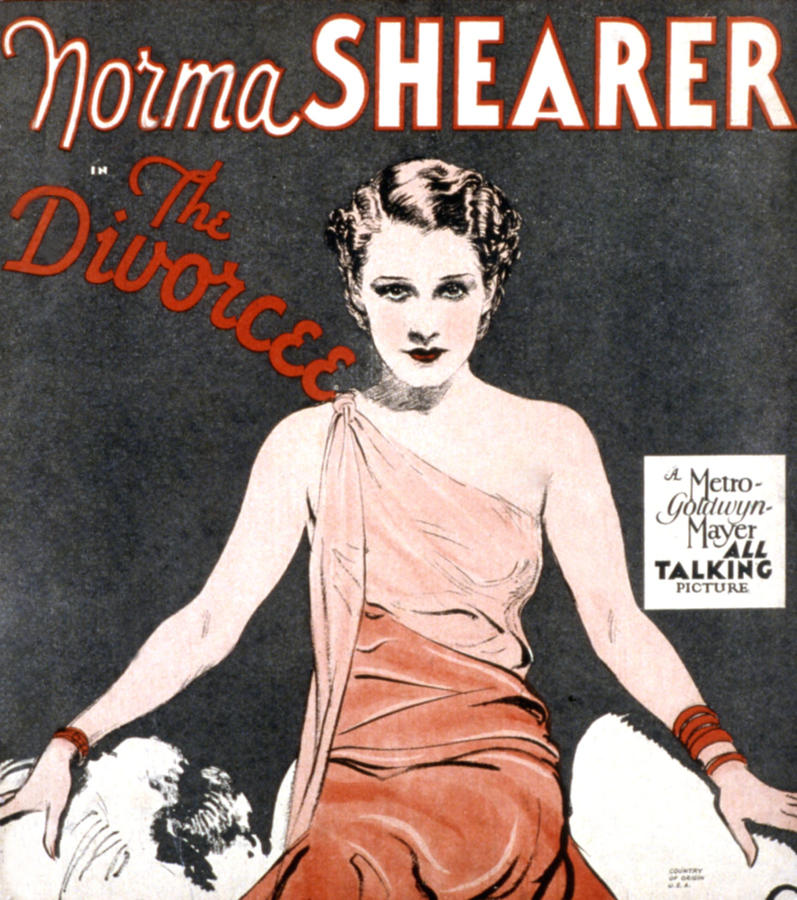
My Pick for Outstanding Production of 1929-30: The Divorcee(1930)
The film from this group of Outstanding Production nominees that I would most want to see again and would most readily recommend to anyone, classic film fan or not, is The Divorcee. The best thing about the film is its main character, Jerry, and Norma Shearer’s Oscar winning performance. I do not think the film judges Jerry for “living it up” after her divorce or for not waiting for men to come to her, but it does treat that behavior as an aberration. Jerry never becomes immoral, she only wants equality. Having a character like this as the star of a movie, no matter how the film ends, is an accomplishment of sorts. Another accomplishment The Divorcee makes is finding the right balance between social consciousness and entertainment. 
The Divorcee begins and ends as a romance, has drama in between, and never feels uneven. Whether with fun scenes of lavish parties or serious scenes between Jerry and her sister, the film maintains a steady pace. The male characters that surround her (Ted, Don, and Paul) are entertaining characters as well. The comedy in The Divorcee certainly holds up and, along with the performances, makes it a lively film. Certain camera shots and sequences keep it visually interesting too.
A modern viewer might be disappointed in The Divorcee’s view of divorce as an unacceptable social ill, but I also think a modern viewer will be far more sympathetic and understanding of Jerry and her actions. The film does not take a stand against double standards and unfairness and inequality toward women, but in simply acknowledging that such things existed The Divorcee was bold and daring for its time. Its values may be dated, but The Divorcee is no less entertaining.

Friday, January 20, 2017

Best Pictures #28: 1929-30 (3rd) Academy Awards Outstanding Production Winner, All Quiet on the Western Front (1930)

by A.J.

Best Pictures #28: 1929-30 (3rd) Academy Awards Outstanding Production Winner

All Quiet on the Western Front was not the first big budget war film to be nominated for or win Best Picture—that would be Wings (1927)—but it is the first antiwar film to be recognized by the Academy. This film opens with a title card explaining that it is “neither an accusation or a confession… least of all an adventure… It will try simply to tell of a generation of men who, even though they may have escaped its shells, were destroyed by the war…” Wings was an adventure film about young men that dreamed of flying airplanes. In 7th Heaven (1927) war was a fact of life that interrupts a couple’s romance. All Quiet on the Western Front has its main character telling a classroom full of boys eager to enlist in the army and go the frontlines, “It’s dirty and painful to die for your country.” The boys and their teacher call him a coward.
At the beginning of the film The Great War has just broken out and young Paul (Lew Ayers) jumps up from his desk at school to declare that he is enlisting in the army after his teacher gives an ultra-patriotic speech about the glory of war. The other young men in class follow suit and jump up and declare they will go off to war too. They all hope to go to the front and they all expect to come home in one piece. Their first experience as soldiers is the petty tyranny of the local postman turned drill sergeant. He makes sure the boys get plenty muddy and miss their leave, but that is just another school experience that in no way prepares them for real combat. The harsh realities of modern warfare overwhelm Paul and the rest of the new recruits almost immediately and their experiences only get worse and worse as the war goes on and on.
All Quiet on the Western Front had the large budget of $1.4 million (the equivalent of nearly $21 million in 2016 dollars). With the then recent stock market crash and ensuing depression less a year before, it was quite a risk for Universal and its studio head, Carl Laemlle, Jr. The risk turned out to be worthwhile. All Quiet on the Western Front was a hit at the box office and won Universal its first Best Picture Oscar. The film was less well received abroad however, most notably in Germany. Based on the novel by Erich Maria Remarque, inspired by his own experiences at the front, this is one of the few films about World War I to portray Germans as the main characters. Laemmle himself was a German immigrant and he and director Lewis Milestone felt they made a film that was antiwar, not anti-German. The film caused riots in Germany, most notably Berlin, where the disruptions of screenings—mice were released into theaters showing the film—and subsequent riots—the beating of projectionists and anyone that looked Jewish—were led by Joseph Goebbels and Nazi thugs. The film was ultimately banned by the German government, though the Nazi party had yet to take power. Laemmle agreed to make cuts to the film and even took out an ad in a Berlin newspaper explaining that the film was not anti-German, it just objectively showed the experience of war. The film was rereleased but memories of the Nazi riots kept audiences away. It would be banned again by the Nazi government a few years later. Interestingly, it was banned in Poland for being pro-German.
There are several shots and sequences that keep All Quiet on the Western Front visually interesting; a stark contrast to the visually dull The Racket (1928), also directed by Milestone. Milestone won Best Director, his second Oscar, making him the first person to win more than one Oscar and All Quiet on the Western Front the first film to win awards for Best Picture and Best Director. One of the most memorable scenes in the movie is an extended tracking shot that shows enemy soldiers running toward machinegun fire and being mowed down and tumbling into barbed wire. A bomb goes off in front of one enemy soldier and when the smoke clears we see a brief shot of his severed hands clutching the barbed wire. The rest of him is nowhere to be found.
I think this would have been a violent film for its time. Though there is very little blood, there are many, many dead bodies. There are explosions galore, bursting bombs, and hand to hand combat, but none of it is exciting in an adventurous way. One of the early battle scenes has the soldiers hunkered down under a prolonged bombardment. The shelling goes on and on and the roof of their bunker cracks dumping dirt on them. It is not the glorious adventure they imagined as schoolboys.
Perhaps because the characters, even the main characters, are all basic, thin archetypes, I was never fully engaged with this movie. They serve the plot just fine, but All Quiet on the Western Front feels like it is lacking full-fledged characters. The performances of Louis Wolheim and Lew Ayers may have been fine for the time that this film was released, but they do not hold up as well as the technical aspects. The heightened, exaggerated acting style of time feels at odds with the gritty realism All Quiet on the Western Front was aiming to achieve. 
All Quiet on the Western Front is impressive technically for its battle scenes and sound quality. Even more impressive is the fact that it was a big Hollywood movie that dared to acknowledge the many horrors of war at a time when sentimentality and happy endings were the order of the day. It is hard not to hold all of the antiwar film beats and clichés against All Quiet on the Western Front, however, as with its fellow Outstanding Production nominee, The Big House and its genre clichés, it must be kept in mind that this film is the source of those familiar beats and plot points. All Quiet on the Western Front is notable for being the first Best Picture winner that was more than pure escapist entertainment. Unfortunately it has not aged well.
Nominee: Universal
Producer: Carl Laemmle, Jr.
Director: Lewis Milestone
Screenplay: George Abbott, adaptation & dialogue by Maxwell Anderson, adaptation by Del Andrews, based on the novel by Erich Maria Remarque
Cast: Louis Wolheim, Lew Ayers, John Wray
Release Date: August 24th, 1930
Total Nominations: 4, including Outstanding Production
Win(s): Outstanding Production, Director-Lewis Milestone
Other Nominations: Writing-George Abbott, Maxwell Anderson, Del Andrews, Cinematography-Arthur Edeson

Wednesday, January 11, 2017

Best Pictures #27: 1929-30 (3rd) Academy Awards Best Picture Nominee, The Big House (1930)

by A.J.

Best Pictures #27: 1929-30 (3rd) Academy Awards Best Picture Nominee
The Big House, released in 1930, is considered by classic film fans and film historians to be the first realistic prison movie produced by Hollywood. MGM production chief Irving Thalberg sent screenwriter Francis Marion to San Quentin State Prison to observe real prisoners, guards, and conditions inside prison walls. She interviewed inmates and prison staff alike. The result was a screenplay that won Marion the Oscar for Best Writing, making her the first woman to win a non-acting Academy Award.

The Big House stars Chester Morris, Robert Montgomery (who also appeared together in The Divorcee), and Wallace Beery as cellmates. Each handles prison life in a different way. Robert Montgomery plays Kent, who has just begun a 10-year sentence for killing someone while driving drunk. He is put in a cell with Morgan (Chester Morris), a thief on the verge of parole, and Machine Gun Butch (Wallace Beery), a ruthless multiple murderer that runs the cellblock. Beery had been out of work for more than a year when cast in The Big House. Though Beery had been a successful character actor during the silent era and done a successful sound test, his contract was dropped by Paramount when the studio converted to sound. Beery’s performance earned him an Oscar nomination for Best Actor and his career rebounded.

Directed by Francis Marion’s husband, George Hill, The Big House is well paced and well shot. The lighting design of certain scenes with low light and harsh shadows is reminiscent of Film Noir, a subgenre that is defined in part by its use of shadows and antiheroes that wouldn’t be fully developed until the mid-1940’s. As Morgan is marched from the cell block down to the dungeon for solitary confinement, the light fades and shadows envelope the frame. Morgan and Butch, also in solitary, call out to each other over the shouts, screams, and singing of the other inmates. All we see is the empty, dark hallway as the scene slowly fades out.

There is a brief respite from the bleak drudgery of prison life when Morgan escapes after losing his parole. He visits Kent’s sister, Anne, with whom he has been infatuated since seeing her picture. Anne goes from being suspicious of Morgan to falling in love with him rather quickly. It is his brief time with her that convinces him to go straight after he’s captured and taken back to prison. When Morgan won’t go along with Butch’s big escape plan, Butch thinks that Morgan has turned into an informer. The climax of The Big House is a full-blown riot and shootout between guards and prisoners. Each side has pistols, rifles, and Tommy guns. At one point army tanks roll into the fray.

The performances all around are pretty good. The first character we meet is Kent as he is being processed into the prison. As he unravels and buddies up to the prison’s main informer, Morgan emerges as our sympathetic hero. Montgomery is great playing a character that is not cut out for prison, scared, and just trying to get by and get out, misguided as he might be. Chester Morris is quite good as Morgan; when he decides to go straight we believe his change. The warden, played by Lewis Stone, is also an interesting character. Neither cruel nor corrupt, he is a reasonable, benevolent man. He sees clearly the problems of his prison and the prison system as a whole, but is powerless to make any changes to better the situation. He tells a guard that the prison was built to hold 1,800 men but has 3,000 prisoners. They want to lock them up, he says, but don’t want to provide for them after they’re locked up. The guard replies, “The whole prison system is cock-eyed.” The flaws of the prison system that Francis Marion observed and wrote into her screenplay in 1930 still remain unfortunately accurate.

Douglas Shearer, Norma Shearer’s brother, won the first Academy Award for Sound Recording for his work in The Big House, and the sound design is very good and effective indeed. The first thing we hear is the sound of marching footsteps of prisoners. That sound is repeated throughout the film, and it is also the last thing we hear over the “The End” card instead of closing music. The footsteps on hard floors and gravel, food slopping on plates, and crowd noises are all pronounced and important to the effectiveness of the images. The sound cues in The Big House do more than just match what happens on screen, they underline and emphasize it. The shots of dozens upon dozens of prisoners marching in line, often from the shoulder down, or filling the mess hall, sitting at the same time, being served at the same time, all wearing the same uniform and making the same sounds suggests that humanity and individuality have been stripped away from these men.

I think The Big House is as realistic as a film of this time could be, even during the Pre-Code era. The Big House probably would not hold up to more recent prison dramas, but it is still an entertaining film. It has good performances from all the main players, great cinematography, a great screenplay, and even a dark sense of humor. Morgan warns Butch against including a certain violent prisoner in the escape, but Butch replies, “sure, Hawk cut his mother’s throat, but he was sorry about it.”

The Big House has every prison movie cliché you would expect to see in a prison movie: escape plans, stool pigeons, riots, cruel guards, bad food. However, like many genre films from this time period, it is the source of those clichés. All of the beats and plotlines still work and are still effective and entertaining.

Nominee: Cosmopolitan, MGM
Producer: Irving Thalberg (uncredited)
Director: George W. Hill
Screenplay: story and dialogue by Frances Marion, additional dialogue by Joe Farnham and Martin Flavin
Cast: Chester Morris, Wallace Beery, Robert Montgomery, Lewis Stone, Leila Hyams
Release Date: June 24th, 1930
Total Nominations: 4, including Outstanding Production
Win(s): Writing-Frances Marion, Sound Recording-Douglas Shearer
Other Nominations: Actor-Wallace Beery

Tuesday, January 3, 2017

Classic Movie Picks: January 2017

by Lani

Each month, I scour the Turner Classic Movies schedule for upcoming films that I can't miss. The highlights are posted here for your reading and viewing pleasure! (All listed times are Eastern Standard, check your local listings or TCM.com for actual air times in your area. Each day's schedule begins at 6:00 a.m.; if a film airs between midnight and 6 a.m. it is listed on the previous day's programming schedule.)


REDS movie poster

1/4, 10 PM - Reds (1981)
Scheduled as part of an evening highlighting "quadruple threats," Reds was directed, produced, and written (with the assistance of playwright Trevor Griffiths and screenwriters Robert Towne and Elaine May) by Warren Beatty. Beatty also stars as journalist/activist/adventurer John Reed, whose best-known work Ten Days That Shook the World, chronicled the Russian Bolsheviks' rise to power in 1919. The film takes us along for Reed's many exploits, while also focusing on his romance with journalist Louise Bryant (played by Diane Keaton). Reds received 12 Oscar nominations, including Best Picture, screenplay, and acting nods for Beatty and Keaton, and ultimately won three awards for Maureen Stapleton's supporting performance as anarchist Emma Goldman, Vittorio Storaro's cinematography, and Beatty's direction. Beatty holds the distinction, shared only by Orson Welles (I believe), of earning Oscar nominations for acting, writing, producing, and directing in the same year. Of course, Welles only did that once, while Beatty managed it twice(His first quadruple-threat effort, 1978's Heaven Can Wait, will be shown tonight at 8PM.) Because Beatty is a multi-talented filmmaker, and so indelibly associated with Hollywood, I was surprised to learn that he has acted in only seven films in the 35 years since Reds. And despite being an Oscar-winning director, he has only directed 3 more films since Reds. However, he hasn't retired -- his latest film, Rules Don't Apply, was released in late 2016. 

1/20: The Saint Marathon
8 PM - The Saint in New York (1938)
9:30 PM - The Saint Strikes Back (1939)
10:45 PM - The Saint in London (1939)
12:15 AM - The Saint's Double Trouble (1940)
1:30 AM - The Saint in Palm Springs (1941)
2:45 AM - The Saint's Vacation (1941)
4 AM - The Saint Meets the Tiger (1943)
Gentleman detective/vigilante Simon Templar, aka The Saint, was born from a series of stories by Leslie Charteris. As described by the author, Templar was "a roaming adventurer who loves a fight...a dashing daredevil, imperturbable, debonair, preposterously handsome, a pirate or a philanthropist, as the occasion demands." A character like that was a natural for a film adaptation, plus his backstory as a former criminal gave the Saint a morally-gray edge and left him open to using not-necessarily-legal means for bringing down his adversaries. In this series of Saint films from the 30s and 40s, our hero's varied exploits include killing NYC crime bosses, seeking vengeance for a policeman's daughter, acting a bodyguard to a stamp collector, and unmasking a gang of gold smugglers. In the films on tonight's schedule, Templar is portrayed by Louis Hayward, George Sanders, and Hugh Sinclair. Charteris felt that the actors selected to play his creation were hopelessly miscast, preferring instead a Ronald Colman, Douglas Fairbanks Jr., or Cary Grant. But those were "A List" stars, and these were low budget "B" pictures. However, audiences didn't seem to agree with the author as the Saint films were quite popular. Sanders in particular was so popular as the Saint (though he hated the role), he was later cast in a similar series of detective pictures as "The Falcon."


Magnificent Obsession movie poster

1/26: Jane & Ross & Douglas & Rock
8 PM - Magnificent Obsession (1954)
10 PM - All That Heaven Allows (1955)
Star of the Month Jane Wyman had many phases to her long acting career, from chipper chorine to soap opera matriarch. In the 1950s, following her Best Actress Oscar for Johnny Belinda (1948), Jane was the queen of the dramatic tearjerker. The best films from this period were her collaborations with director Douglas Sirk and producer Ross Hunter who specialized in films which combined style, schmaltz, and social commentary. Young beefcake Rock Hudson got his breakthrough dramatic role in Magnificent Obsession. The team came back together for another winner the next year with All That Heaven Allows. Each film follows a similar formula -- Wyman is a widow who falls in love with the much younger Hudson, to the disapproval of society, and each finds redemption in their love -- though the details and plot twists change. The melodramatic stories are elevated through appealing performances from the leads and impeccable production design (shown in glorious Technicolor). 


Debbie Reynolds in Singin in the Rain

1/27: TCM Remembers Debbie Reynolds
6 AM - It Started with a Kiss (1959)
7:45 AM - Bundle of Joy (1956)
9:30 AM - How The West Was Won (1962)
12:30 PM - The Tender Trap (1955)
2:30 PM - Hit the Deck (1955)
4:30 PM - I Love Melvin (1953)
6 PM - Singin' in the Rain (1952)
8 PM - The Unsinkable Molly Brown (1964)
10:30 PM - The Mating Game (1959)
12:30 AM - The Catered Affair (1956)
2:15 AM - The Singing Nun (1966)
4 AM - How Sweet It Is! (1968)
In tribute to the late Debbie Reynolds, TCM has pre-empted its original schedule to devote the day to her films. I intend to watch every single one. 
Reynolds was America's Sweetheart in the 1950s, and considering her pretty looks, appealing alto voice, and spunky energy it is easy to see why. Not all her films are masterpieces, but she brought vivacity and spirit to each role, which, for me at least, makes any Debbie Reynolds film worth watching. 
Today's line-up includes several films which were important to Reynolds' career and to cinema history, starting in the morning with Bundle of Joy. A musical remake of the Ginger Rogers film Bachelor Mother, the film was designed to capitalize on the publicity surrounding the marriage of Reynolds and co-star Eddie Fisher. Though the marriage didn't last, it did produce Reynolds' beloved children Carrie and Todd Fisher. In fact, Reynolds was pregnant with their daughter during filming -- a bit of trivia which seems more amazing as you watch Reynolds fly through high energy dance numbers while seven months pregnant! 
Reynolds was part of the all-star cast of How the West Was Won, the first film shot in Cinerama -- a widescreen process which required three cameras placed side-by-side to film, and three projectors to screen it on a special wide, curved screen. The complications of filming and projecting Cinerama prevented it from taking off, but I imagine it was dazzling in its day, a predecessor of today's IMAX experience. (See if you can spot the lines separating the three images in the finished film.) 
Her breakout role came in Singin' in the Rain, as Debbie proved that despite no professional dance experience she could keep up with veteran hoofers Gene Kelly and Donald O'Connor. She worked tirelessly to get the steps, a work ethic which would be a hallmark of her long career, and in the film she makes it look effortless.
Reynolds would continue to star in musicals through the 50s and 60s, the most successful being The Unsinkable Molly Brown. Her performance in the title role garnered an Oscar nomination, and perhaps more impressively, inspired astronauts Gus Grissom and John Young to name their Gemini 3 spacecraft "Molly Brown." The lively and ultimately "unsinkable" Brown would come to be synonymous with Reynolds herself -- weathering life's triumphs and tragedies with an indomitable spirit.
Read TCM's tribute to Reynolds here