Showing posts with label David Cronenberg. Show all posts

Tuesday, October 25, 2022

13 Nights of Shocktober: Scanners

by A.J. 

This is my favorite time of year, second only to Christmas. Autumn has arrived, the weather is cooling down, and October becomes the month-long celebration of scary movies called Shocktober. So, for the days leading up Halloween I’ll be posting some horror movie recommendations to help you celebrate Shocktober.


Night 7: Cronenberg Night

We're gonna do this the scanner way.

Scanners

“You’re a scanner but you don’t realize it,” the main character of Scanners is told about six minutes into the film. Writer-director David Cronenberg wastes no time in getting to the plot and action of his 1981 sci-fi horror thriller. Wasting no time may as well be the mantra of Scanners, which is famous for being the movie where someone’s head explodes in the first 10 minutes (it actually happens around 13 minutes into the movie). I don’t want to give the impression that Scanners is some sort of adrenaline filled special effects geek show. This is a well-paced thriller that combines science-fiction, action, and, of course, body horror that also manages to be a surprisingly believable story about warring groups of psychics. 

Cameron Vale (Stephen Lack), a drifter suffering from constantly hearing voices, awakes in a strange room and is told by Dr. Ruth (Patrick McGoohan) that he is a scanner, a person able to connect with and affect others by means of telepathy. Dr. Ruth works for an organization called Consec that recruits scanners and develops a serum that suppresses the constant barrage of voices. It is unclear whether Consec is a private company or government organization, but it certainly has secrets and shady members. Dr. Ruth trains Vale to harness his ability to use against Daryll Revok (Michael Ironside), a rogue scanner out to build a scanner army and dominate non-scanning humans. Revok kills all scanners who will not join.
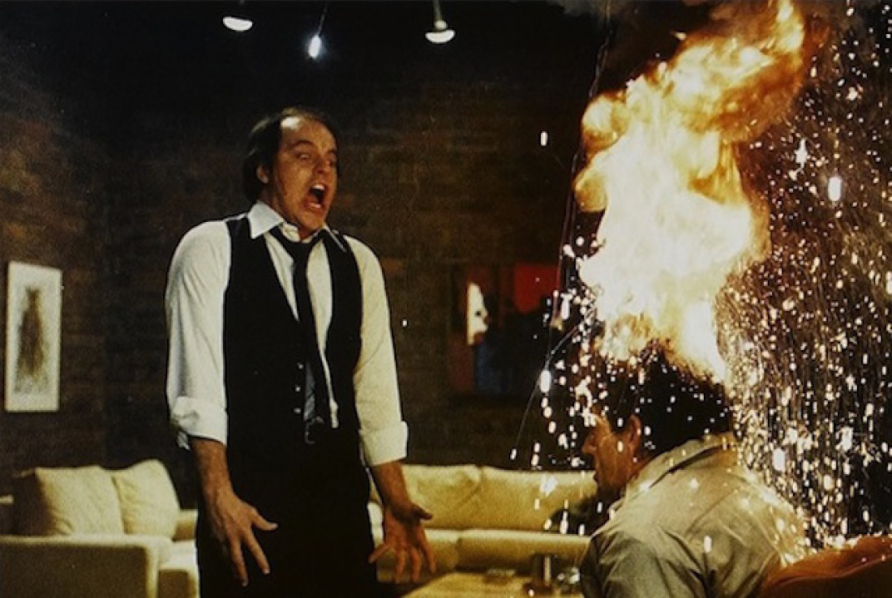
At a public but sparsely attended demonstration a scanner attempts to demonstrate proof of his telepathy by scanning people from the audience. Unfortunately, the volunteer is Revok, who, in one of the most famous moments in modern horror film history, makes the other scanner’s head explode. The exploding effect is done in full light in a single shot and in close up. Even if you’ve never seen the movie, you’ve likely seen this moment as a meme or gif around the internet to demonstrate that something is “mindblowing”. Yes, it is graphic and gross, but honestly, I think most viewers would be too in shock by what they’ve just seen to be grossed out. In a nice touch there is a reaction shot of Revok and even he is shocked by what just happened. It manages to catch me off guard at each viewing. In any case, there is nothing else like that in the movie, so if you can make it past that scene the rest of the violence is tame by comparison. On the other hand, if you are looking for a movie filled with impressive practical visual and make-up effects, you’ll probably be disappointed and should check out Cronenberg’s version of The Fly

As in many of Cronenberg’s films, the paranormal is presented as a new scientific finding. For a movie about telepathy and psychics, nothing feels mystical or magical. This is a film where scanning can be clearly demonstrated and studied in controlled environments and is in the realm of scientists instead of mystics. The only time scanning seems metaphysical is when Vale finds a commune of peaceful hippy scanners who use it as a means of mediation and communion. Yet, the overall attitude the film takes towards scanning and telepathy is not as the communion of souls or even consciousnesses. Dr. Ruth says flatly, “Telepathy is not mind reading. It is the direct linking of two nervous systems separated by space.” It is more important to the plot that Vale scans a computer system, instead of a person, for secret knowledge. It is clear that the metaphysical movement of the 1970’s influenced Cronenberg’s script. Another layer is added when you remember that his wife joined a cult in the 1970’s. As with Cronenberg movies like Rabid (where the Canadian government acknowledges and responds fairly well to a zombie outbreak), or Videodrome, or The Brood,  you don’t get a sense that the scanners are being concealed or covered up, even if the public doesn’t take notice. 
This is the kind of film that has lines of dialogue like: “I’m a Psycho-pharmacist by trade, specializing in the phenomenon of scanners” and “I scanned him. He’s for real.” I’ll admit this movie might not work for everyone. If you can buy the scenes of the scanners using their abilities, meaning scenes of the actors shaking their heads, making pained expressions, using overly expressive eyes, and intense face acting, then this will be an interesting, even thrilling movie. A psychic thriller as it were. If you can’t, I can’t blame you. There isn’t much to Stephen Lack’s performance as Vale. He comes across as a blank, but he is meant as the audience surrogate, learning as he goes along. Patrick McGoohan plays Dr. Ruth with a cold authority that is serious but not stern. We’re able to believe everything he tells us. The stand out is Michael Ironside as the evil scanner, Revok. Ironside plays a great villain but he’s also a great screen presence with his own kind of charm. He sells the intense facial expressions of scanning in a way that make those scenes and the whole movie compelling and tense. 

Scanners is streaming on HBOmax and the Criterion Channel.

Sunday, October 27, 2019

13 Nights of Shocktober: Rabid

by A.J.

This is my favorite time of year, second only to Christmas. Autumn has arrived, the weather is cooling down, and October becomes the month-long celebration of scary movies called Shocktober. So, in the days leading up Halloween I’ll be posting some scary movie recommendations to help you celebrate Shocktober.

Night 9: Cronenberg Night
“So, don’t let anybody bite you.”
David Cronenberg’s second feature film, Rabid, along with his controversial debut feature, Shivers (aka They Came From Within), established him as a distinct and creative voice in horror cinema and helped make his name synonymous with the body horror subgenre. Rabid shares a lot of common ground with Shivers. Both involve a manmade infection or plague that spreads through bodily contact and causes the veneer of civilization to crumble. Both involve a “mad,” or at least overconfident, scientist experimenting on a woman’s body, causing it to become monstrous. In Rabid, however, the woman that has been experimented on is the main character, and she comes across as more of a victim than a monster.
After a bad motorcycle accident, Rose is rushed to the nearest medical facility where an experimental skin graft is performed, even though the doctor is aware of the potentially dangerous side effects. One side effect the doctor did not foresee is Rose growing a bloodsucking needlelike appendage that shoots out of a slit in her armpit so she can feed an uncontrollable bloodlust. Rose becomes a sort of vampire, but the people she feeds on become like ravenous zombies attacking anyone they encounter.
Rose is played by Marilyn Chambers, the adult film star most famous for the cult classic porn film Behind the Green Door. Chambers was looking to transition to mainstream movies, and the producers decided to cash in on her notorious fame. As a legitimate actress, Chambers gives a sympathetic and believable performance as the tragic Rose. Rose oscillates between embracing being a bloodthirsty predator and fighting her monstrous desires, and Chambers does a good job portraying both sides of the character. There is a complexity to her role that is not typically given to female characters in horror movies. If there is a stiff, underwritten character, it is Rose’s boyfriend, Hart (Frank Moore), who spends most of the movie being confused or receiving exposition. In any other horror movie, Hart would be the hero and Rose would just be the monster.
Rabid does not oversexualize Marilyn Chambers. There are nude scenes of Chambers, but there are more scenes where Rabid uses the Marilyn Chambers persona to subvert lurid audience expectations. When Rose is on the prowl, she exudes a seductive aura. Her encounters with her prey (mostly lascivious, predatory men) appear as though they will lead to sex, but they end abruptly and very un-erotically.
Rabid makes such good use of its resources that it does not feel like a low budget movie. There are impressive car crashes, chaotic crowd scenes, shoot outs, and even soldiers and tanks in the streets of Montreal. The special makeup effects have a dated look (the blood is that certain shade of bright orange-red that was popular in 1970’s horror films), but they are still effective. Rabid is not as gory or effects heavy as Cronenberg’s later movies, but a more squeamish viewer would still probably have to avert their eyes more than a few times.
There is more to Rabid than some would be willing to give it credit for. Cronenberg packs in themes of science run amok, how society responds to a crisis, and women losing body autonomy. In the world of Cronenberg, supernatural occurrences stem from radical scientific discoveries and are accepted by the characters. The challenge characters in a Cronenberg movie face isn’t convincing skeptics, but in how they will deal with an extraordinary problem. Whether you dive into the subtext and themes or just want to enjoy a hybrid vampire-zombie movie, Rabid will make for a thrilling and interesting Shocktober viewing.

Thursday, October 24, 2019

13 Nights of Shocktober: The Fly (1958)

by A.J.

This is my favorite time of year, second only to Christmas. Autumn has arrived, the weather is cooling down, and October becomes the month-long celebration of scary movies called Shocktober. So, in the days leading up Halloween I’ll be posting some scary movie recommendations to help you celebrate Shocktober.

Night 6: Creature Feature Night
“They wouldn't harm anything, not even a fly.”
The 1950’s saw the rise of the science fiction genre as the framework to tell both adventure stories and horror stories. Concerns brought on by the Atomic Age and sudden advances in science and technology manifested themselves on screen with stories about mad scientists, man-made monsters, and the unintended consequences of science run amok. Given its premise and its more famous, and grotesque, remake, the original version of The Fly, released in 1958, may not be the sci-fi/horror movie you would expect.
The premise is certainly schlock B-movie material, but the screenplay by Shogun author James Clavell and solid performances from the cast give this movie just enough depth to make it a step above a hokey exploitation picture. The story of a brilliant scientist that accidentally merges his body with a housefly while experimenting with teleportation checks all the boxes of a 1950’s sci-fi/horror, but this movie also works as a drama and presents itself as a mystery. The film opens with the body of a scientist, Andre Delambre (Al Hedison), being discovered in a metal factory he owns. His head and left arm were crushed in a metal press. His wife, Helene (Patricia Owens), says she murdered him but was only following his final wish. Andre’s brother, François (Vincent Price) and a police inspector listen to her tell her story.
Most of the movie is of Andre and Helene’s happy, idyllic homelife with their son. Andre is a good husband and father and an ambitious, hardworking scientist. He is nowhere close to being like the mad scientists that were common in sci-fi movies of 1950’s. The movie invests so much in Andre that it is more tragic than thrilling when he is transformed into a fly-man creature. Hedison does a good job in human form, but when he loses the ability to speak, he uses exaggerated body language to communicate and goes a bit over the top. Patricia Owens gives a great and believable performance that is the emotional center of the movie. Vincent Price is a supporting player here and does an excellent job playing the kind and caring brother of Andre.
The Fly plays like a slow burn to a big reveal. You can see that reveal coming from several miles away, but it still feels like a shocking moment. This is by no means a gross film in terms of special effects, but because the subject involves flies, which nearly every person finds repulsive, it has an icky feel. Even with dated special effects, the shock value of The Fly still works. When Vincent Price finally finds the fly with a human head and arm, it is still a creepy and disturbing sight.
The Fly became an influential film thanks in large part to its two big reveals. It would become a common pop culture reference (even parodied in The Simpsons' Halloween special Treehouse of Horror VIII) and be remade with great success in 1986 by David Cronenberg. In Joe Dante’s 1993 film Matinee, the fictional B-movie promoter played by John Goodman is debuting a film called MANT, about a half-man half-ant creature. I put off watching this version of The Fly for a long time because I wasn’t expecting much more than a hokey drive-in movie. After finally watching it earlier this year, I can see why this film stood apart from others in the genre and has stuck around for so long.

Monday, October 24, 2016

13 Nights of Shocktober: The Brood (1979)

by A.J.

This is my favorite time of year, second only to Christmas. Autumn has arrived, the weather is cooling down, and October becomes the month long celebration of scary movies called Shocktober. There are a lot of horror movies out there, but as a genre, horror is still looked down upon by some mainstream critics and moviegoers. It doesn’t help that, admittedly, there are so few quality horror movies made but, like comedy, it’s a very difficult and subjective genre. So, in the days leading up Halloween I’ll be posting some recommendations for scary movies to help you celebrate Shocktober.

Night 6: Cronenberg Night
“These thing have a way of expressing themselves.”

The Brood (1979)
The Brood is a strong contender for being David Cronenberg’s most polarizing film—Crash (1996) would be the reigning champion. Roger Ebert called The Brood “a particularly nasty little number” and “an el sleazo exploitation film.” He ended his review wondering, “Are there really people who want to see reprehensible trash like this?” In its theatrical run, The Brood failed to be a hit at the box office, but it developed a cult following over time after it was released on home video. Carrie Rickey, in her essay “The Brood: Separation Trials,” included with the film’s Criterion video release, called The Brood, “an emotionally realistic horror movie.” She also writes about how differently she perceived the film before and after having children. Cronenberg himself said that “The Brood is my version of Kramer vs. Kramer, but more realistic.” This statement seems like a wry blurb for his own film, which it is, but it is also true to some extent. The Brood shows through horror movie violence how the nastiness of a bad divorce can radiate out and effect more than just the spouses. He wrote The Brood while going through a very difficult divorce and custody battle. His soon to be ex-wife allegedly absconded with their daughter to a cult in California. It’s safe to assume that Cronenberg did not relate to the divorce in Kramer vs Kramer.
When The Brood begins Frank and his wife Nola are already estranged and out of regular contact. Nola is staying at an institute and undergoing an extreme version of a radical new therapy called psychoplasmics. It involves the therapist role playing as a patient’s abusive parent and belittling and berating them to bring out and confront their own rage. The creator of the bizarre therapy, Dr. Raglan, played by Oliver Reed, has Nola in isolation, but allows visits from Candy, Frank and Nola’s 5-year-old daughter. When Frank picks up Candy from the institute one day, he notices scratches and bruises on Candy’s back. He assumes that Nola must have abused Candy, and the truth is something close to but not exactly that. There is an unintended and dangerous side effect to psychoplasmics: the rage that is released through the therapy manifests itself physically in the body.
Dr. Raglan is praised as a genius. Nola is a devote follower and believer. Frank thinks that Raglan is a quack and his method is a sham. This can be seen as a take on the cliché of a spouse feeling that their therapist has sided with the other spouse and they are united against him/her. Frank meets with a former patient of Raglan’s that is suing Raglan for physiological damage to his body that lead to cancer. He believes Raglan turned his body against him. Frank seeks sole custody of Candy but his lawyer tells him that even with the evidence he has of abuse he doesn’t have a strong case because “the law believes in motherhood.” Meanwhile, people close to Frank and Candy begin to die. The effect psychoplasmics has on Nola is to manifest her rage in a brood of murderous children that carry out violent attacks on the objects of her rage. Subconsciously, Nola is responsible for the abuse of Candy and murder of friends and family members. The murderous dwarf wearing a child’s red coat can’t help but bring to mind Nicholas Roeg’s marital drama/thriller film Don’t Look Now. The detective in charge of the murder investigation thinks that the culprit is someone’s deformed child that they kept locked up in an attic. “It wouldn’t be the first time,” he says.
I find that Cronenberg’s horror films have a pro-science perspective though they are about wild and fantastic stuff. Generally in films the scientist character, when not mad from the start, is the last to believe whatever paranormal event is occurring or continues to deny it even in the face of it. The scientific method is not about shouting down new claims. It is about evidence. Extraordinary claims require extraordinary evidence, as Carl Sagan would say. In Cronenberg’s films the extraordinary events of the story leave behind tangible evidence and the doctor or scientist and the other characters accept the claim as fact when presented with the evidence. In The Brood, one of the dwarf creatures is killed and an autopsy is done. The pathologist, the detective, and Frank are there to witness that the dwarf creature has no sexual organs or navel and is not entirely human. The evidence presented is met with acceptance not skepticism or hesitation. This is also true in Shivers, Rabid, The Brood, Scanners, Videodrome, The Dead Zone, and The Fly.
The controversy surrounding The Brood stems from claims that it is a misogynist film, and it is not difficult at all to read the film as such. With lines like, “You got involved with a woman that married you for your sanity, hoping it would rub off. It worked the other way,” and the fact that Nola is the source of all marital discord and conflict, it is understandable why the film could be viewed this way. I, and certain female fans of this film (yes they exist), view The Brood differently. The horror in The Brood stems from how psychoplasmics transformed Nola’s body. This is Cronenberg’s second film in which the female body transforms and becomes monstrous. In The Brood, Rabid, and Shivers the female body only becomes dangerous or monstrous and the site of horror after it has been tampered with by a male scientist seeking to improve the woman. In his first film, Shivers, the female body is the source of an infectious parasite that spreads to the tenants of a high rise building. What separates The Brood from Rabid (in which after surgery gone wrong a woman becomes a type of vampire), is that Raglan is trying to heal and improve Nola’s mind, not her body, and to some extent succeeds but unintentionally causes physiological damage to Nola. The mad scientist is to blame for unleashing horror through a female in Shivers, Rabid, and The Brood. Dr. Raglan certainly is a mad psychotherapist; he even has a faithful assistant like all mad scientists.
While the murderous brood are carrying out Nola’s subconscious desires, she is neglecting her child born from her marriage for her children born of her rage. One of the most horrific and gross images in the movie is when Nola licks the blood off of one of her newborn offspring. It was actress Samantha Eggar’s idea for her to lick the blood off of her offspring, the way a mother dog does, and was pleased that she was able to disgust the male crew. From a scholarly angle, you can view this as a maternal instinct being presented as horrific, or as the male perception of a maternal instinct being horrific. 
Samantha Eggar gives a great performance as Nola and is convincingly creepy as a true believer and fanatic of Dr. Raglan. She is not quite as over the top as Piper Laurie as Mrs. White, Carrie’s mom, in Carrie, but she is close. Oliver Reed is also good as the eccentric Dr. Raglan who becomes an uneasy ally of Frank, played by Art Hindle. The Brood has a great string based score by Howard Shore, reminiscent of Bernard Herman’s score for Alfred Hitchcock’s Psycho. The special effects and make up effects hold up very well and look great, or gross depending on your sensibility. Despite what Roger Ebert says in his review, The Brood is not just a geek show. Yes, it will likely make you squirm and shift in your seat, but it also uses suspense to put you ill at ease. In particular, the scene in which Dr. Raglan tries to get Candy out of the secret room where the brood has taken her is evocative of a similar scene with Rod Taylor in Alfred Hitchcock’s The Birds. The Brood, like Cronenberg’s previous horror movies, is an elevated exploitation film. This film has violence and scares and is shocking and even disgusting, but it is also a film of substance and troubling ideas. The Brood is quality horror that works on many levels.

Friday, October 30, 2015

13 Nights of Shocktober: Night of the Creeps

by A.J. 

This is my favorite time of year, second only to Christmas. Autumn has arrived, the weather is cooling down, and October becomes the month long celebration of scary movies called Shocktober. There are a lot of horror movies out there, but as a genre, horror is still looked down upon by some mainstream critics and moviegoers. It doesn’t help that, admittedly, there are so few quality horror movies made but, like comedy, it’s a very difficult and subjective genre. So, in the days leading up Halloween I’ll be posting some recommendations for scary movies to help you celebrate Shocktober.

Night 12: Spooky Fun Night, “The good news is your date is here. The bad news is…he’s dead.”
Night of the Creeps
The first time I saw the cult classic Night of the Creeps was on TCM as part of TCM Underground. I couldn’t believe what I was seeing, on TCM of all channels, but I was very entertained and glad TCM included it in their programming schedule, uncut and commercial free. It is a cheesy 1980’s B-film of a horror movie but it is also a thoroughly entertaining love letter to cheesy 1950’s sci-fi/horror movies. Even a sharp observer will have to hit the rewind button a few times to catch all of the direct and indirect references to other horror movies and horror filmmakers.  
Right away Night of the Creeps lets you know what kind of movie you’re in for. It begins with two aliens with ray-guns on a spaceship chasing after a third alien carrying a cylinder. When the aliens speak, their dialogue is subtitled in both English and, what I assume to be, their alien language. The aliens are so obviously short men in suits and masks that I think that is what director Fred Dekker must have intended since the special effects later in the movie are pretty good. Dekker would go on to direct another cult classic with great effects, The Monster Squad, which is either a terrible or great film depending on what age you were when you first saw it. I think it’s great.
The mysterious alien cylinder is shot into space and lands on Earth in 1959. The first scene on Earth is in black and white and looks like a clichéd scene from 1950’s teen horror movie. The setting is sorority row and not that far away a boy and girl are in a parked car. From the alien cylinder a wormy slug springs into the mouth of the boy who left his date alone in the car. While an alien parasite worm is jumping into his mouth, an axe wielding escaped mental patient is attacks the girl. After this scene you should definitely know that Night of the Creeps is campy, over the top, self-aware fun. The movie then jumps to 1986 during "Pledge Week." We meet Chris and J.C., two college freshmen. Chris talks J.C. into pledging a fraternity with him because he is desperate to impressive the very pretty Cynthia, who he thinks (for no reason at all) is only interested in frat guys. Cynthia’s boyfriend, Brad, is the head of the fraternity and gives them the pledge task of stealing a dead body from the university medical lab. Chris and J.C. accidentally unfreeze the body of the college boy infected with the alien parasite back in the 50’s. They freak out and run away. The infected zombie body walks out of the university, but not before attacking a young scientist played by a young David Paymer

The zombie body walks to the sorority house where its head splits open and releases more parasite slugs. The slugs enter into a body then eat at the brain turning a person into essentially a zombie until their head explodes to spread more slugs. The special effects are great old-school practical effects. Some effects, like the slugs and zombie make-up hold up better than others, like the animatronic zombie dog and cat, which still look pretty cool and scary. The effects do get pretty gross, but they are meant to scare and entertain you, not just shock you and make you feel queasy. Night of the Creeps has fun with its effects too. When a bus driver sees the decaying zombie dog in the road, his eyes bulge out of his head, like a cartoon.


Night of the Creeps is a movie you watch for the fun, gross effects, but there are some good characters to go along with the effects too. Chris and J.C. are supposed to be geeks, but there’s nothing much geeky about them other than that they’re not jocks. Chris Romero, our main character, is unfortunately blandly average. His only motivation is to impress the pretty girl because she is pretty. The characters around him, however, are pretty interesting and entertaining. His goofy friend J.C. (James Carpenter) Hooper, is more socially adept and aware and is, overall, a more well-rounded character. The character that steals the movie is the hardened, self-destructive Detective Cameron played by Tom Atkins. He walks into a crime scene and says “thrill me” and constantly refers to Chris and J.C. as Spanky and Alfalfa. When he shoots one zombie in the head he says, “It’s Miller time.” It doesn’t make any sense but it’s great. My favorite scene with him is when he tells Chris a haunting story of revenge from his past. It’s a serious and intense speech in the middle a campy movie and an awkward moment for Chris. Somehow, this character isn’t laughable but is still fun and fits right in with the rest of the movie.

My favorite character is Cynthia Cronenberg, the object of everyone’s affections, played by Jill Whitlow. To say that the female roles in 80’s comedies, especially 80’s teen comedies, are lacking in substance would be a gross understatement. Cynthia, however, is not a trophy or a doll. She’s not impressed with Chris at first since he sent J.C. to talk to her for him. She puts together that the attacks happening around the college are related to the missing body from the medical lab and has to convince Chris and J.C., who are skeptical. At the climax, when a busload of slug infested zombie frat guys descend upon the sorority house, she fights them off along with Chris and Detective Cameron to protect the rest of the sorority. Shooting the zombies stops them, but then the slugs inside just explode out and scatter. The only thing that kills the slugs is fire, so Detective Cameron gets a flamethrower from the police armory (because of course they have a flamethrower). It’s Cynthia who uses that flame thrower while wearing her formal gown to kill off the alien slugs, and she is as badass as she sounds.
This movie is as much a tribute to the whole horror genre as it is a send up of 50’s sci-fi/horror movies. If the characters last names sound familiar it is because many characters are named after horror and science fiction directors like: David Cronenberg (Shivers), James Cameron (Piranha II, Terminator), Sean S. Cunningham (Friday the 13th), Steve Miner (Friday the 13th Part II and III), Sam Raimi (Evil Dead), John Carpenter (Halloween), Tobe Hooper (Texas Chainsaw Massacre), John Landis (An American Werewolf in London), and George Romero (Night of the Living Dead). The characters all attend Corman University, named after legendary producer Roger Corman, who made many, many campy films. When the sorority house mother is attacked she is watching Plan 9 from Outer Space on TV, perhaps the campiest film ever made by the man once voted worst director of all time, Ed Wood. 
Night of the Creeps was a flop when it was released in theaters but has since gone on to build a cult following. I can understand why. This movie has everything: horror, comedy, aliens, sorority girls, awesome horror effects, zombie jocks, a zombie cat, a zombie David Paymer, scenes in black and white, a scene with Dick Miller (who appears in several 80's horror movies), a suicidal cop on edge, a montage of college kids getting ready for a dance, and, best of all, a badass sorority girl with a flamethrower. Night of the Creeps is lots of fun and even a little scary. It’s a perfect movie for horror movie fans, people that like campy movies, and people that just want to have a spooky good time. 


Wednesday, October 21, 2015

13 Nights of Shocktober: Shivers


by A.J.  

This is my favorite time of year, second only to Christmas. Autumn has arrived, the weather is cooling down, and October becomes the month long celebration of scary movies called Shocktober. There are a lot of horror movies out there, but as a genre, horror is still looked down upon by some mainstream critics and moviegoers. It doesn’t help that, admittedly, there are so few quality horror movies made but, like comedy, it’s a very difficult and subjective genre. So, in the days leading up Halloween I’ll be posting some recommendations for scary movies to help you celebrate Shocktober.

Night 3: Dial C for Cronenberg, “Biology is destiny.” –David Cronenberg

Shivers
Whether he is working with a big budget or a small one, master filmmaker David Cronenberg uses ideas to disturb his audience and make them squirm. No matter how graphic or gross the special effects are, they always emphasize an idea or serve as a metaphor. A special effect is never just an empty thrill in a Cronenberg film. This is true even in 1975 Cronenberg’s debut feature, Shivers, in which the budget is low and effects are sparse and even tame when compared to his later films like The Brood and The Fly.  
Shivers takes place in an ultra-modern, nearly self-sufficient, luxury high rise apartment building called Starliner Tower on an island in a lake just outside of Montreal. In the opening scene we see an older man struggling with a teenage girl in a school uniform. He cuts her open on a table then kills himself. Very little is shown, but the sound effects we hear more than make up the lack of blood and guts. We find out later that the man was a scientist who created a parasite that would make people think less and be more sexual with the ultimate goal of turning the world into "one beautiful mindless orgy.” He changed his mind and was trying to kill the parasite he infected her with, but the parasite worked too well, and by that time she had already spread it to a few different men in the building. The scientist’s idea seems outlandish until I remember that the era of Vietnam War protest signs reading “Make Love Not War” had only recently ended. 
With a premise like that, you might expect Shivers to be an exploitation film and though there is a fair amount of nudity, this film does not have a lascivious gaze. Shivers unnerves its audience so well because it does not take a stance on whether spreading the parasite is good or bad. Cronenberg has said in interviews that the parasite is a metaphor for any idea that takes hold. A dramatic and severe change is spreading through the high rise building and Cronenberg is ambivalent about that change, but he is aware and direct about his ambivalence. He does his best to show that “…things might be dangerous and wonderful at the same time, that things might be disgusting and beautiful at the same time.” He says that the movie takes the viewpoint of “straight society” but “emotionally and viscerally” the audience was with the infected people. 
Shivers is an interesting take on the on the zombie film, which had only recently been reinvented by George Romero in 1968 with Night of the Living Dead. “Straight society” is represented by Dr. Saint Luc (played by Paul Hampton) who works in the building’s medical clinic with his girlfriend, Nurse Forsythe. They respond to reports of tenants acting strangely, and attacking other tenants. Some of the infected people act crazed and bizarre like the bellhop who obscenely eats a slice of pie at a mother and daughter in an elevator. Others act only slightly odd and suspicious like the woman who consoles her upset friend by seducing her. The number of infected grows and Dr. Saint Luc is soon being pursued by a horde. It seems as though everyone has gone mad and he is the last sane person. When he runs down a hallway, every apartment he looks into has something strange happening. It reminded me of the scene in Stanley Kubrick’s The Shining where Shelley Duval runs though the Overlook Hotel and finds something horrifying at every turn. The final scene finds Dr. Saint Luc at the Starliner’s indoor pool seeing an infected Nurse Forsythe rise up out of the glowing waters. It is a haunting image that is equal parts alluring and frightening.
Shivers is a low budget horror film that makes the best of what is available. Cronenberg shows great skill at making a believable self-contained world in Starliner Tower. The special effects are simple but effective. The parasites themselves, little slug-like creatures, are not shown very often. The cast is solid though there is some overacting from the minor characters but that hardly harms the movie.
The original title of Shivers was The Parasite Murders. In the U.S. it was released as They Came From Within, which is a title that Cronenberg actually liked and felt fit the theme of the movie. Change and revolution have seemingly external beginnings, but the ultimate change in person from one way of thinking to another happens within. As an idea spreads and other people embrace it, the world may seem like it is turning upside down, until you come around to embrace the same idea. Sometimes the change is for the better, sometimes it is not. Sometimes change just needs to happen. 
My favorite scene of Shivers happens after Nurse Forsythe has been infected with the parasite. She tells Dr. Saint Luc about a dream she had days before that had been troubling her. What follows is a beautiful, haunting, exciting, and frightening speech excellently written by Cronenberg and wonderfully delivered by actress Lynn Lowry. It is also a sort of thesis statement for just about the entirety of David Cronenberg’s body of work. She says that in her dream she was trying to make love to a man, but he was old and dying and repulsive: “But then he tells me that everything is erotic, that everything is sexual… He tells me that even old flesh is erotic flesh. That disease is the love of two alien kinds of creatures for each other. That even dying is an act of eroticism. That talking is sexual. That breathing is sexual. That even to physically exist is sexual. And I believe him, and we make love beautifully.”