Showing posts with label WWII. Show all posts

Saturday, March 9, 2024

Best Pictures #105: 2023 (96th) Academy Awards Best Picture Nominee: Oppenheimer

by A.J.

Best Pictures #105: 2023 (96th) Academy Awards Best Picture Nominee

“Who would want to justify their whole life?”
A drama about the life of a scientist that is one of the biggest box office hits of the year. One of the greatest accomplishments in science that is also one of its worst. A story that is full of wonder and excitement and also dread and doom. A story about the past that feels like it is about today. A work of commerce that is also art. These things seem paradoxical, but as J. Robert Oppenheimer explains to his lone student about the new science of quantum physics, “It’s paradoxical, and yet, it works.” This is also true of Oppenheimer, Christopher Nolan’s 3 hour epic biopic of the “father of the atomic bomb,” which is indeed a heavy drama but also very entertaining. From start to finish it is a completely engrossing film that leaves a lasting impression on its audience. Nolan has made excellent films before (Memento (2000), The Dark Knight (2008), Inception (2010), Interstellar (2014) Dunkirk (2017)), but Oppenheimer feels like a crowning achievement; it is easily the best movie of 2023.
This epic historical film features one of the most impressive ensemble casts in recent memory, and yet, at the center is a brilliant performance by Cillian Murphy as Oppenheimer. Murphy, a longtime favorite of Nolan, finally gets a starring role in one of the director’s films, and not only that but one upon which the entire film depends. He captures the unlikely charisma of Oppenheimer–or “Oppy” as he affectionately called–and complexities and conflict that he tried to keep hidden. Oppenheimer was an unlikely choice to head up the Manhattan Project, especially given his left wing tendencies (an intellectual interest in communist ideas but not politics, and associations, including romances, with known or former communists), but the man in charge of the secret government nuclear bomb project, General Groves (Matt Damon), knows that “Oppy” is the right man for the job. 
Damon seems like he should be the antagonist; he is a pragmatist concerned with getting the project done and Oppenheimer is the creative idealist, but this actually makes them allies. Damon, who looks quite natural in a general’s uniform, also serves as the film’s sort of comic relief, or at least as a tension breaker. He is like the principal to Oppenheimer’s cool teacher, actually giving him a lot of leeway while keeping the higher ups off his back. Likewise, Emily Blunt as Oppenheimer’s wife, Kitty, is also a pragmatist which also makes her a good partner for him, though they clash just like Groves and Oppenheimer clash. She too is a scientist, a biologist and botanist, but is relegated to the role of wife and mother. “Oppy” is most alive when doing theory work, managing Los Alamos, or talking about science and theory. This is fine for friends and fellow scientists but perhaps it explains why his relationships with his wife and on-again-off-again girlfriend turned mistress, Jean Tatlock (Florence Pugh), feel very important but not very intimate and is the cause of the discord in each relationship. Both Blunt and Pugh give great performances as strong minded women who find happiness and strife with Oppenheimer.
Oppenheimer’s true antagonist is admiral turned bureaucrat Lewis Strauss—pronounced “straws”—who Oppenheimer thinks so little of that he doesn’t even register as a rival. Robert Downey Jr., an immensely talented actor, gives his best and most complex performance in years. Strauss brings Oppenheimer to Princeton, where Einstein already works, seemingly to add to his collection of famous scientists. In interviews, Downey Jr compared his character to Salieri, the composer desperate for acknowledgment and so jealous of Mozart that plotted to kill him in Amadeus. He does a wonderful job playing a modern Salieri, a petty and frail ego, and his Oscar nomination for Best Supporting Actor is most deserved. 
Strauss’s scenes, set in the 1950’s and shot in black and white, deal with his senate confirmation hearings for Commerce secretary in Eisenhower’s cabinet, but his questionable past treatment of Oppenheimer becomes the focus of the hearings. These scenes are intercut with a different timeline, shot in color, of Oppenheimer technically not on trial but in a hostile hearing to restore his government security clearance, though it is clear to all that the verdict is a foregone conclusion. He reads his life into the record and we see story of his early life and work at Los Alamos in flashbacks. Jumping from timeline to timeline sustains a steady momentum for each story and gives us a fuller understanding of events and the state of mind of the characters. It is also one of the things that keeps Oppenheimer from being a just straightforward biopic.
The supporting cast is a treasure trove of familiar names and faces including: Josh Harnett, Kenneth Branagh, Jason Clarke, David Krumholtz, Rami Malek, Alden Ehrenreich, and the list goes on and on. No matter how big or small the role, each cast member gives a great performance. Nolan and casting director John Papsidera wisely chose performers with distinctive and memorable faces, so even if you don’t remember every minor character’s name you still don’t lose track of them. 
The score by Ludwig Göransson is ever present but not intrusive. It is dramatic and abstract as needed and enhances the emotions and situations on film instead of cuing the audience on how to feel. The cinematography by Hoyte Van Hoytema is impressive not just because it utilizes the IMAX format to capture the vistas of New Mexico and the stunning splendor and horror of the clouds of fire of the first nuclear test, but also because of how it captures the actors. IMAX cameras lose focus easily, but Nolan and Van Hoytema turned this into an advantage by making great use of close ups–and performers like Murphy, Downey Jr, and Blunt know how make the most of a close up without overacting.  
At times Oppenheimer feels like a heist movie: a couple of characters have an impossible task to achieve in little time and must assemble a team and work out a practical plan. This is where the excitement comes in as Oppenheimer recruits scientists, many of whom are famous in their own right and have theories, equations, and labs named after them. They are in a race to beat the Nazis, who have a two year head start. They are also driven by the thrill of discovery and doing something that’s never been done before. Yet, over every moment looms the weight of the very real and terrible death and destruction of the atomic bomb. There are no scenes of carnage, no real life documentary footage or photos of the effects of the bombs dropped on Hiroshima and Nagasaki, but Oppenheimer, and the audience, fully understand the horror of what has happened. “I have blood on my hands,” he says to an unmoved President Truman and his concerns about the consequences of the atomic age fall of deaf ears.
Nolan focuses the last hour of the movie on what is behind Oppenheimer’s haunted face. His masterful use of filmmaking leaves the audience haunted too. Nolan’s screenplay is based on the biography by Kai Bird and Martin J. Sherwin titled American Prometheus and that is a perfect title for the story of J. Robert Oppenheimer. Niels Bohr (Kenneth Branagh), the Danish physicist who proved Einstein wrong about quantum theory tells Oppenheimer, “You are an American Prometheus. A man who gave them the power to destroy themselves.”

Wednesday, February 28, 2024

Best Pictures #97: Academy Awards Best Picture Nominee: The Zone of Interest

 by A.J.

Best Pictures #97: Academy Awards Best Picture Nominee

“I wasn't really paying attention... I was too busy thinking how I would gas everyone in the room.”
There are several scenes of pleasant sunny days in the countryside: picnics, swimming, horseback riding, a family enjoying each other’s company, enjoying their lives. Everything on screen is meant to evoke the word “idyllic.” It certainly seems that way, but the family is that of Rudolph Höss, the commandant of the Auschwitz death camp, and the camp itself is right on the other side of the wall of the family’s country estate. Nothing in The Zone of Interest, the first film in 10 years from director Jonathan Glazer, is played for shock or sensation. Unlike other Holocaust films, The Zone of Interest aims to unsettle and disturb its audience not in showing the atrocities inside Auschwitz but the cold indifference outside of Auschwitz. The film succeeds in this though that cold indifference hardly comes as a revelation.
There is very little story or plot. Glazer’s screenplay kept little of the novel by Martin Amis, aside from the premise and title. We do not get to know Rudolph Höss (Christian Friedel) or his wife, Hedwig (Sandra Hüller), so much as we observe them. There are very few close ups, no discussions of ideology or race or religion. The camera stays back and we catch snippets of their lives: the children show off collections of teeth they’ve found; Hedwig tries on a fur coat stolen from the latest group of victims; Hedwig’s mother wonders if her Jewish former employer is at the camp; the industrial sounds of trains and smokestacks mixed with distant shouting and gunshots are part of the everyday background noise. The closest the film comes to a plot is Hedwig’s concern over Rudolph’s transfer (he’s so good at his job he’s been promoted to an administrative position in Berlin) which threatens to disrupt or even end the lifestyle she loves (she is the “queen of Auschwitz” after all). 
Glazer, a music video director turned arthouse movie director, has managed to build a cult following around each of his films (
Sexy Beast, Birth, Under the Skin). The Zone of Interest represents his most widely acclaimed film earning 5 Academy Award nominations including Best Picture and Best Director for Glazer. However, this is still an art film with experimental elements. It begins with about two minutes of black screen with discordant music. At one point there is a flash to a solid red screen. A scene of a girl hiding apples in a field is shown in polarized black and white (in the background of a later scene we hear a guard shouting at a prisoner about an apple). These abstract flourishes function like unexpected and jarring punctuation but do not necessarily enhance the viewing experience. The only affecting flourish comes close to the end and involves a flash forward in time. 
We never see inside the death camp. This film means to unsettle us with what Hannah Arendt called “the banality of evil.” A scene of  concentration camp commandants discussing what to do about the Hungarian Jews plays like a bland bureaucratic office meeting. To everyone in that room it was, and to the Höss family the regular eruption of the smokestacks on the other side of the brick wall was more than normal. It was acceptable. Their lives were calm and mundane because they thought there was nothing wrong with the industrialized evil of the Nazis. The closest the film comes to a hateful outburst is Hedwig coldly telling her Polish house servant, “I could have my husband spread your ashes across the fields of Babice.”
The Zone of Interest is well-done on just about every technical level, including the subdued performances from Friedel and Hüller, but overall it falls short of being an arresting film. Its detachment from the characters is meant to emphasize the detachment the characters have from the atrocities despite their physical proximity and involvement. That detachment, though key to the approach of director Glazer, makes for an intellectually interesting film but not an engaging one.
The weight of what we see and don't see and only hear comes inherently from the subject matter and whatever knowledge of the Holocaust the viewer brings with them. The Zone of Interest is only effective when taken as part of the larger range of the Holocaust on film, including films like Schindler’s List, The Grey Zone, and the profoundly affecting, epic length documentary Shoah.

Sunday, February 9, 2020

Best Pictures #62: 2019 (92nd) Academy Awards Best Picture Nominee: Jojo Rabbit

by A.J.

Best Pictures #62 
2019 (92nd) Academy Awards Best Picture Nominee

“You're not a Nazi, Jojo. You're a ten-year-old kid who likes dressing up in a funny uniform and wants to be part of a club.”
A good movie lets you know what you’re in for right away. A great movie surpasses those expectations. You’ll know within the first ten minutes of Jojo Rabbit whether this film is for you or not. It opens with real footage of crowds roaring ecstatically for Adolf Hitler while a German version of “I Want to Hold Your Hand” plays over the titles. This is how 10-year-old Johannes sees Hitler. In fact, his goofy, encouraging imaginary best friend is none other than Adolf. Any comedy set in Nazi Germany is going to be tricky to say the least, even for a talented filmmaker like writer-director Taika Waititi. In previous films, Waititi has tackled broad, dark comedy (the vampire comedy What We Do In The Shadows) and mixed comedy and sentimental drama (the wonderful Huntfor the Wilderpeople). In Jojo Rabbit, Waititi combines sharp satire, broad comedy, devastating drama, and sincere sentiment with incredible results. Movies like Jojo Rabbit don’t come along too often. This is without a doubt one of the best movies of 2019.
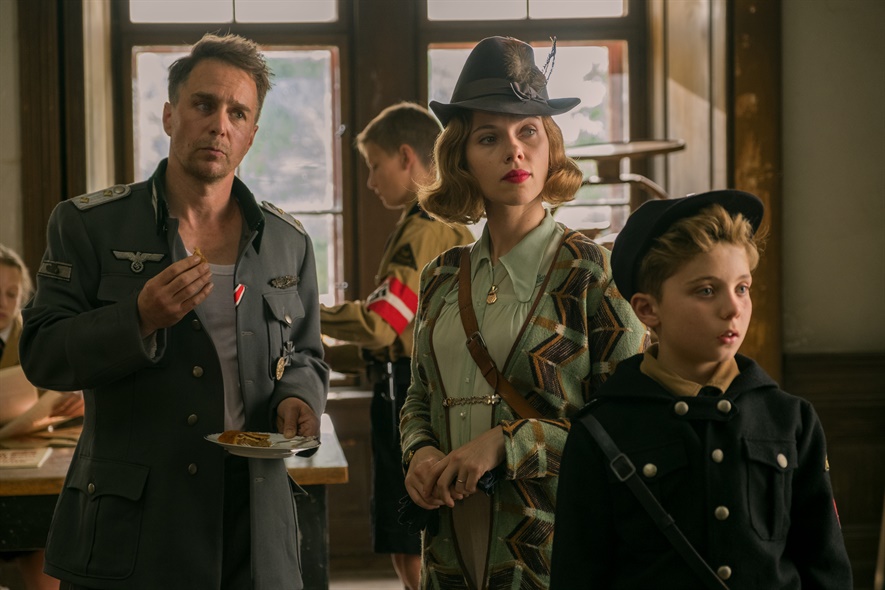
Roman Griffin Davis plays Johannes who is young enough that he believes all of the most awful and absurd antisemitic Nazi propaganda. He wants to be the best Nazi he can be, but doesn’t measure up. Older members of the Hitler Youth nickname him Jojo Rabbit after he can’t bring himself to kill a rabbit. His mother, Rosie (Scarlett Johansson) is raising is him alone—his soldier father is presumed dead, or possibly a deserter—and trying to counteract the hateful propaganda Jojo has been absorbing. She is also secretly sheltering a Jewish girl, Elsa (Thomasin McKenzie), in an upstairs crawlspace. When Jojo discovers Elsa, he knows he can’t turn her in without getting his mother in trouble, so he decides question her about being Jewish to write a book. His initial shock and fright turn to confusion: she has no horns and doesn’t sleep upside down. In fact, she appears to be a normal girl and he develops a crush on her.
Waititi walks a fine line both as a filmmaker, maintaining the film’s dark comic tone, and as an actor, playing the imaginary Adolf. His performance is broad and over the top but it matches what 10-year-old Jojo would conjure up. Scarlett Johansson has earned a Supporting Actress nomination for her role as Jojo’s mother and I think it’s well deserved. Her portrayal of a someone doing all she can to be a good parent and a good person is compelling. Sam Rockwell turns in another good performance as a washed-up Nazi officer that may actually be hiding a sense of decency. In a small but chilling role Stephen Merchant plays a Gestapo officer that comes to investigate Jojo’s house; his thin but imposing 6’7” figure is used for unease and intimidation. Archie Yates as Yorki, Jojo’s only friend in real life, is a natural born scene stealer.  
This film is not meant to be an actual representation of life under Hitler’s Third Reich. This is a fable about a how a young boy experiences the horrors of the Nazi regime and is able to survive not just with his life but with his heart and soul. The screenplay, adapted by Waititi from the novel Caging Skies by Christine Leunen, believes that fanatism is absurd, so everything presented on screen follows that principal. Nazis are presented as ridiculous because their whole belief system is based on the hateful absurdity that a certain group of people are superior to others. The comedy in this movie is audacious and even uncomfortable but it never mocks or minimizes the horrific actions of the Nazis. When one Nazi gives a Hitler Youth child a live grenade and tells him to run and hug an American soldier, it’s not remotely funny.
Jojo Rabbit shouldn’t work but it does. A large reason for that is the sweet nature of Roman Griffin Davis and his scenes with Thomasin McKenzie, also giving a great performance. Another reason is Taika Waititi’s sensibilities as a filmmaker. He knows just how far to push the comedy and how to play the drama scenes for incredible effect. Advertisements have marketed Jojo Rabbit as an “anti-hate satire” which it certainly is. It is also a story about how hope can survive even in the darkest of places and times, until one day it can step outside again and dance.  
Nominees: Carthew Neal, Taika Waititi
Director: Taika Waititi
Screenplay: Taika Waititi; based on the novel Christine Leunens
Cast: Roman Griffin Davis, Thomasin McKenzie, Scarlett Johansson
Production Companies: Fox Searchlight Pictures, TSG Entertainment, Defender Films, Piki Films
Distributor: Fox Searchlight Pictures
Release Date: October 18th, 2019
Total Nominations: 6, including Best Picture
Other Nominations: Supporting Actress-Scarlett Johansson; Adapted Screenplay-Taika Waititi; Costume Design-Mayes C. Rubeo; Production Design-Ra Vincent, Nora Sopková; Editing-Tom Eagles