“I have adventured it and found nothing but sugar and violence.”
Poor Things is a strange and unusual movie and yet it tells a familiar story with familiar themes. It is a fable of a simpleton who goes out into the world, has new experiences, and inadvertently exposes the nonsense and hypocrisy of society that we all accept as normal. It is the approach and execution by director Yorgos Lanthimos and the stunning work by the costume designer and production designers that make Poor Things enjoyably outlandish and memorable.
This dark, fractured fairy tale mixes elements of Frankenstein and Candide together in a steampunk blender. Emma Stone plays Bella Baxter, a living experiment who moves and sounds like a toddler-like creature though she has the body of an adult woman. She is the creation (of sorts) of mad scientist Dr. Godwin Baxter (Willem Dafoe), who is her father figure and does not mind that Bella’s nickname for him is “God.” He enlists Max McCandles (Ramy Youssef), one of his university students, to track Bella’s development. She learns and matures and of course Max falls in love with her, but Godwin’s lawyer, Duncan Wedderburn (Mark Ruffalo), whisks her away on a tour of Europe with the promise of experiencing life outside of Godwin’s house and laboratory. And so Bella’s journey of enlightenment and eroticism begins.
Emma Stone and Mark Ruffalo’s perfectly over the top performances are a large part of why Poor Things works at all. Stone is great at the broad comedy required. More importantly, she makes Bella’s resilient optimism believable instead of naive or annoying. It’s clear from his very first scene that Wedderurn is a lascivious cad of questionable scruples and also a bit of a buffoon; Ruffalo’s cartoonish take on this character is just right. Bella and Wedderburn’s tour of Europe begins in Lisbon and consists of lots of sex, which Bella calls “furious jumping,” and then more sex. (This film is certainly not shy about sex and nudity.) As Bella learns and experiences more of the world and other people she becomes harder to control and Ruffalo really lets his character’s petulant and buffoonish side take over with great comic results. Even with all the sex and nudity the most interesting parts of Bella’s journey are her encounters with a fellow couple on a cruise, a wizened older woman played by Hanna Schygulla and her younger traveling companion played by Jarrod Carmichel, and her return to London where her optimism and shunning of cruelty are tested.
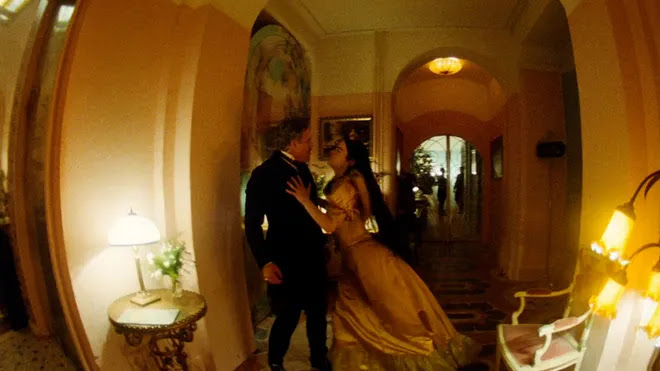
Unusual though the characters and story may be, it is the production design and costumes that make the film eye-catching and memorable. The look is a highly artificial late Victorian steampunk fantasy version of the world, and it is a feast for the eyes. The scenes on the Mediterranean cruise, especially at night, have an enchanting, surreal aesthetic. Production designers Shona Heath and James Price have done some stunning work and have rightfully received Oscar nominations. Likewise, Bella’s costumes with huge puffy shoulders by Holly Waddington, also Oscar nominated, help create the bizarre fairy tale vibe.
There are many points where Poor Things could lose a viewer. The use of a fisheye lens and swish pans, favorite techniques of Lanthimos, are jarring and mostly unnecessary since the production design, costumes, and makeup effects are already doing the heavy lifting in creating the unusual aesthetic. However, the element that may be a strange step too far and downright off putting for some involves Bella’s backstory. I’m not sure if this qualifies as a spoiler as it is revealed relatively early on, but I will write about it now. Dr. Godwin tells Max about how one day he found the fresh corpse of a pregnant woman who jumped from a bridge into a river to kill herself. Unable to resist the scientific possibilities, but wanting to respect the woman’s wish to be dead, he put the brain of the unborn baby into the woman’s head and brought her to life. Hence Bella’s toddling and broken speech. Though she learns and matures quickly, just as Frankenstein’s Monster did, there’s a certain uneasiness to men fawning over Bella, whose mental development is still in progress, especially in the early scenes.
Poor Things has been described by many as a feminist film about a young woman taking agency over her body and her mind. This is certainly true. However, I would certainly not contradict anyone who found its brand of feminism fishy, seeing as how it is about a simple minded woman whose journey of enlightenment and self-realization involves lots and lots of very casual sex. It might come as no surprise to some that the main creative voices behind the movie are all male: director Yorgos Lanthimos, screenwriter Tony McNamara, and Alasdair Gray who wrote the novel.
Yorgos Lanthimos, whose previous films include Dogtooth, The Lobster, The Killing of a Sacred Deer, and the Oscar nominated The Favourite, is no stranger to offbeat and challenging subject matter. Somehow Poor Things almost feels like a departure for him since it lacks the grim darkness of his previous films. Bella’s ever flowing optimism and belief in kindness are the heart of the story and make this an ultimately optimistic, life affirming film.
“Not being able to relate to people isn't a badge of honor.”
Satire is difficult enough, but successfully blending satire with recognizable everyday emotions is a most challenging feat that writer-director Cord Jefferson accomplishes with his more than impressive debut feature, American Fiction. It helps that he has Jeffery Wright in the lead role giving one of the best performances of 2023; Wright has very deservedly received a Best Actor Oscar nomination. More than just a hilarious satire of the literary world and perceptions of race, American Fiction is also a moving family drama, a smart comedy, and the kind of character study that feels like a throwback to the challenging and offbeat films of the late 1960’s and early 70’s.
Wright plays Thelonious “Monk” Ellison, a talented but commercially unsuccessful author and college professor. Monk reaches a breaking point when his latest novel is rejected by publishers while a novel by another Black intellectual, Sintara Golden (Issa Rae), that indulges in stereotypes and street dialect so extreme it sounds more ridiculous than authentic, becomes a bestseller. His frustration leads him to write a parody of “Black trauma porn” called My Pafology under the incredible pseudonym Stagg R. Leigh. He has his agent send it to publishers as a joke but the joke is on Monk because they think it is a serious book and offer a very big payday.
Monk reluctantly takes the money because of the events of the other storyline: his family problems. A forced sabbatical from his university prompts Monk’s return to his hometown of Boston and the nearby family beach house. After a sudden tragedy, he finds himself the primary caretaker of his mother, Agnes (Leslie Uggams), who is in the early stages of dementia. His brother, Clifford (Sterling K. Brown), is little help as he’s going through his own major life events: a divorce and coming out as gay. A bright spot for Monk is a potential relationship with a neighbor, Coraline (Erika Alexander), a recently divorced public defender. Some extra money, and frustration, comes from being a jury member for a literary award with his would-be nemesis Sintara Golden and ends up judging his own secret book, a favorite of the white jury members.
Wright, who conveys so much while seeming to do so little, is grumpy and frustrated but not without reason and a lighter, even happy, side comes out in early scenes with Tracee Ellis Ross as his sister and later in scenes with Erika Alexander. Sterling K. Brown, who earned a Best Supporting Actor Oscar nomination for his performance, also does a great job handling comedy, drama, and believability. Each character feels like a person that you might know or maybe recognize in yourself. They also feel like they have lives outside of each other. Jefferson’s screenplay, adapted from the 2001 novel Erasure by Percival Everett, allows each character layers and dimensions; no one is only one thing.
Most, but not all, of the comedy comes in the scenes dealing with the literary world. Monk has to pretend to be the escaped convict turned novelist Stagg R. Leigh which makes for some awkward and funny scenes. He does everything he can think of to kill the novel once he realizes that no one got the joke, but nothing will stop the hilariously obsequious, and ever frightened of offending, white publishing executives. Also, anyone who took any writing classes or advanced literature courses will very likely recognize the personality types of the three white literary award judges.
Jefferson includes some broad stylistic choices, some of which might be more welcome than others depending on your sensibilities. When Monk writes My Pafology we see the characters from his novel spring to life in front of him and act out his writing. When he gets stuck, one of the characters (played by the great Keith David) turns and questions Monk. The ending is a bit of a departure from the rest of the film. Things don’t wrap up nicely with a bow and closure on each plot point, but life rarely wraps up that way.
“You guys discovered a comet? That's so dope. I have a tattoo of a shooting star on my back.”
It is entirely possible to care about pop culture and the climate crisis. Just because you are interested in a celebrity break up or a subpar movie on Netflix doesn’t mean you have no concern for the condition of the world and its future. These things are not mutually exclusive. Neither are comedy and serious issues, or even comedy and earnestness. With Don’t Look Up it seems that director Adam McKay and co-writer David Sirota believe that such concerns are an either/or matter and their film vacillates between comedy and stone-cold seriousness. A balance is never found. Don’t Look Up aims to be a satire on the level of Stanley Kubrick's Dr. Strangelove—a worthy goal, especially for a film meant to be about climate change. However, to satirize the Cold War, Kubrick made a film that was actually about how a nuclear Armageddon could happen because of foolish politicians and in spite of the best efforts of concerned individuals. To satirize the blending of news and entertainment, Paddy Chayefsky wrote a movie about the blending of news and entertainment, Network. To tackle the climate crisis, Don’t Look Up gives us an allegory full of unfocused anger lashing out at everyone, audience included. Instead of commentary on contemporary culture (both political and pop) we get condescension. Recent years have made satire even more difficult to do effectively. You need to use a scalpel. McKay uses a sledgehammer.
In an ironic wasting of resources, an all-star cast is assembled and squandered. One night a young astronomer, Kate Dibiasky (Jennifer Lawrence), discovers a massive comet. Her mentor, Dr. Mindy(Leonardo DiCaprio), does calculations and realizes the comet is heading right for Earth and will cause an extinction level event in six months. They alert NASA’s head of Planetary Defense, Dr. Teddy Oglethorpe (Rob Morgan, in one of the film’s two standout performances), who takes them to see President Orlean (Meryl Streep), a female stand-in for Donald Trump (or any of his acolytes). Neither she nor her incompetent son and chief of staff (Jonah Hill) are concerned with the comet and decide to do nothing until they need to distract from a scandal and help with the midterm elections. The mission to blow up the comet is called off when an oddball tech-billionaire (Mark Rylance)—in full SNL host shoved into a weird character and just following direction mode—realizes the comet is full of minerals to make electronics. His plan is to send machines to mine the comet right before it hits Earth. Everything goes how you expect.
The only characters that feel like actual people are Rob Morgan as Dr. Oglethorpe and Melanie Lynskey, as Dr. Mindy’s wife—the second standout performance of the film. Overall, every part is well played. It’s no surprise that Leonardo DiCaprio, Jennifer Lawrence, Meryl Streep, Mark Rylance, Melanie Lynskey, Cate Blanchett, Tyler Perry, Timothee Chalamet, and Ron Perlman do their jobs well, but you know that each performer could’ve done more.
Throughout the movie I kept asking myself: am I supposed to laugh? I am not shy about dark comedy or gallows humor but the broad jokes and intense seriousness whiplash against each other and I don’t know how the movie wants me to feel. Certain moments seemed to lampoon the manufactured sincerity of scenes from movies like Michael Bay’s Armageddon, but Don’t Look Up isn’t a disaster movie parody. Later, it uses those same techniques, sincerely this time, to make sure its gut-punch of an ending hits hard.
Just as with Vice, McKay’s biopic of Dick Cheney revealing how Cheney was a terrible person and dangerous politician, my reaction to Don’t Look Up is: I already know. I knew it then, I know it now. I already experience persistent unrelenting existential dread about this all the time. I can’t imagine that this movie would be the straw that finally broke a climate denier’s back and made them “look up.” Everyone that already acknowledges the ever increasing and undeniable effects of climate change is in for a depressing, humorless, masochistic experience. Don’t Look Up is dull satire with stale jokes, full of repeated observations and no new insights. So why do I need this movie, especially if it is not even very funny?
Tapping into the anxieties of the zeitgeist with extremely thinly veiled allegories and metaphors was the forte of master storyteller Rod Serling with The Twilight Zone. Even when Serling appeared at the end of an episode and directly told you the themes and moral of the story, neither he nor the episode had a hint of condescension or scorn. Many episodes were so well executed that they remain loaded with pathos. I mention this only to point out that making a razor thin allegory to affect and entertain is possible. I wish it happened more often. It does not happen in Don’t Look Up.
Nominees: Adam McKay, Kevin J. Messick, producers
Director: Adam McKay
Screenplay: Adam McKay, story by David Sirota
Cast: Jennifer Lawrence, Leonardo DiCaprio, Meryl Streep
Release Date: December 10th, 2021
Production Companies: Hyperobject Industries, Bluegrass Films
Distributor: Netflix
Total Nominations: 4, including Best Picture
Other Nominations: Original Screenplay-Adam McKay, David Sirota; Editing-Hank Corwin; Original Score-Nicholas Britell
“You're not a Nazi, Jojo. You're a ten-year-old kid who
likes dressing up in a funny uniform and wants to be part of a club.”
A good movie lets you know what you’re in for right away. A
great movie surpasses those expectations. You’ll know within the first ten
minutes of Jojo Rabbit whether this film is for you or not. It opens
with real footage of crowds roaring ecstatically for Adolf Hitler while a
German version of “I Want to Hold Your Hand” plays over the titles. This is how 10-year-old
Johannes sees Hitler. In fact, his goofy, encouraging imaginary best friend is
none other than Adolf. Any comedy set in Nazi Germany is going to be tricky to
say the least, even for a talented filmmaker like writer-director Taika Waititi. In previous films, Waititi has tackled broad, dark comedy (the vampire comedy What We Do In The Shadows) and mixed comedy and sentimental drama (the wonderful Huntfor the Wilderpeople). In Jojo Rabbit, Waititi combines sharp satire,
broad comedy, devastating drama, and sincere sentiment with incredible results.
Movies like Jojo Rabbit don’t come along too often. This is without a
doubt one of the best movies of 2019.
Roman Griffin Davis plays Johannes who is young enough that
he believes all of the most awful and absurd antisemitic Nazi propaganda. He wants
to be the best Nazi he can be, but doesn’t measure up. Older members of the
Hitler Youth nickname him Jojo Rabbit after he can’t bring himself to kill a
rabbit. His mother, Rosie (Scarlett Johansson) is raising is him alone—his
soldier father is presumed dead, or possibly a deserter—and trying to counteract
the hateful propaganda Jojo has been absorbing. She is also secretly sheltering
a Jewish girl, Elsa (Thomasin McKenzie), in an upstairs crawlspace. When Jojo
discovers Elsa, he knows he can’t turn her in without getting his mother in
trouble, so he decides question her about being Jewish to write a book. His
initial shock and fright turn to confusion: she has no horns and doesn’t sleep
upside down. In fact, she appears to be a normal girl and he develops a crush
on her.
Waititi walks a fine line both as a filmmaker, maintaining
the film’s dark comic tone, and as an actor, playing the imaginary Adolf. His
performance is broad and over the top but it matches what 10-year-old Jojo
would conjure up. Scarlett Johansson has earned a Supporting Actress nomination
for her role as Jojo’s mother and I think it’s well deserved. Her portrayal of
a someone doing all she can to be a good parent and a good person is compelling.
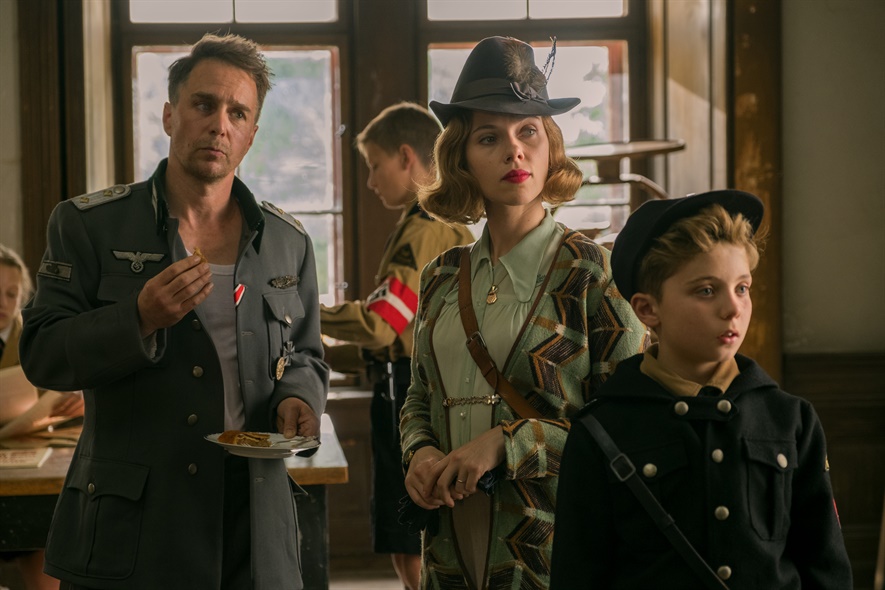
Sam Rockwell turns in another good performance as a washed-up Nazi officer that
may actually be hiding a sense of decency. In a small but chilling role Stephen Merchant plays a Gestapo officer that comes to investigate Jojo’s house; his thin but imposing 6’7” figure is used for unease and intimidation.
Archie Yates as Yorki, Jojo’s only friend in real life, is a natural born scene
stealer.
This film is not meant to be an actual representation of
life under Hitler’s Third Reich. This is a fable about a how a young boy
experiences the horrors of the Nazi regime and is able to survive not just with
his life but with his heart and soul. The screenplay, adapted by Waititi from
the novel Caging Skies by Christine Leunen, believes that fanatism is
absurd, so everything presented on screen follows that principal. Nazis are
presented as ridiculous because their whole belief system is based on the
hateful absurdity that a certain group of people are superior to others. The
comedy in this movie is audacious and even uncomfortable but it
never mocks or minimizes the horrific actions of the Nazis. When one Nazi gives
a Hitler Youth child a live grenade and tells him to run and hug an American
soldier, it’s not remotely funny.
Jojo Rabbit shouldn’t work but it does. A large
reason for that is the sweet nature of Roman Griffin Davis and his scenes with
Thomasin McKenzie, also giving a great performance. Another reason is Taika
Waititi’s sensibilities as a filmmaker. He knows just how far to push the
comedy and how to play the drama scenes for incredible effect. Advertisements
have marketed Jojo Rabbit as an “anti-hate satire” which it certainly
is. It is also a story about how hope can survive even in the darkest of places
and times, until one day it can step outside again and dance.
Nominees: Carthew Neal, Taika Waititi
Director: Taika Waititi
Screenplay: Taika Waititi; based
on the novel Christine Leunens
Cast: Roman Griffin Davis, Thomasin McKenzie,
Scarlett Johansson
Production Companies: Fox Searchlight
Pictures, TSG Entertainment, Defender Films, Piki Films
Distributor: Fox Searchlight Pictures
Release Date: October 18th, 2019
Total Nominations: 6, including Best Picture
Other Nominations: Supporting Actress-Scarlett Johansson;
Adapted Screenplay-Taika Waititi; Costume Design-Mayes C. Rubeo; Production
Design-Ra Vincent, Nora Sopková; Editing-Tom Eagles
“You know what kind of plan never fails? No plan. No plan at
all. You know why? Because life cannot be planned.”
It’s rare for a foreign film to gain as much popularity with
American audiences as the South Korean film Parasite has done. It’s even
rarer for a foreign film to earn Academy Awards nominations for Best Foreign
Language (now called International) film and Best Picture, but Parasite
has managed to join this exclusive club. Director Bong Joon-ho has long been
turning out top quality, intriguing work (I’m a big fan of his melancholy 2003
film Memories of Murder, about a years long hunt for a serial killer). Bong Joon-ho and Han Jin-won’s Oscar nominated original
screenplay switches tones and even genres so abruptly and successfully, it
makes Parasite a unique movie to say the least. Combined with a stellar cast,
excellent cinematography, production design, and pacing, Parasite becomes a
thoroughly engrossing, extraordinary experience. Movies like this in any
language are rare indeed.
Parasite begins as a dark comedy and sharp satire
about economic inequality and class disparity. The Kim family lives in a shabby
basement apartment. The street level window provides them a view of ankles and
urinating drunks. They work short term odd jobs and hunt around their apartment
for a spot with Wi-Fi. A change in luck comes when a friend of their teenage
son recommends him as a tutor for the daughter of a wealthy family, the Parks.
The son, Ki-woo, reluctantly accepts though he is under qualified. Soon the Kim
family schemes to replace each of the Park family servants with themselves
though they pose under false identities. The 20-ish Kim daughter, Ki-jeong, provides the
family with false credentials. Things take a fateful and irreversible turn when
the Kims decide to have a night in luxury while the Parks are away for the
weekend.
That plot description seems to make the title describe the
Kim family. As you watch them work their way into the home of the Park family,
you may find the title applies more to the Parks whose lifestyle requires
people like the Kims. The differences between a family that is oblivious of
their wealth and a family that schemes to get stable, working-class jobs is
apparent. But then, the film reveals layers and depth that make it truly
profound. When the film becomes a riveting thriller, it does not eschew its
themes and substance. I cannot recall the last time I had no idea where a film
was going, not because of incompetence, but because I was watching the work of
a master filmmaker.
The entire ensemble is terrific. Each role is well cast and
there’s a great chemistry between the members of the respective families. The stand
outs for me, however are Song Kang-ho as the Kim family patriarch and Park So-dam as his clever daughter. Cho Yeo-jeong as the daffy and gullible Park
matriarch is great comic relief.
What sets Parasite a step above other socially
conscious films is it does not sacrifice entertainment for the sake its social
commentary or vice versa. It never pontificates or pretends to have any
didactic solution. It is like a classic Twilight
Zone episode, up front about its themes but in such a way that doesn’t
speak down to audience and feels detached and immediate simultaneously. There
is not a single pandering moment in the entire film. Parasite uses the real
problems and concerns of modern society to tell a compelling and universal
story that causes us to reflect on our world. That can be the definition a
great film and great art.
Nominees: Sin-ae Kwak, Bong Joon Ho
Director: Bong Joon-ho
Screenplay: Bong Joon-ho, Han
Jin-won; story by Bong Joon-ho
Cast: Song Kang-ho, Choi Woo-shik, Park So-dam, Chang
Hyae-jin, Lee Sun-kyun, Cho Yeo-jeong
Production Companies: Barunson E&A
Distributor: CJ Entertainment
Release Date: November 8th, 2019
Total Nominations: 6, including Best Picture
Other Nominations: Director-Bong Joon Ho; Original
Screenplay-Bong Joon Ho, Jin Won Han; International Feature Film-South Korea;
Production Design-Ha-jun Lee, Won-woo Cho; Film Editing-Jinmo Yang