Saturday, February 16, 2019

Best Pictures #46: 2018 (91st) Academy Awards: Bohemian Rhapsody

by A.J.

Best Pictures #46: 2018 (91st) Academy Awards Best Picture Nominee

“Is this the real life?”
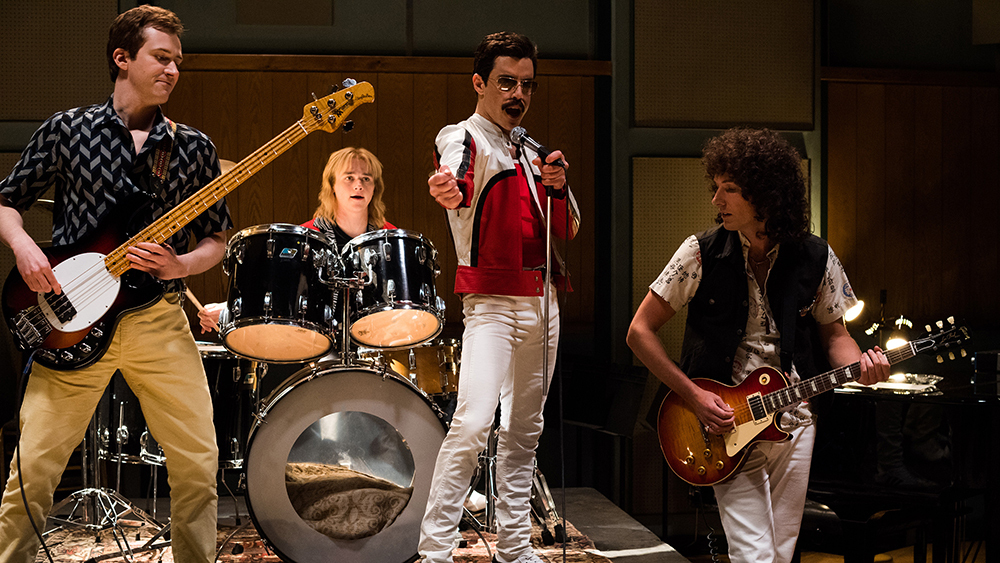
My enjoyment of Bohemian Rhapsody corresponded directly with whether or not a Queen song was being played. The big budget Freddie Mercury/Queen biopic is at its best during scenes of the band in the recording studio or performing on stage. Rami Malek stars as Queen frontman Freddie Mercury. He emulates the way Mercury moved his body during performances and reproduces his captivating stage presence with a surprising degree of success. The scenes between the music, however, for Malek and everything else in the picture fall flat.
Queen was not an average band so it’s perplexing and flat out disappointing that the movie telling the story of the band and its flamboyant lead singer is so by the numbers and full of biopic clichés. Every scene feels like it has been transposed from any other musician biopic. There is the scene where the band has a rough start to a gig but wins over the audience. There is the scene of the lead singer being offered a solo album deal. There is the scene of a press conference where reporters only want to ask about the lead singer’s private life and not the new album. There is the scene of a record label executive telling the band that their most famous song will never be a hit. This scene is an eye-rolling low point mainly because the record executive who tells Queen that teenagers will never rock out to "Bohemian Rhapsody" in their cars is played by Mike Meyers (who starred in Wayne’s World where he famously rocked out to "Bohemian Rhapsody" in a car). There is even a scene where a fatal illness is signaled by a character coughing a few drops of blood on a tissue. This is the kind of biopic Bohemian Rhapsody is.
When he’s not imitating Mercury on stage, Rami Malek does a good enough job in the dramatic scenes but the oversized fake teeth he wears to look more like Mercury are distracting. Yes, Mercury did have a noticeable overbite but these false teeth make Malek look more like Bugs Bunny. The bland, basic biopic script doesn’t give Malek, or anyone else, much to work with in those dramatic non-music scenes. Mercury’s sexuality isn’t played down but it also isn’t fully explored. A montage of the band on tour (typical quick shots of tour buses, roaring crowds, etc.) shows Mercury, at the time married to Mary Austin (Lucy Boynton), glancing at and checking out other men. It’s unclear if Mercury is just looking at these men longingly or if he’s sleeping with them. The movie also never makes clear if the wolf-in-sheep’s-clothing record producer Paul (Allen Leech) is Mercury’s lover or just a hanger-on. We do get to see Mercury working through his inner struggles by composing some great songs, namely “Bohemian Rhapsody”.
The most original and exciting scene for me was the recording session of “Bohemian Rhapsody.” We see Brian May (Gwilym Lee) playing his guitar solo all alone in the empty barn serving as their recording studio. Then we cut to the rest of the band in the control room listening what the solo sounds like mixed with the rest of tracks. Mercury is like a conductor getting his bandmates to sing at the top of their vocal registers. First, they sing alone in the recording booth, then together, then all of those separate tracks are mixed together to create the final product. I once accompanied a musician friend when his band recorded in a real studio. This is exactly how a band records a song but I’d never seen a recording session portrayed this way until now.
Bohemian Rhapsody is definitely a Freddie Mercury biopic rather than a Queen biopic but each of the other band members get their due. After all, Queen is the only band that has had each of its members admitted separately to the Songwriters Hall of Fame. The bandmates argue about whose song should go on the album, whose song should be the single. These are some of the better scenes in the movie. I have to admit it was refreshing to see a movie about a musician that acknowledges and gives credit to other members of his band. Straight Outta Compton, about the rap group NWA, focused on 3 of its 6 members (a 7th member wasn’t included at all in the movie) and in the Johnny Cash biopic Walk the Line, which I like very much, Cash’s two long time bandmates barely have any lines at all.
There is a lot to tell in the story of Freddie Mercury and Queen so the movie rushes through the band’s beginnings—they’re signed to a record label and playing sold out tours in no time—to focus on Mercury’s personal struggles and the creation of several crowd-pleasing songs. Instead of feeling rushed, however, the movie still feels long and dragged out. The climax of the picture is Queen’s iconic performance at Wembley Stadium for Live Aide. Nearly their entire performance is recreated. This isn’t just the plot climax, it’s the emotional climax of the movie and I’ll admit to being overcome with the exact emotions the film was aiming to get out of me. Though as they played song after song I wondered, why not just show the real Live Aide footage? 
Despite being roasted by critics Bohemian Rhapsody was a box office hit finishing among the top grossing films of 2018 and it has picked up 5 Oscar nominations, including Best Picture and Best Actor for Rami Malek. I must admit I am baffled by the movie’s accolades and box office success. I presume that audiences and the people in charge of awards are responding to the great music of Queen and not the film itself. It certainly helps that the movie sends audiences out on the band’s most iconic performance of some of their best songs. But, you can get the same pathos and enjoyment from listening to Queen’s greatest hits and skipping the movie.
Nominees: Graham King, producer
Director: Bryan Singer
Screenplay: Anthony McCarten; story by Anthony McCarten, Peter Morgan
Cast: Rami Malek, Lucy Boynton, Gwilym Lee
Production Companies: 20th Century Fox, New Regency, GK Films, Queen Films
Distributor: 20th Century Fox
Release Date: November 2nd, 2018
Total Nominations: 5, including Best Picture
Other Nominations: Actor-Rami Malek, Editing-John Ottman; Sound Editing-John Warhurst, Nina Hartstone; Sound Mixing-Paul Massey, Tim Cavagin, John Casali

Tuesday, October 31, 2017

13 Nights of Shocktober: Club Dread (2004)

by A.J.

Happy Halloween! The countdown is over and Halloween is finally upon us. Tonight, hopefully, you'll be relaxing, eating some candy, and watching a scary, or not-so-scary, movie. There are a lot of options for tonight and I hope I've been of some help. Here is my final recommendation to help bring an end to Shocktober:

Night 13: Happy Happy Halloween!
“I think you’re referring to my song Pina Colada-burg.”
Club Dread (2004)
To follow up the hilarious film Super Troopers, the comedy troupe Broken Lizard turned their style of comedy to the slasher movie. The result is Broken Lizard’s Club Dread, a self-aware horror-comedy that is as bloody as it is funny. It works as a comedy and as a horror-slasher movie; and since it features a hilarious performance from the late Bill Paxton, I couldn’t think of a better movie to close out this Shocktober.
Club Dread takes place on Pleasure Island, a tropical spring break style party resort. The island paradise is owned by Coconut Pete (Bill Paxton), a mostly washed up Jimmy Buffet-esque musician whose song Pina Colada-burg would’ve been a bigger hit if not for a certain Jimmy Buffet song. College age kids arrive on the island for a nonstop party, but a masked killer starts murdering the staff members one by one. The remaining staff try to keep the murders a secret from the party guests while trying to figure out the identity of the killer. The staff are played by the Broken Lizard members. The standouts of the group are Jay Chandrasekhar (who is also the director) as Putman, the tennis instructor with a vague, indeterminable accent and a comical mass of dreadlocks, and Kevin Heffernan as Lars, the new masseur with a close to magic touch. The female lead is Brittany Daniel who plays Jenny, the aerobics instructor that has all the men tripping over themselves.
Instead of just making fun of horror movie clichés and tropes, Club Dread uses those elements for comedic effect. The killer, like all slasher movie killers, lurks and moves slowly towards his running victims. One girl runs and gets into a golf cart that moves so slow the killer almost passes her as he walks. The killer leaves clues too, and the staff has to interpret the silly lyrics of Coconut Pete’s songs to find out who is going to be killed next. In a great self-aware moment Jenny is all alone in her cabin and getting ready to take a shower while there is a killer on the loose. She decides against the cliched shower scene. Jenny, like any Final Girl is resourceful and level headed, but unlike the typical Final Girl, Jenny is blonde and sexually active. The movie gets some jokes out of Jenny’s promiscuity, but it never judges her for that.
The cast, Broken Lizard or not, is incredibly likable and fun to be around for an hour and forty-five minutes. Even the non-professional comedians are very funny. Bill Paxton is great to watch as a beach bum musician that can’t remember the lyrics to his songs or even making the albums. He’s no stranger to comedic roles and knows just how to deliver the Broken Lizard material. He has a lot of fun playing Coconut Pete and passes that fun along to the audience. Plus, it’s great to hear Paxton sing ridiculous beach songs.
Club Dread is great horror movie fun from beginning to end. The blood and gore, though plentiful, are not too intense. This movie never loses sight of its main goal: to make sure everyone has a great time. It’s clear that the Broken Lizard team knows and loves horror movies. Their movie follows the plot points of a slasher movie, but Broken Lizard uses that template for their own unique version. They find fun ways to poke fun at each slasher cliché. My favorite comes when the killer reveals his identity but forgets the reason he’s killing everybody. There’s so much to enjoy here, even if you don’t like horror movies. I highly recommend Club Dread for a spooky-fun Shocktober night.

Monday, October 30, 2017

13 Nights of Shocktober: Masque of the Red Death (1964)

by A. J.

This is my favorite time of year, second only to Christmas. Autumn has arrived, the weather is cooling down, and October becomes the month-long celebration of scary movies called Shocktober. There are a lot of horror movies out there, but as a genre, horror is still looked down upon by some mainstream critics and moviegoers. It doesn’t help that, admittedly, there are so few quality horror movies made but, like comedy, it’s a very difficult and subjective genre. So, in the days leading up Halloween I’ll be posting some recommendations for scary movies to help you celebrate Shocktober.

Night 12: Vincent Price Night
The Red Death held illimitable dominion over all.
You never know what you’re going to get from a Roger Corman movie. He has produced an incredible number of movies of wildly varying degrees of quality. This includes the films he directed himself, such as this one. You may get absolute dreck (prime fodder for Mystery Science Theater 3000), an enjoyable but campy B-movie, or you may get a genuinely good film. Masque of the Red Death falls into the third, and smallest, category.
Vincent Price stars as the villainous Prince Prospero, a tyrannical medieval lord that worships the devil. He is passing through a village when he is confronted by two of the angry and poor villagers. Prospero sentences them to death but Francesca (Jane Asher) begs for their lives because they are her father, Lodovico, and her lover, Gino. Prospero takes them all to his castle and orders the village burned to the ground when the plague known as the Red Death is discovered there.
Lavish, decadent parties are the order of the day at Prospero’s castle. At these gatherings Prospero humiliates his guests by commanding them to act like animals and even kills people without a second thought. While Francesca is taught etiquette by Prospero’s consort, Juliana, Gino and Lodovico are forced to train to fight each other to the death. Prospero gives Francesca a tour of his palace and its different colored rooms. One room is solid yellow, another is solid purple, another white, and so on. Everything in each room is the same shade of color making the rooms look unnatural and surreal. The colors of the sets and costumes are rich and bold and easily capture the eye. The sets look artificial but this only adds to the surreal, gothic atmosphere of the film.
Vincent Price is excellent as the evil Prince Prospero. He plays his villains as characters that know they are bad and enjoy being bad, or he plays them as sympathetic, tragic figures forced to do villainous deeds. Prince Prospero is firmly in the former group. Price is the rare kind of actor that always knows exactly what kind of film he is in and attunes his performance accordingly. Because Price allows himself to have fun with his performance it allows the audience to enjoy the villain and the film completely. 
Masque of the Red Death is based on the Edgar Allen Poe story of the same name, and also has a subplot based on Hop-Frog. It also includes references to other Poe stories like The Raven and The Pit and the Pendulum. The screenplay was co-written by Charles Beaumont, who also wrote many of the best episodes of The Twilight Zone. As you might imagine, the film greatly expands upon Poe’s short story but the chilling touch of Poe is never lost. This is one of several films based on Poe stories that Roger Corman and Vincent Price made together and it is widely acknowledged as one of, if not the, best. 

Sunday, October 29, 2017

13 Nights of Shocktober: An American Werewolf in London (1981)

by A.J.

This is my favorite time of year, second only to Christmas. Autumn has arrived, the weather is cooling down, and October becomes the month-long celebration of scary movies called Shocktober. There are a lot of horror movies out there, but as a genre, horror is still looked down upon by some mainstream critics and moviegoers. It doesn’t help that, admittedly, there are so few quality horror movies made but, like comedy, it’s a very difficult and subjective genre. So, in the days leading up Halloween I’ll be posting some recommendations for scary movies to help you celebrate Shocktober.

Night 11: Werewolf Party Night!
“Beware the moon.”
Aside from the classic Universal Monsters movie The Wolf Man (1941), An American Werewolf in London is arguably the most well-known werewolf movie. It is famous for its prolonged transformation scene done in full light with incredible practical effects created by special makeup effects master Rick Baker and set to the song “Blue Moon.” Writer/director John Landis’s previous work as director had been the frenetic comedies The Blues Brothers (1980), National Lampoon’s Animal House (1978), and Kentucky Fried Movie (1977). With his first horror movie, Landis combines his skills as a comedy director with his personal love of monster movies and created one of the most memorable modern monster movies.
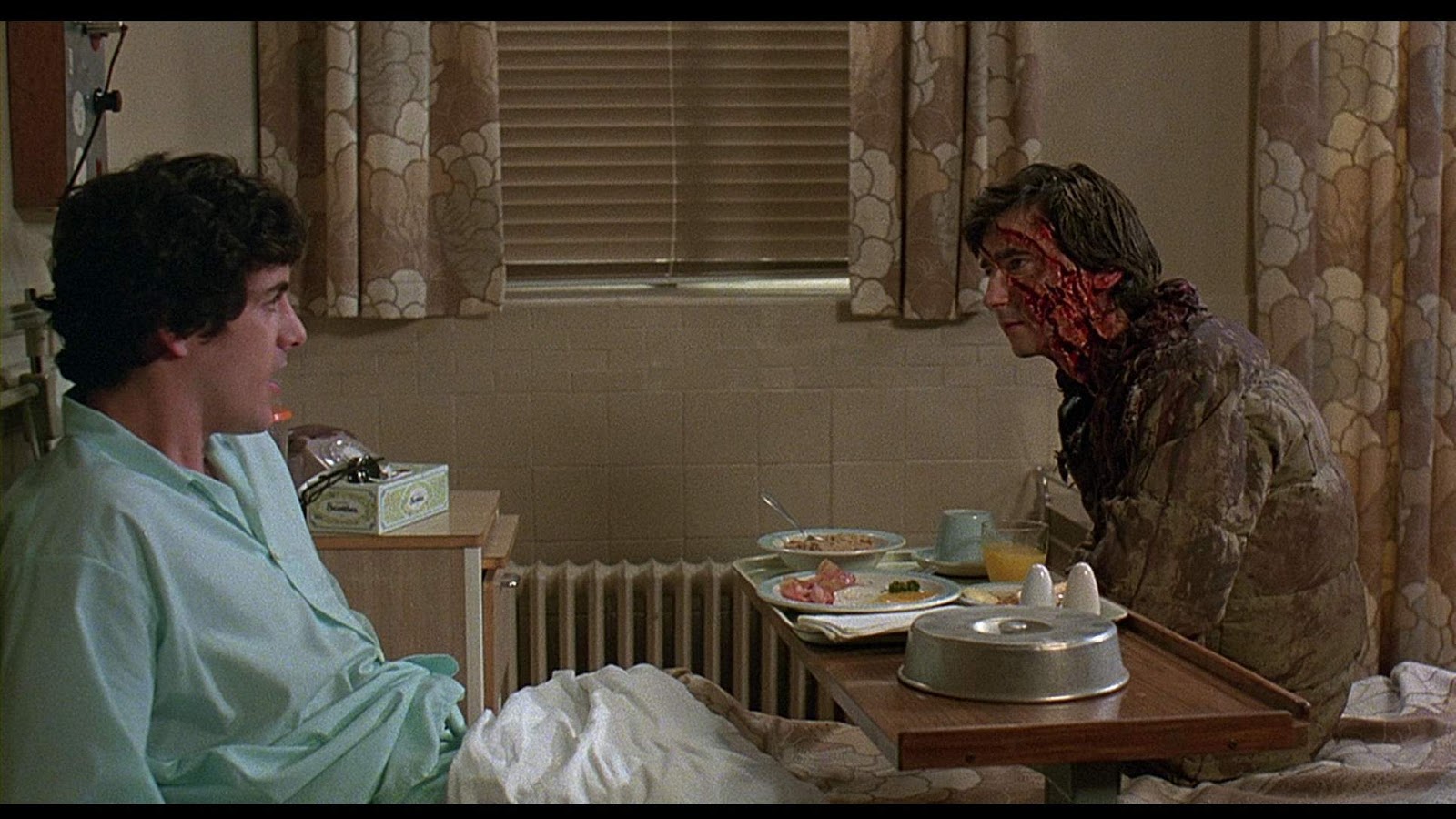
The film begins with a classic horror movie scenario: young travelers fall victim to hidden local dangers. The travelers are two American college students, David (David Naughton) and Jack (Griffin Dunne), backpacking their way through Europe. Their plan is to start in England and finish in Italy. They are making their way through the North of England looking for a place to get dinner and stay the night. The locals at the pub are suspicious, shady characters. Some of them want David and Jack to leave, others beg that they stay. When David and Jack do leave they are told to “keep clear of the moors" and “beware the moon.” They don’t, and they are attacked on the moors by a large, vicious beast. Jack is killed and David is patched up and taken to a hospital in London. Jack returns as a bloody, mauled, mutilated corpse and tells David that they were attacked by a werewolf and now David is a werewolf. Jack and any others he kills will be in limbo until David ends the curse by killing himself.
Though Jack is an undead corpse, his personality is intact and he’s still very funny. Griffin Dunne does a great job of being both comic relief and an exposition source. He also decays more and more each time he appears. The makeup effects used on Dunne are gloriously gross. He’s still able to act naturally under the makeup and the juxtaposition of his bloody, gory condition with his still casual attitude (he talks to David about the girls that showed up to his own funeral) make for great, strange humor. The stereotype of British people as ever subdued and reserved people is used for maximum comic effect and makes for some great scenes. When the werewolf attacks a couple outside of an apartment building, someone inside looks out the window and calmly remarks, “I think something’s happening outside.”
There are plenty of laughs and silly moments in An American Werewolf in London, more so than you may expect. While it is usually classified as a horror-comedy, it leans heavily in favor of horror. Long before David transforms into a werewolf he has terrible, frightening nightmares which provide some intense scares. The infamous transformation scene is the centerpiece of the film. Landis wanted a werewolf transformation that could be shown in full light without having to hide anything in shadows. The result is one of the most memorable scenes in modern horror history. The transformation remains impressive to say the least. David does not just become hairy and grow fangs. His body morphs and grows into a giant wolf and it looks and sounds incredibly painful. While I nearly always prefer a half-wolf half-man werewolf, as opposed to someone that just turns into a wolf, the monster wolf in this movie is a happy exception. For his work in An American Werewolf in London, Rick Baker won the first Academy Award for makeup (making this movie part of the very small club of Oscar nominated and/or winning horror movies).
There’s more to An American Werewolf in London than cool special effects. Landis’s screenplay and the actors’ performances find a nice balance between the horror and comedy of the film. These characters live in a world of real history (David’s doctor fought Nazis in WWII) and real movies (references to the Universal classic The Wolf Man), so they are as aware as the audience of the absurd and bizarre nature of the situation in which they find themselves. This may not make the werewolf plot any more believable, but it allows us to easily follow these characters on the strange, wild ride that is An American Werewolf in London.

Saturday, October 28, 2017

13 Nights of Shocktober: Near Dark (1987)

by A.J.

This is my favorite time of year, second only to Christmas. Autumn has arrived, the weather is cooling down, and October becomes the month-long celebration of scary movies called Shocktober. There are a lot of horror movies out there, but as a genre, horror is still looked down upon by some mainstream critics and moviegoers. It doesn’t help that, admittedly, there are so few quality horror movies made but, like comedy, it’s a very difficult and subjective genre. So, in the days leading up Halloween I’ll be posting some recommendations for scary movies to help you celebrate Shocktober.

Night 10: Bill Paxton Memorial Night III/Vampire Night
“Howdy. I'm gonna separate your head from your shoulders. Hope you don't mind none.”
Near Dark (1987)
The DVD rerelease cover art for Near Dark has the male and female leads airbrushed to like characters from Twilight, but don’t be fooled. Though there is a romance, Near Dark is a full bore action-horror vampire western. The original poster for Near Dark shows only Bill Paxton, skin burned black and covered in dirt and blood with shafts of light bursting through his body. It’s a much more accurate promise of what’s in store for the audience.
After a night out at a bar, small town cowboy, Caleb (Adrian Pasdar), meets a mysterious young woman with short hair. She says that the light that just left the stars will take a billion years to get to Earth and when it does, she’ll still be here. As dawn approaches she becomes nervous and when Caleb won’t drive her home right away, she bites him and runs away. When the sun comes up Caleb becomes sick and starts to smolder and burn. An RV speeds by and pulls him inside.
The mysterious young woman is Mae (Jenny Wright). She’s one of a motley crew of Oklahoma vampires. The gang is led by Lance Henriksen as Jesse, who is so old he says he fought for the South (“We lost.”). Jenette Goldstein plays his longtime companion, Diamondback. Joshua Miller plays Homer, an aged vampire trapped in the body of a child. Rounding out the monstrous family is Bill Paxton as Severen, the flamboyant and ultra-violent loose cannon. They reluctantly take in Caleb but pressure him to make a kill. Meanwhile, Caleb’s father and local law enforcement are on their trail.
There is not as much bloodsucking in Near Dark as there is bloodshed. Necks are bitten but most of the violence comes from shootouts and Severen’s creative killing techniques. The gang takes Caleb to a bar to make a kill and we watch and each vampire kill a patron. It’s a prolonged and bloody scene but is incredibly engaging and totally dominated by Bill Paxton. The scene plays out not like a group of vampires preying on victims, but a group of psychos entertaining themselves. This may sound like a torture porn-esque scene, but it is not full of dread and despair. The blood and gore are not the point of the scene; it’s about seeing what these vampires are capable of and the intense danger that surrounds Caleb and Mae.
There’s really not much to the character of Caleb or the romance plot between him and Mae, but the eccentric and violent vampire family are incredibly interesting and entertaining. Paxton swings for the rafters with his performance and lands every time. He’s easily the most memorable part of Near Dark and it’s no wonder he’s the poster for movie. Lance Henriksen’s performance is as subtle and lowkey as Paxton’s is loud and centerstage, Since Hendriksen plays his character as a quiet menace, he and Paxton balance each other.
Near Dark is more influenced by The Wild Bunch than any vampire movie. It has the look of gritty westerns of the 1970’s. Everything looks and feels run down and lived in, even the character’s clothes and hair. The cinematography by Adam Greenberg gives the film an excellent dusty look. For being a movie about vampires, this movie has a very bright, sun-drenched look. In every daylight scene the sunlight feels intense, like you could almost feel the heat and there is dust or smoke in nearly every shot. The score by Tangerine Dream gives this unusual vampire movie a unique, mysterious feel. All of these elements come together most excellently under Katherine Bigelow’s direction. Her sole entry into the horror genre gave us a most noteworthy and entertaining vampire movie. 

Friday, October 27, 2017

13 Nights of Shocktober: Kwaidan

by A.J. 

This is my favorite time of year, second only to Christmas. Autumn has arrived, the weather is cooling down, and October becomes the month-long celebration of scary movies called Shocktober. There are a lot of horror movies out there, but as a genre, horror is still looked down upon by some mainstream critics and moviegoers. It doesn’t help that, admittedly, there are so few quality horror movies made but, like comedy, it’s a very difficult and subjective genre. So, in the days leading up Halloween I’ll be posting some recommendations for scary movies to help you celebrate Shocktober.

Night 9: Anthology Horror Night
Ghost Stories of Old Japan
Kwaidan (1964)
Kwaidan is one of my favorite Japanese horror movies. It is also an anthology film, another favorite genre of mine. I first saw this film several years ago on TCM late at night. It has since become part of their programming rotation and usually airs in October. Kwaidan translates to “Ghost Stories” or “Strange Stories” and the film is exactly that: a collection of ghost stories from Japanese folklore. The vignettes are based on the writings of Lafcadio Hearn, a writer and folklorist who was born in Greece, spent time in the United States, and eventually moved to Japan in the late 1800’s where he married into a samurai family and changed his name to Yakumo Koizumi. Everything about Kwaidan feels so distinctly Japanese that I was surprised to learn that a Westerner was in any way involved.
The first story, titled "The Black Hair," is about a young samurai that abandons his wife to marry into another family of higher status. He comes to regret his decision and returns to his first wife to make amends, but all it not what it seems. This where the story turns to the supernatural. This first segment is a slow burn, but builds to a satisfyingly spooky reveal and sets the tone for the rest of the film. 
The second story, "The Woman of the Snow," is my favorite. A young woodcutter becomes lost in a forest during a snowstorm. The Woman of the Snow, a cold, icy spirit comes to drink the warm blood of the woodcutter, but she takes pity on him because he is so young and handsome. She tells him that he ever tells anyone what he saw in the snowy woods, even his own mother, she will return and kill him. Soon after, the woodcutter meets a lovely girl alone on a road and invites her to take shelter with him and his mother. He and the woman fall in love, marry, and have children, but as the years go by the other women in the village notice that the woman doesn’t age... 
In "Hoichi the Earless," a mysterious samurai comes to a temple at night and asks Hoichi, a blind singer, to perform the ballad of a massacred samurai clan for his lord. The samurai leads Hoichi to a mysterious gathering every night and Hoichi must keep it a secret. The final story, "In a Cup of Tea," is the shortest and most peculiar. A samurai fills up a cup with tea and sees the reflection of another man in the cup. He drinks the tea, mysterious reflection included. Later, at night the samurai gets an otherworldly visitation from the man he drank.
Kwaidan is directed by Masaki Kobayashi whose previous films were social dramas. This was his first horror film and also his first film in color. Kobayashi brilliantly and effectively utilizes color throughout his nearly 3-hour film. Rich, bold colors along with a surreal production design fill Kwaidan with memorable, vivid visuals. The sets and matte paintings are highly stylized so that they appear obviously artificial and surreal. This only enriches the ethereal, storybook atmosphere of the movie. When the woodcutter is lost in the forest in "The Woman of the Snow," the painted clouds in the sky resemble watching eyes. Somehow even the white snow is vivid and intense. Probably the most memorable image in all of Kwaidan is of Hoichi with a holy text written all over his body... except for his ears. This was the image chosen for the Criterion DVD release of Kwaidan.
Kwaidan won the Special Jury Prize at the 1964 Cannes Film Festival. It also received an Oscar nomination for Best Foreign Language Picture, making it part of the very small club of Oscar nominated horror films. Kwaidan was heavily edited for its American theatrical release but has since been restored to its original version. Though this movie does take its time telling these stories, it doesn’t drag and its epic scope justifies the runtime. Kwaidan feels unique among anthology horror films, and even among other Japanese horror films. It chronicles folklore and evokes the same tone and feel these stories likely had when told by one generation to the next. There is not blood or gore or pop-up scares in Kwaidan, but there is plenty to chill you and make you want to keep the lights on. 

Thursday, October 26, 2017

13 Nights of Shocktober: Brain Dead (1990)

by A.J.

This is my favorite time of year, second only to Christmas. Autumn has arrived, the weather is cooling down, and October becomes the month-long celebration of scary movies called Shocktober. There are a lot of horror movies out there, but as a genre, horror is still looked down upon by some mainstream critics and moviegoers. It doesn’t help that, admittedly, there are so few quality horror movies made but, like comedy, it’s a very difficult and subjective genre. So, in the days leading up Halloween I’ll be posting some recommendations for scary movies to help you celebrate Shocktober.

Night 8: Bill Paxton Memorial Night II/Psychological Horror Night
"We can’t all do good, but at least do no harm."
Brain Dead (1990) 
Brain Dead is perhaps most famous for being the movie that stars both Bill Pullman and the late Bill Paxton. No one would blame you if the movie’s DVD cover art and producer, Julie Corman (wife of the legendary B-movie producer Roger Corman), made you think that Brain Dead was just B-horror movie schlock. It’s actually a psychological thriller about the mind’s perception of reality, with some B-horror schlock thrown in. The screenplay was written in the 1960’s by Charles Beaumont for Roger Corman, but remained unproduced until Julie Corman rediscovered the script in the late 80’s. Charles Beaumont’s other writing credits include several episodes of The Twilight Zone (including some of my favorites: "Number 12 Looks Just Like You," "The Living Doll", and "Perchance to Dream"). Director Adam Simon updated the story for the 80’s and the film was released in 1990. 
Bill Pullman plays Dr. Rex Martin, a neurosurgeon researching brain functions and mental illnesses. He is asked by an old friend, Jim Reston, played by Bill Paxton, to investigate a mathematician, Halsey, played by Bud Cort, that had a mental breakdown, killed his family, and destroyed the top secret research he was doing for Paxton’s company. Paxton pressures Pullman to perform a risky brain operation that would either cure Halsey’s mind and allow him to remember the sensitive corporate information or would leave him brain dead. Each actor fits nicely into their respective roles. Pullman as Dr. Rex is completely comfortable with his character and great to watch as the reserved, intellectual scientist that loses his mind to paranoia and delusions. Paxton as Reston, with his slicked back hair, is great as a corporate sleaze and potentially dubious friend.You're equally willing to believe that he has a devious secret agenda or that he's a trustworthy friend. It's a role he plays with brilliant ease. The company Paxton’s character works for is a giant conglomerate whose holdings are so ridiculously diverse that a cutting edge neuroscience division seems plausible. The downside is that science is expected to conform to corporate bottom lines, once again proving that real villain of many 80’s and early 90’s movies is, you guessed it, Reaganomics.
While Brian Dead is more than just B-movie schlock, it still does not take itself too seriously. Pullman works in a lab with brains floating in jars and the approach to brain surgery is just a step above The Man With Two Brains. The film really hits its stride when it travels into mind bending territory. The visions Halsey has while being operated on are creative, fascinating, and surreal. Pullman’s character keeps seeing a laughing man in a bloody white suit. At an incredibly awkward dinner he hallucinates that Paxton is kissing his wife while his boss pats him on the back. Pullman reaches for the rafters with his descent into madness and hits every note solidly.
Even as it delves into dreams, delusions, and altered reality Brain Dead still keeps an exciting and very interesting tone. Don’t get caught up in trying to figure out where a mental break happened or a dream began. The fun in Brain Dead is in the twists and turns and not knowing what will happen next. 
Brain Dead is a psychological mind bender with more traditional horror movie effects and scares. Shades of The Cabinet of Dr. Caligari and The Twilight Zone run throughout the story. It finds a nice balance between serious psychological horror and campy fun horror. You could call it cerebral schlock, but no matter how you categorize it, Brain Dead makes for great Shocktober viewing.